
UP Records Steady Gains Under Atal Bhujal Yojana
WATER & WASTE

UP Records Steady Gains Under Atal Bhujal Yojana

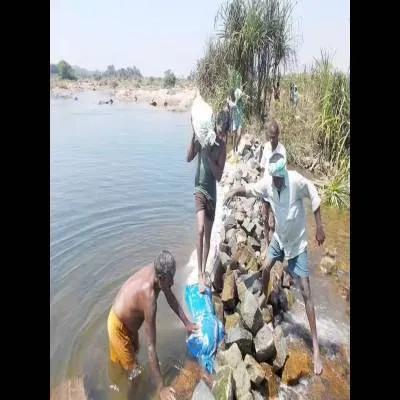
Atal Bhujal Yojana, a pilot initiative for community-led groundwater management, was implemented across 8,203 priority water-stressed Gram Panchayats in seven States, including 549 in Uttar Pradesh. The programme has demonstrated notable improvements through participatory planning, adoption of efficient water-use practices, community monitoring and the creation of recharge structures.
Key activities undertaken include public disclosure of groundwater data across all participating Gram Panchayats, preparation and annual updation of community-led Water Budgets and Water Security Plans, and the installation of piezometers, digital water-level recorders and rain gauges. Nearly 1.28 thousand training sessions were conducted at village, block, district and State levels, while around 70,000 wells were monitored with data publicly shared. Mapping of more than 99,000 existing water-conservation structures and construction or renovation of over 83,800 supply-side works have further strengthened groundwater recharge. About 0.97 million hectares across the seven States have adopted efficient water-use measures such as drip irrigation, sprinklers, mulching and crop diversification.
State-wise details are available in Annexure I, with district-level information for Uttar Pradesh provided in Annexure II. Performance-based funding was allocated to States under the programme, and convergence with ongoing schemes has been central to implementation. As reported by the Uttar Pradesh State Project Monitoring Unit, Rs 2753.5 million has been mobilised through convergence for activities recommended in Water Security Plans.
Water budgeting and Water Security Plans—core components of Atal Bhujal Yojana—have been completed and updated annually for all 549 participating Gram Panchayats in Uttar Pradesh. According to periodic assessments between 2023 and 2025, 344 of these Gram Panchayats have shown improvement in groundwater levels, while 205 are yet to meet the benchmark. Details of improved Gram Panchayats are listed in Annexure V.

Atal Bhujal Yojana, a pilot initiative for community-led groundwater management, was implemented across 8,203 priority water-stressed Gram Panchayats in seven States, including 549 in Uttar Pradesh. The programme has demonstrated notable improvements through participatory planning, adoption of efficient water-use practices, community monitoring and the creation of recharge structures.Key activities undertaken include public disclosure of groundwater data across all participating Gram Panchayats, preparation and annual updation of community-led Water Budgets and Water Security Plans, and the installation of piezometers, digital water-level recorders and rain gauges. Nearly 1.28 thousand training sessions were conducted at village, block, district and State levels, while around 70,000 wells were monitored with data publicly shared. Mapping of more than 99,000 existing water-conservation structures and construction or renovation of over 83,800 supply-side works have further strengthened groundwater recharge. About 0.97 million hectares across the seven States have adopted efficient water-use measures such as drip irrigation, sprinklers, mulching and crop diversification.State-wise details are available in Annexure I, with district-level information for Uttar Pradesh provided in Annexure II. Performance-based funding was allocated to States under the programme, and convergence with ongoing schemes has been central to implementation. As reported by the Uttar Pradesh State Project Monitoring Unit, Rs 2753.5 million has been mobilised through convergence for activities recommended in Water Security Plans.Water budgeting and Water Security Plans—core components of Atal Bhujal Yojana—have been completed and updated annually for all 549 participating Gram Panchayats in Uttar Pradesh. According to periodic assessments between 2023 and 2025, 344 of these Gram Panchayats have shown improvement in groundwater levels, while 205 are yet to meet the benchmark. Details of improved Gram Panchayats are listed in Annexure V.

Next Story
Technology

AI-Enabled Workflows Lift Profitability and Productivity

Organisations modernising frontline workflows with artificial intelligence, automation and real-time data are reporting stronger financial performance, higher productivity and improved employee engagement, according to a global study by Zebra Technologies and Oxford Economics.The research covered 1,000 senior leaders across retail, manufacturing, transportation and logistics in the US, Mexico, the UK, Germany, India, Japan, Australia and New Zealand.In transportation and logistics, 54 per cent of companies that improved picking and packing operations reported faster operational performance, wh..

Next Story
Real Estate

India Leads Global AI Readiness but Implementation Lags

Indian companies lead global averages across all eight artificial intelligence readiness indicators tracked by JLL, but only 19 per cent have started making changes to their workplaces, according to the JLL 2026 Future of Work Survey.The study found that 77 per cent of Indian business leaders expect AI to change their office requirements, creating a 58-percentage-point gap between awareness and implementation. The survey covered more than 2,200 CEOs, CFOs and real estate leaders across 21 countries during the first quarter of 2026.Despite concerns over automation, 58 per cent of Indian leaders..

Next Story
Equipment

Three WOLFF Cranes Build Riyadh Cable-Stayed Bridges

Three WOLFF 180 B luffing jib cranes are supporting the construction of two cable-stayed bridges alongside the existing Wadi Laban Bridge in Riyadh, Saudi Arabia. The project is being developed for the Royal Commission for Riyadh City and executed by the ICRC joint venture comprising IC Ictas and Al Rashid Trading & Contracting Company.The cranes are handling lifting operations including formwork, reinforcement, concrete placement, work platforms, surveying equipment and other construction materials. Each crane is fitted with a 40 m jib, reaches a hook height of 157 m and offers a maximum ..

Advertisement

Subscribe to Our Newsletter

Get daily newsletters around different themes from Construction world.

STAY CONNECTED

Advertisement

Advertisement

Advertisement