Lodha’s Palava ranked India’s No. 1 city to live in
SMART CITIES

Lodha’s Palava ranked India’s No. 1 city to live in

India’s first greenfield integrated smart city, Lodha Group’s Palava City has been ranked as the No. 1 emerging city of India by Jones Lang LaSalle’s (JLL) proprietary research report ‘Livability Quotient – A Paradigm Shift in India’s Emerging Cities’. The report scrutinised performance of 10 emerging cities and townships for its city administration practices, sustainability, and overall livability quotient.
 
In the lieu of releasing this report, Shaishav Dharia, Regional CEO, Lodha Group said, “It’s a great honour for us that Palava has been recognised as the No. 1 livable city among others in India. It gives us a sense of pride of making a privately-managed city competent with city administrations and corporations. This report is a testimony of our efforts of making Palava one of the 50 most livable cities in the world.”
 
He further added, “With the impending population boom, the drastic impact on existing resources is a major concern. The government has been trying relentlessly to address this issue through initiatives which work towards providing a better quality of life for the citizens and the vital need for sustainable growth. The aim is to make Palava a marquee development that provides its residents a technologically-advanced city catering to existing as well as the future needs while also combating the fast urbanization of Mumbai as a whole.”
 
Palava topped the chart in parameters like urban planning, utilities and daily needs, leisure and recreation, smart governance and real estate performance, thus making it the most livable city in the country.
 
  • Planning: Palava has been planned to ensure a healthy and fulfilling lifestyle for its residents. Be it through lacs of trees at Palava that provide clean air or through the open areas that constitute more than 60 per cent of spaces at Palava. Palava also leads with a 5/10/15 concept which means that the residents can reach convenience retail, bus stops in a five-minute walk, schools and areas of recreation in a 10-minute walk and commercial business district in 15-minutes.
  • Utilities: Palava has strengthened its approach towards a holistic living along with uninterrupted delivery of daily utilities. It ensures 24 x 7 water supply, intercity transportation, education and healthcare facilities, fiber connectivity, asset management systems are one of the many provisions. This integrated township recycles 100 per cent of the waste water through sewage treatment plant and is building a 15-acre solar farm.
  • Leisure and recreation: Further increasing the recreational quotient of Palava, it provides its residents a 5 lakh sq ft Xperia mall, nine-hole golf course, FIFA approved football field, grand clubhouses, a 1.3-km-long riverside promenade with an open amphitheatre where Palava hosts its cultural events and a 6-acre landscaped Park around a natural lake with a nature interpretation centre.
  • Smart Governance: Palava has adopted a unique CCTV model – which stands for citizens, community, technology and vision. To institute participative citizenship and inclusion of efficient city management practices, Palava has formed a private municipal and resident councils that work together to run the city. Palava has also established a city command centre, Palava Portal and Palava smart card facility to instil centralized monitoring and analytics in the areas of 911 Emergency. This allows Palava with real time monitoring, ensuring safety and security of the citizens including the 311 emergency management systems.
  • Real Estate Performance: The proliferation of real estate and infrastructure in and around Kalyan-Dombivli has propelled Palava’s growth threefold since 2009, making it one of the most profitable investments in the MMR region. With 29,000 families making Palava their home already and an annual population growth of more than 50 per cent, Palava is the fastest growing city in India presently.

India’s first greenfield integrated smart city, Lodha Group’s Palava City has been ranked as the No. 1 emerging city of India by Jones Lang LaSalle’s (JLL) proprietary research report ‘Livability Quotient – A Paradigm Shift in India’s Emerging Cities’. The report scrutinised performance of 10 emerging cities and townships for its city administration practices, sustainability, and overall livability quotient.   In the lieu of releasing this report, Shaishav Dharia, Regional CEO, Lodha Group said, “It’s a great honour for us that Palava has been recognised as the No. 1 livable city among others in India. It gives us a sense of pride of making a privately-managed city competent with city administrations and corporations. This report is a testimony of our efforts of making Palava one of the 50 most livable cities in the world.”   He further added, “With the impending population boom, the drastic impact on existing resources is a major concern. The government has been trying relentlessly to address this issue through initiatives which work towards providing a better quality of life for the citizens and the vital need for sustainable growth. The aim is to make Palava a marquee development that provides its residents a technologically-advanced city catering to existing as well as the future needs while also combating the fast urbanization of Mumbai as a whole.”   Palava topped the chart in parameters like urban planning, utilities and daily needs, leisure and recreation, smart governance and real estate performance, thus making it the most livable city in the country.   Planning: Palava has been planned to ensure a healthy and fulfilling lifestyle for its residents. Be it through lacs of trees at Palava that provide clean air or through the open areas that constitute more than 60 per cent of spaces at Palava. Palava also leads with a 5/10/15 concept which means that the residents can reach convenience retail, bus stops in a five-minute walk, schools and areas of recreation in a 10-minute walk and commercial business district in 15-minutes. Utilities: Palava has strengthened its approach towards a holistic living along with uninterrupted delivery of daily utilities. It ensures 24 x 7 water supply, intercity transportation, education and healthcare facilities, fiber connectivity, asset management systems are one of the many provisions. This integrated township recycles 100 per cent of the waste water through sewage treatment plant and is building a 15-acre solar farm. Leisure and recreation: Further increasing the recreational quotient of Palava, it provides its residents a 5 lakh sq ft Xperia mall, nine-hole golf course, FIFA approved football field, grand clubhouses, a 1.3-km-long riverside promenade with an open amphitheatre where Palava hosts its cultural events and a 6-acre landscaped Park around a natural lake with a nature interpretation centre. Smart Governance: Palava has adopted a unique CCTV model – which stands for citizens, community, technology and vision. To institute participative citizenship and inclusion of efficient city management practices, Palava has formed a private municipal and resident councils that work together to run the city. Palava has also established a city command centre, Palava Portal and Palava smart card facility to instil centralized monitoring and analytics in the areas of 911 Emergency. This allows Palava with real time monitoring, ensuring safety and security of the citizens including the 311 emergency management systems. Real Estate Performance: The proliferation of real estate and infrastructure in and around Kalyan-Dombivli has propelled Palava’s growth threefold since 2009, making it one of the most profitable investments in the MMR region. With 29,000 families making Palava their home already and an annual population growth of more than 50 per cent, Palava is the fastest growing city in India presently.

Next Story
Infrastructure Urban

Implementation Status of Jal Jeevan Mission

Since August 2019 the Government has implemented Jal Jeevan Mission to provide assured potable water through household tap connections in rural India. At the start of the mission only 32.3 million (mn) rural households, representing 16.7 per cent, were reported to have tap water connections. States and union territories have reported that 125.8 mn additional rural households have since been provided with tap connections. As a result, of about 193.6 mn rural households roughly 158.2 mn, or 81.71 per cent, are reported to have tap water supply at home.\n\nThe State, district and village level st..
Next Story
Infrastructure Urban

Jal Jeevan Mission Reaches Eighty One Per Cent Rural Coverage

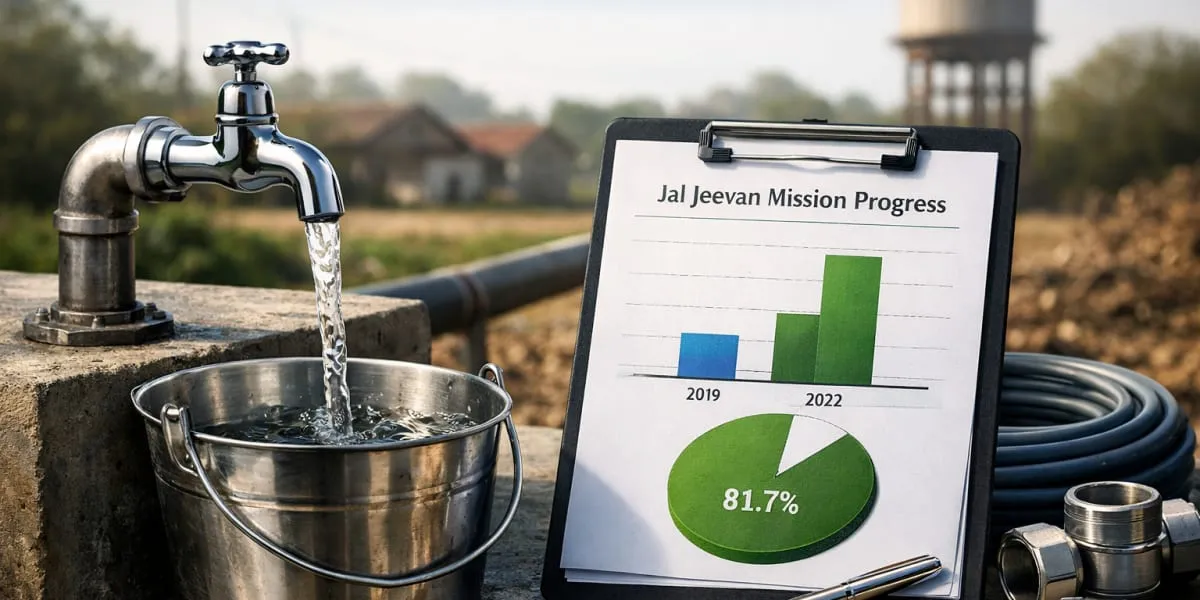
The Government reported substantial progress under the Jal Jeevan Mission, launched in August 2019 to provide tap water to every rural household. At launch only 32.3 million (mn) rural households had tap connections and states and Union territories reported provision of 125.8 mn additional households by March 2026. Consequently, out of about 193.6 mn rural households around 158.2 mn, or 81.71 per cent, are reported to have tap water at home. The Finance Minister announced extension of the mission until 2028 in the 2025-26 budget speech. The Swachh Bharat Mission Grameen, launched in October 20..
Next Story
Infrastructure Urban

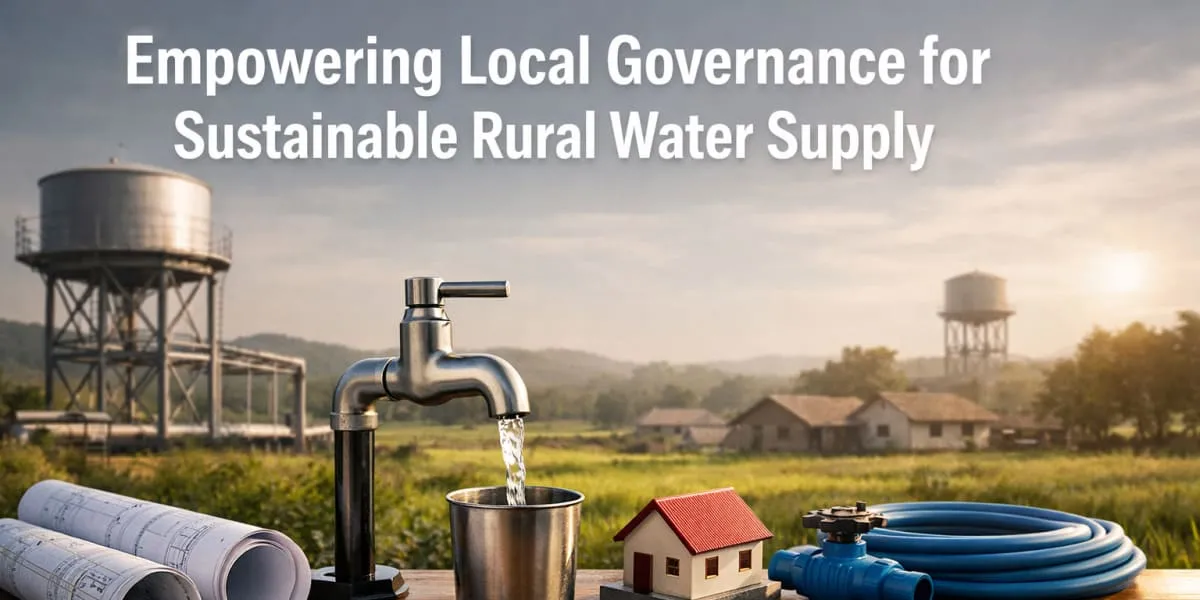
Empowering Local Governance for Sustainable Rural Water Supply

The Ministry of Jal Shakti has aligned the Jal Jeevan Mission (JJM) with the 73rd Amendment to strengthen village level planning and community ownership of water supply. Gram Panchayats, village water and sanitation committees and Pani Samitis are to plan, implement, manage and maintain piped water systems, with gram sabha processes formalising handover and oversight. Implementation support agencies including non government organisations, community based organisations and self help groups have been empanelled to train local committees and promote women participation. Under JJM, the department ..

Advertisement

Subscribe to Our Newsletter

Get daily newsletters around different themes from Construction world.

STAY CONNECTED

Advertisement

Advertisement

Advertisement