

Global construction coatings market to boom by 2027
Products

Global construction coatings market to boom by 2027

Recent research “Changing Construction Practices Transforming the Global Construction Coatings Market, 2020” by California-based business consulting firm Frost and Sullivan found a divide in the competitive environment of the sector between regional companies and large market participants, that are engaging increasingly in acquisitions and mergers, and joint ventures among themselves.

Larger coating companies have established long-term relationships with their key customers. However, for many coatings manufacturers, presently there is reliability on third-party distributors. These companies have recognised the need for increased direct customer interaction, and there is an expectation for improvement among the customers and supply networks in the coming three to five years. The market expects to increase from $13.37 billion in 2020 to $18.15 billion by 2027 at a 4.5% compound annual growth rate (CAGR). 

However, the report says demand for the construction sector has been deeply affected due to the outbreak of Covid-19 pandemic. The largest market for construction coatings in Asia-Pacific with growth potential in China for nearly all types of products. The need for infrastructure improvement is the need for the hour due to increasing economic development and migration of people to urban areas. Currently, the region has witnessed a rise in construction activity of residential, commercial and industrial sectors. 

Frost & Sullivan’s Christeena Thomas suggested that the total construction spending in the US is not suspected of returning to its pre-pandemic levels till 2022. In this, the construction of retail shops, amusement parks or recreation centres, and hotels are most likely to be affected. Increase in demand for new construction is expected due to the development of transportation, data centres, public safety, and healthcare services. 

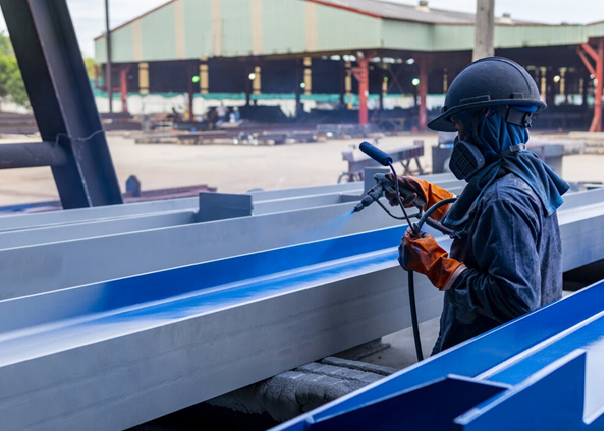
The growth of the market depends on the execution of new construction projects and repainting of existing buildings. Additionally, due to regulatory pressures, consumers are switching to powder or waterborne coating for lower VOC emissions and durability. 

To increase revenue opportunities, they must focus on tailored products for prefabricated construction to drive demand for high-solid solvent as well as powder coatings for all substrate materials. Additionally, they must improve capabilities such as research and development to source raw materials locally. Relationships with local manufacturers will improve their reach in the market. Lastly, investing in durable and waterborne coatings can bring environmental sustainability. 

Image Source

Recent research “Changing Construction Practices Transforming the Global Construction Coatings Market, 2020” by California-based business consulting firm Frost and Sullivan found a divide in the competitive environment of the sector between regional companies and large market participants, that are engaging increasingly in acquisitions and mergers, and joint ventures among themselves. Larger coating companies have established long-term relationships with their key customers. However, for many coatings manufacturers, presently there is reliability on third-party distributors. These companies have recognised the need for increased direct customer interaction, and there is an expectation for improvement among the customers and supply networks in the coming three to five years. The market expects to increase from $13.37 billion in 2020 to $18.15 billion by 2027 at a 4.5% compound annual growth rate (CAGR).  However, the report says demand for the construction sector has been deeply affected due to the outbreak of Covid-19 pandemic. The largest market for construction coatings in Asia-Pacific with growth potential in China for nearly all types of products. The need for infrastructure improvement is the need for the hour due to increasing economic development and migration of people to urban areas. Currently, the region has witnessed a rise in construction activity of residential, commercial and industrial sectors.  Frost & Sullivan’s Christeena Thomas suggested that the total construction spending in the US is not suspected of returning to its pre-pandemic levels till 2022. In this, the construction of retail shops, amusement parks or recreation centres, and hotels are most likely to be affected. Increase in demand for new construction is expected due to the development of transportation, data centres, public safety, and healthcare services.  The growth of the market depends on the execution of new construction projects and repainting of existing buildings. Additionally, due to regulatory pressures, consumers are switching to powder or waterborne coating for lower VOC emissions and durability.  To increase revenue opportunities, they must focus on tailored products for prefabricated construction to drive demand for high-solid solvent as well as powder coatings for all substrate materials. Additionally, they must improve capabilities such as research and development to source raw materials locally. Relationships with local manufacturers will improve their reach in the market. Lastly, investing in durable and waterborne coatings can bring environmental sustainability.  Image Source

Next Story
Infrastructure Urban

Implementation Status of Jal Jeevan Mission

Since August 2019 the Government has implemented Jal Jeevan Mission to provide assured potable water through household tap connections in rural India. At the start of the mission only 32.3 million (mn) rural households, representing 16.7 per cent, were reported to have tap water connections. States and union territories have reported that 125.8 mn additional rural households have since been provided with tap connections. As a result, of about 193.6 mn rural households roughly 158.2 mn, or 81.71 per cent, are reported to have tap water supply at home.\n\nThe State, district and village level st..

Next Story
Infrastructure Urban

Jal Jeevan Mission Reaches Eighty One Per Cent Rural Coverage

The Government reported substantial progress under the Jal Jeevan Mission, launched in August 2019 to provide tap water to every rural household. At launch only 32.3 million (mn) rural households had tap connections and states and Union territories reported provision of 125.8 mn additional households by March 2026. Consequently, out of about 193.6 mn rural households around 158.2 mn, or 81.71 per cent, are reported to have tap water at home. The Finance Minister announced extension of the mission until 2028 in the 2025-26 budget speech. The Swachh Bharat Mission Grameen, launched in October 20..

Next Story
Infrastructure Urban

Empowering Local Governance for Sustainable Rural Water Supply

The Ministry of Jal Shakti has aligned the Jal Jeevan Mission (JJM) with the 73rd Amendment to strengthen village level planning and community ownership of water supply. Gram Panchayats, village water and sanitation committees and Pani Samitis are to plan, implement, manage and maintain piped water systems, with gram sabha processes formalising handover and oversight. Implementation support agencies including non government organisations, community based organisations and self help groups have been empanelled to train local committees and promote women participation. Under JJM, the department ..

Advertisement

Subscribe to Our Newsletter

Get daily newsletters around different themes from Construction world.

STAY CONNECTED

Advertisement

Advertisement

Advertisement