Bharat Coking Coal Limited Reports March Production; FY26 Output Falls
COAL & MINING

Bharat Coking Coal Limited Reports March Production; FY26 Output Falls

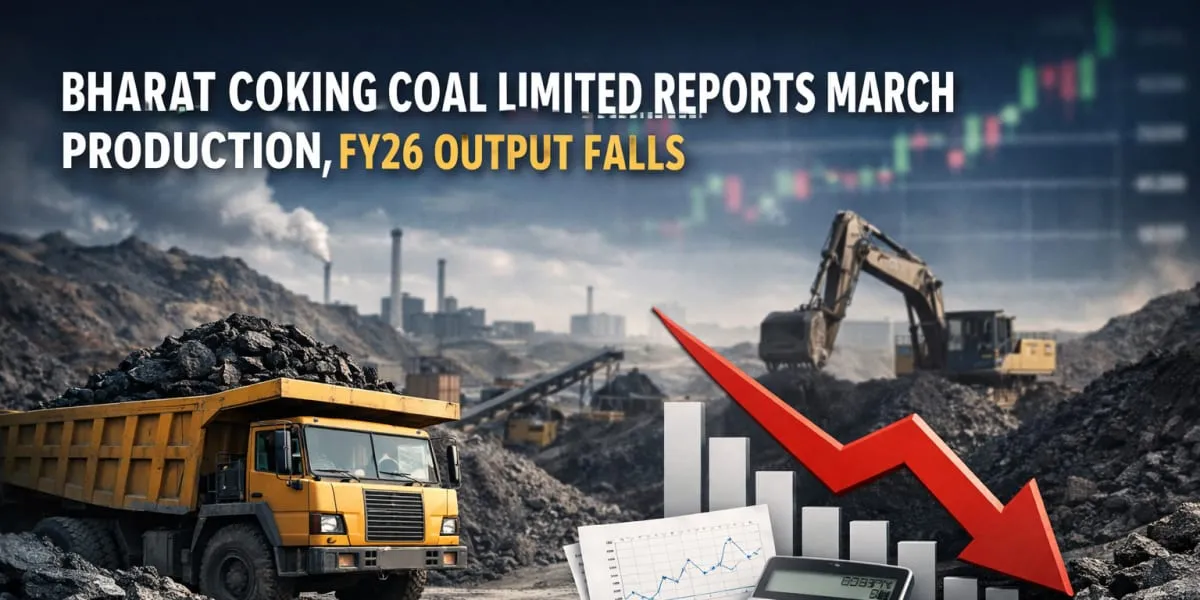
Bharat Coking Coal Limited (BCCL) disclosed provisional production figures for March 2026 and the full financial year April 2025–March 2026 under the SEBI Listing Obligations and Disclosure Requirements. The disclosure was submitted to BSE Limited and the National Stock Exchange of India by the company secretary and compliance officer. Raw coal output rose slightly in March but full year production declined by 12.3 per cent year-on-year, reflecting operational constraints during the period.

In March 2026 BCCL reported raw coal production of 4.42 million tonnes (mn t) compared with 4.33 million tonnes (mn t) in March 2025, representing a two per cent year-on-year increase. Coking coal output rose to 4.22 mn t from 4.07 mn t, an increase of three point six per cent, while non-coking coal fell to 0.20 mn t from 0.26 mn t, down 22.9 per cent. The rise in coking coal offset the decline in non-coking volumes for the month.

For the full financial year BCCL recorded raw coal production of 35.52 mn t, down from 40.50 mn t in FY25, a decline of 12.3 per cent. Annual coking coal production declined to 33.70 mn t from 38.89 mn t, down 13.4 per cent, while non-coking coal rose to 1.82 mn t from 1.61 mn t, up 13 per cent. Mining mode data showed continued reliance on opencast operations as underground output weakened and washed coal volumes and overburden removal fell year-on-year.

Coal dispatch also contracted, with March shipments at 2.66 mn t against 3.52 mn t a year earlier, a fall of 24.4 per cent, and annual offtake at 33.05 mn t versus 38.25 mn t, down 13.6 per cent. The results underline pressures on domestic metallurgical coal availability for the steel sector and may influence import requirements if production and dispatch trends persist. The company will need to address operational and logistical constraints to restore output and sales momentum.

Bharat Coking Coal Limited (BCCL) disclosed provisional production figures for March 2026 and the full financial year April 2025–March 2026 under the SEBI Listing Obligations and Disclosure Requirements. The disclosure was submitted to BSE Limited and the National Stock Exchange of India by the company secretary and compliance officer. Raw coal output rose slightly in March but full year production declined by 12.3 per cent year-on-year, reflecting operational constraints during the period. In March 2026 BCCL reported raw coal production of 4.42 million tonnes (mn t) compared with 4.33 million tonnes (mn t) in March 2025, representing a two per cent year-on-year increase. Coking coal output rose to 4.22 mn t from 4.07 mn t, an increase of three point six per cent, while non-coking coal fell to 0.20 mn t from 0.26 mn t, down 22.9 per cent. The rise in coking coal offset the decline in non-coking volumes for the month. For the full financial year BCCL recorded raw coal production of 35.52 mn t, down from 40.50 mn t in FY25, a decline of 12.3 per cent. Annual coking coal production declined to 33.70 mn t from 38.89 mn t, down 13.4 per cent, while non-coking coal rose to 1.82 mn t from 1.61 mn t, up 13 per cent. Mining mode data showed continued reliance on opencast operations as underground output weakened and washed coal volumes and overburden removal fell year-on-year. Coal dispatch also contracted, with March shipments at 2.66 mn t against 3.52 mn t a year earlier, a fall of 24.4 per cent, and annual offtake at 33.05 mn t versus 38.25 mn t, down 13.6 per cent. The results underline pressures on domestic metallurgical coal availability for the steel sector and may influence import requirements if production and dispatch trends persist. The company will need to address operational and logistical constraints to restore output and sales momentum.

Next Story
Infrastructure Transport

Contracts, Corridors and Cash Flows

India’s roads sector enters 2026 at a decisive junction, where the conversation is no longer about kilometres alone but contracts that allocate risk wisely, corridors that unlock economic value, and cash flows that remain credible over the long term. After more than a decade of relentless expansion, India’s road-building ecosystem is moving into a phase of maturity – where engineering complexity, financial discipline and institutional coordination matter more than sheer scale.Between 2014 and 2024, India built highways at a pace few nations have ever matched. National Highway length expa..

Next Story
Real Estate

The Walled Garden

I am not suggesting Indian architects are inadequate. The profession has produced extraordinary work – from Charles Correa's quiet humanism to Balkrishna Doshi's Nobel-recognised genius. However, the regulatory barriers meant to protect the profession are holding it back. It is time for an honest conversation about this.The Architects Act of 1972 established the Council of Architecture (COA) as the statutory body regulating architecture practice in India. Its founding logic was sound: to ensure those calling themselves architects meet a minimum standard of competence and to protect the publi..

Next Story
Real Estate

We completed a 1BHK home on a private island in 7 days!

Reimagining construction through a ‘War on Waste’, Circato founders T Paul Koshy, Sushma Joseph and Praveen Crasta speak to CW on turning single-use plastic into high-performance building systems – demonstrated at Bengaluru International Airport with a 16-ft wall installed in just 48 hours.What specific gap in the construction ecosystem led to the creation of Circato?Sushma Joseph: We felt the industry had normalised inefficiency. In construction, timelines, costs and outcomes often remain uncertain, yet that is widely accepted. We wanted to show that inefficiencies can be..

Advertisement

Subscribe to Our Newsletter

Get daily newsletters around different themes from Construction world.

STAY CONNECTED

Advertisement

Advertisement

Advertisement