Government Directs Faster City Gas Projects And More LPG For Commerce
OIL & GAS

Government Directs Faster City Gas Projects And More LPG For Commerce

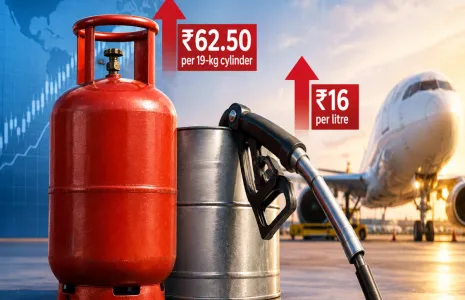
The government has directed administrative authorities to expedite approvals for city gas projects and to increase commercial allocations of liquefied petroleum gas (LPG) to mitigate supply stress. The move is intended to streamline gas distribution networks across urban centres and to ensure continuity of supply to industrial and commercial consumers amid a strained global energy situation. Officials indicated that the steps form part of a broader approach to bolster supply resilience and to promote cleaner fuel usage in cities.

The Petroleum and Explosives Safety Organisation (PESO) has instructed its regional offices to dispose of City Gas Distribution (CGD) applications within 10 days to accelerate the rollout of piped natural gas (PNG). The directive is aimed at shortening administrative timelines and reducing procedural bottlenecks that have slowed network expansion in several areas. Authorities have also advised that commercial LPG consumers in major cities and urban localities should transition to PNG where infrastructure permits.

Increasing allocations of LPG for commercial use has been combined with the shift to PNG to manage immediate supply pressures and to prioritise sectors that depend on cylinder supplies. Policy makers outlined that freeing up bottled LPG by encouraging substitution in commercial establishments will help safeguard household supplies, while supporting industry and transport where alternatives are not yet viable. The steps are being framed as temporary adjustments calibrated to evolving supply conditions and logistical constraints.

The government has called on developers, pipeline operators and municipal agencies to coordinate closely with regulators to expedite connection works and safety clearances. Officials emphasised that accelerated approvals should not compromise safety standards and that training and compliance checks will continue alongside speedier processing. Stakeholders were urged to expedite meter installations and consumer outreach to facilitate the transition, and the administration indicated that monitoring mechanisms will be used to review allocations and to adapt measures as conditions change.

The government has directed administrative authorities to expedite approvals for city gas projects and to increase commercial allocations of liquefied petroleum gas (LPG) to mitigate supply stress. The move is intended to streamline gas distribution networks across urban centres and to ensure continuity of supply to industrial and commercial consumers amid a strained global energy situation. Officials indicated that the steps form part of a broader approach to bolster supply resilience and to promote cleaner fuel usage in cities. The Petroleum and Explosives Safety Organisation (PESO) has instructed its regional offices to dispose of City Gas Distribution (CGD) applications within 10 days to accelerate the rollout of piped natural gas (PNG). The directive is aimed at shortening administrative timelines and reducing procedural bottlenecks that have slowed network expansion in several areas. Authorities have also advised that commercial LPG consumers in major cities and urban localities should transition to PNG where infrastructure permits. Increasing allocations of LPG for commercial use has been combined with the shift to PNG to manage immediate supply pressures and to prioritise sectors that depend on cylinder supplies. Policy makers outlined that freeing up bottled LPG by encouraging substitution in commercial establishments will help safeguard household supplies, while supporting industry and transport where alternatives are not yet viable. The steps are being framed as temporary adjustments calibrated to evolving supply conditions and logistical constraints. The government has called on developers, pipeline operators and municipal agencies to coordinate closely with regulators to expedite connection works and safety clearances. Officials emphasised that accelerated approvals should not compromise safety standards and that training and compliance checks will continue alongside speedier processing. Stakeholders were urged to expedite meter installations and consumer outreach to facilitate the transition, and the administration indicated that monitoring mechanisms will be used to review allocations and to adapt measures as conditions change.

Next Story
Infrastructure Transport

The Critical Path

In Ircon International Ltd v. Afcons Infrastructure Ltd, OMP (Comm) 279/2019, the Delhi High Court examined how delay and extension of time (‘EOT’) are to be assessed in construction contracts, particularly in the context of the ‘critical path’ while dealing with challenge to an arbitral award under Section 34 of the Arbitration and Conciliation Act 1996 (‘the Act’). The High Court’s observations regarding the critical path are of significant import for construction and infrastructure projects and related arbitration. The parties entered into a contract for construction of T..

Next Story
Infrastructure Urban

Urgently Wanted: 2 Million Workers!

Construction, India’s second largest employer by industry, employs about 50 million workers but could additionally absorb another 40 million workers, according to estimates shared by the Construction Skill Development Council of India (CSDCI) in 2023. Within this, citing trade estimates, Rahul Bahl, Managing Director, Krishna Buildestates, says the shortage of trained, skilled workers is currently about 2 million, and is expected to rise to 5 million by 2030.Not only is the construction industry struggling to find workers but construction labour productivity in India significantly trails g..

Next Story
Real Estate

144 Years in the Making!

1. A century-spanning construction storyConstruction began in 1882, making the Sagrada Família one of the longest-running architectural projects in modern history. Today, the project is overseen by the Fundació Junta Constructora del Temple Expiatori de la Sagrada Família, with Chief Architect Jordi Faulí leading its final construction phases.2. The world’s tallest church towerhe Sagrada Família in Barcelona reached its final height of 172.5 m (566 ft) on February 20, 2026, with the installation of the cross atop the Tower of Jesus Christ, making it the tallest church in the world...To ..

Advertisement

Subscribe to Our Newsletter

Get daily newsletters around different themes from Construction world.

STAY CONNECTED

Advertisement

Advertisement

Advertisement