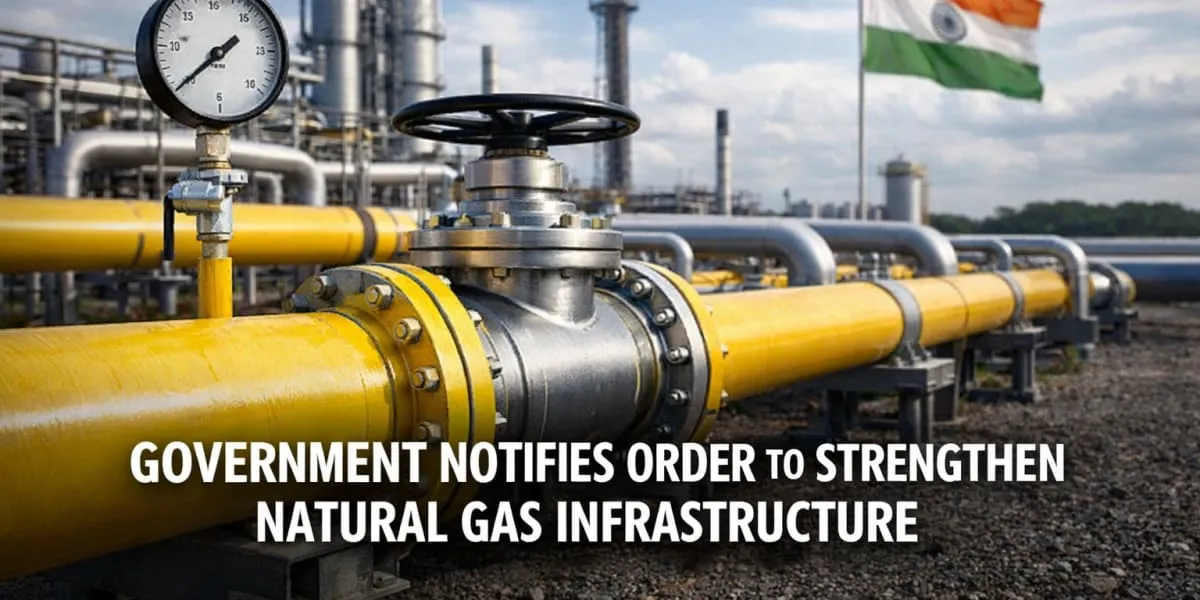
Government Notifies Order To Strengthen Natural Gas Infrastructure
OIL & GAS

Government Notifies Order To Strengthen Natural Gas Infrastructure

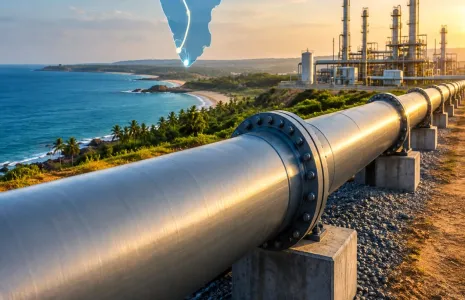
The Government of India, through the Ministry of Petroleum and Natural Gas, has notified the Natural Gas and Petroleum Products Distribution Order, 2026 under the Essential Commodities Act, 1955 and put it into immediate effect. The order establishes a streamlined, time-bound framework for laying, building, operating and expanding pipeline infrastructure and seeks to address delays in approvals and access to land that have hindered investment. It presents a comprehensive, transparent and investor-friendly regime to accelerate development of gas distribution networks across jurisdictions.

The order is expected to facilitate expansion of piped natural gas (PNG) networks and improve last-mile connectivity to households, transport and industrial users. It envisages faster rollout of city gas distribution (CGD) systems and trunk pipelines and aims to provide seamless access for authorised entities to lay and expand lines. Consumer-centric measures include time-bound provision of PNG connections and flexibility where physical connectivity is not technically feasible.

The reform introduces standardised processes, timelines and charges to reduce ambiguity and arbitrariness in approvals, and it prescribes defined compensation and restoration mechanisms such as dig-and-restore or dig-and-pay to minimise disputes with local authorities. Time-bound approvals with deemed clearance provisions will shorten procedural delays and reduce compliance burden through simplified documentation. Operational safeguards, including calibrated bank guarantee requirements, are designed to ensure accountability while avoiding excessive financial burden on developers.

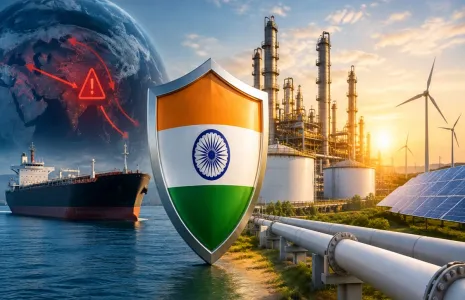
The government says the measure will strengthen energy security and diversify the fuel mix, supporting a transition to a cleaner gas-based economy. Improved regulatory certainty and faster approvals are expected to boost investor confidence and catalyse infrastructure investment in urban and semi-urban areas. Wider adoption of natural gas for cooking, transport and industry is anticipated to contribute to better air quality and lower emissions while supporting economic growth.

The Government of India, through the Ministry of Petroleum and Natural Gas, has notified the Natural Gas and Petroleum Products Distribution Order, 2026 under the Essential Commodities Act, 1955 and put it into immediate effect. The order establishes a streamlined, time-bound framework for laying, building, operating and expanding pipeline infrastructure and seeks to address delays in approvals and access to land that have hindered investment. It presents a comprehensive, transparent and investor-friendly regime to accelerate development of gas distribution networks across jurisdictions. The order is expected to facilitate expansion of piped natural gas (PNG) networks and improve last-mile connectivity to households, transport and industrial users. It envisages faster rollout of city gas distribution (CGD) systems and trunk pipelines and aims to provide seamless access for authorised entities to lay and expand lines. Consumer-centric measures include time-bound provision of PNG connections and flexibility where physical connectivity is not technically feasible. The reform introduces standardised processes, timelines and charges to reduce ambiguity and arbitrariness in approvals, and it prescribes defined compensation and restoration mechanisms such as dig-and-restore or dig-and-pay to minimise disputes with local authorities. Time-bound approvals with deemed clearance provisions will shorten procedural delays and reduce compliance burden through simplified documentation. Operational safeguards, including calibrated bank guarantee requirements, are designed to ensure accountability while avoiding excessive financial burden on developers. The government says the measure will strengthen energy security and diversify the fuel mix, supporting a transition to a cleaner gas-based economy. Improved regulatory certainty and faster approvals are expected to boost investor confidence and catalyse infrastructure investment in urban and semi-urban areas. Wider adoption of natural gas for cooking, transport and industry is anticipated to contribute to better air quality and lower emissions while supporting economic growth.

Next Story
Infrastructure Transport

The Critical Path

In Ircon International Ltd v. Afcons Infrastructure Ltd, OMP (Comm) 279/2019, the Delhi High Court examined how delay and extension of time (‘EOT’) are to be assessed in construction contracts, particularly in the context of the ‘critical path’ while dealing with challenge to an arbitral award under Section 34 of the Arbitration and Conciliation Act 1996 (‘the Act’). The High Court’s observations regarding the critical path are of significant import for construction and infrastructure projects and related arbitration. The parties entered into a contract for construction of T..

Next Story
Infrastructure Urban

Urgently Wanted: 2 Million Workers!

Construction, India’s second largest employer by industry, employs about 50 million workers but could additionally absorb another 40 million workers, according to estimates shared by the Construction Skill Development Council of India (CSDCI) in 2023. Within this, citing trade estimates, Rahul Bahl, Managing Director, Krishna Buildestates, says the shortage of trained, skilled workers is currently about 2 million, and is expected to rise to 5 million by 2030.Not only is the construction industry struggling to find workers but construction labour productivity in India significantly trails g..

Next Story
Real Estate

144 Years in the Making!

1. A century-spanning construction storyConstruction began in 1882, making the Sagrada Família one of the longest-running architectural projects in modern history. Today, the project is overseen by the Fundació Junta Constructora del Temple Expiatori de la Sagrada Família, with Chief Architect Jordi Faulí leading its final construction phases.2. The world’s tallest church towerhe Sagrada Família in Barcelona reached its final height of 172.5 m (566 ft) on February 20, 2026, with the installation of the cross atop the Tower of Jesus Christ, making it the tallest church in the world...To ..

Advertisement

Subscribe to Our Newsletter

Get daily newsletters around different themes from Construction world.

STAY CONNECTED

Advertisement

Advertisement

Advertisement