Adani Green Adds Over Five Gigawatt Renewable Capacity In FY26
POWER & RENEWABLE ENERGY

Adani Green Adds Over Five Gigawatt Renewable Capacity In FY26

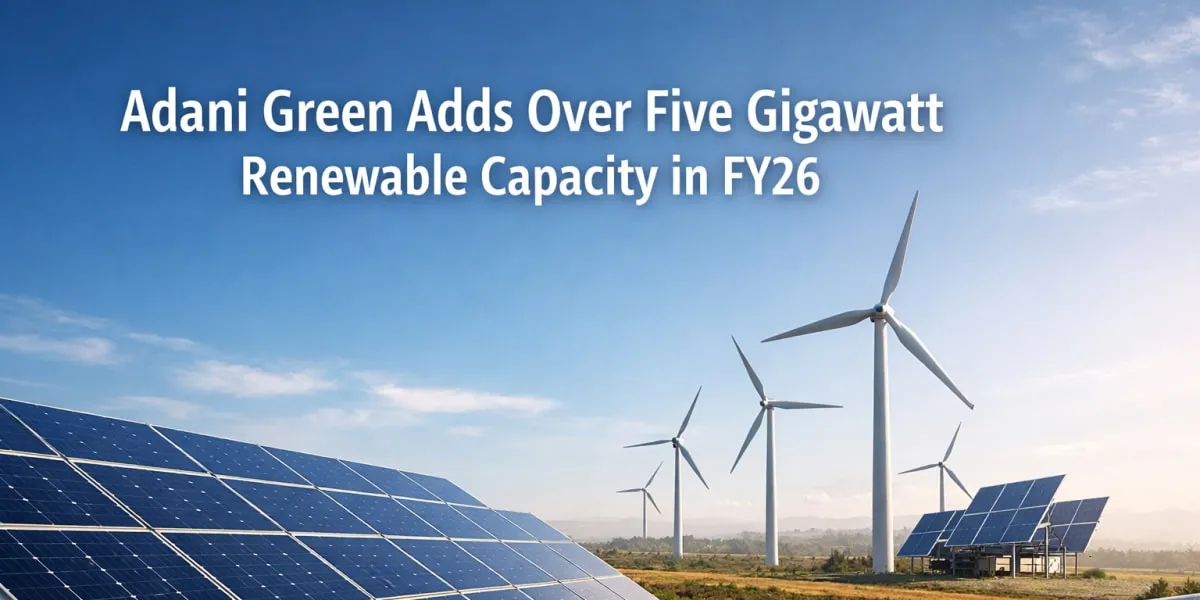
Adani Green Energy added over five gigawatt (GW) of renewable energy capacity in fiscal year 2026, taking its total operational portfolio to 19.3 GW and marking the highest greenfield annual capacity expansion globally outside China. The new capacity comprised three point four gigawatt of solar, zero point seven gigawatt of wind (686 megawatt (MW)) and one gigawatt of wind-solar hybrid capacity, reflecting a diversified clean energy build-out strategy. The additions underline a focus on scale and diversified site deployment across technologies.\n\nMost of the incremental capacity was commissioned at the Khavda renewable energy park in Gujarat, which is emerging as the world’s largest renewable energy plant. At Khavda, the company had installed nine point four gigawatt (9,413 megawatt (MW)) of capacity out of a planned 30 gigawatt by 2029, highlighting strong progress towards one of the most ambitious renewable projects globally. The pace of commissioning indicates strong project management and supply chain coordination.\n\nThe company also completed an initial 1,376 megawatt-hour (MWh) of battery energy storage system capacity at the site within eight months of commencing work to help ensure grid stability and support renewable energy integration. The fresh capacity is expected to offset 10 million tonnes (mn t) of carbon emissions annually, while the entire operational portfolio of 19.3 GW is expected to offset 36 million tonnes (mn t) annually, reinforcing emissions reduction benefits. The deployment timeline illustrated rapid mobilisation of resources. The scale-up will support the company’s target of 50 GW of renewable capacity by 2030 and contribute to national decarbonisation efforts.\n\nThe milestone reinforces rapid national progress in utility-scale solar, wind and hybrid assets and strengthens confidence in execution of large-format renewable infrastructure projects. Continued deployment of storage alongside generation capacity is expected to underpin integration and bolster energy security. Market observers consider the development a key indicator of private sector leadership in the energy transition.

"Join industry leaders at RAHSTA Expo, India's premier platform for roads, highways and traffic infrastructure. Register now to explore innovations, network with experts and shape the future of mobility."

Adani Green Energy added over five gigawatt (GW) of renewable energy capacity in fiscal year 2026, taking its total operational portfolio to 19.3 GW and marking the highest greenfield annual capacity expansion globally outside China. The new capacity comprised three point four gigawatt of solar, zero point seven gigawatt of wind (686 megawatt (MW)) and one gigawatt of wind-solar hybrid capacity, reflecting a diversified clean energy build-out strategy. The additions underline a focus on scale and diversified site deployment across technologies.\n\nMost of the incremental capacity was commissioned at the Khavda renewable energy park in Gujarat, which is emerging as the world’s largest renewable energy plant. At Khavda, the company had installed nine point four gigawatt (9,413 megawatt (MW)) of capacity out of a planned 30 gigawatt by 2029, highlighting strong progress towards one of the most ambitious renewable projects globally. The pace of commissioning indicates strong project management and supply chain coordination.\n\nThe company also completed an initial 1,376 megawatt-hour (MWh) of battery energy storage system capacity at the site within eight months of commencing work to help ensure grid stability and support renewable energy integration. The fresh capacity is expected to offset 10 million tonnes (mn t) of carbon emissions annually, while the entire operational portfolio of 19.3 GW is expected to offset 36 million tonnes (mn t) annually, reinforcing emissions reduction benefits. The deployment timeline illustrated rapid mobilisation of resources. The scale-up will support the company’s target of 50 GW of renewable capacity by 2030 and contribute to national decarbonisation efforts.\n\nThe milestone reinforces rapid national progress in utility-scale solar, wind and hybrid assets and strengthens confidence in execution of large-format renewable infrastructure projects. Continued deployment of storage alongside generation capacity is expected to underpin integration and bolster energy security. Market observers consider the development a key indicator of private sector leadership in the energy transition.

Next Story
Infrastructure Urban

ABS Marine Sees CRISIL Credit Rating Upgrade

ABS Marine Services has secured an upgrade to its long term and short term credit ratings from CRISIL, reflecting improved profitability and revenue growth through long term contracts. CRISIL moved the long term rating from BBB+/Stable to A-/Stable and revised the short term rating from A2 to A2+. The action signals strengthened financial metrics and operational resilience. The company benefited from durable client relationships with firms such as ONGC and Schlumberger. The rating decision followed stronger cash flows and an enlarged bank loan facility, which increased from Rs 3,705 million (m..

Next Story
Infrastructure Transport

Project BRAHMANK Marks 16 Years Of Strategic Roads In Arunachal

Project BRAHMANK is marking 16 years of work to establish strategic road and bridge links across Arunachal Pradesh, maintaining and developing 811 kilometres of roads and nearly 86 bridges that range from small culverts to large steel and arch bridges. These transport links are described as critical for ensuring year-round movement of defence personnel, equipment and essential supplies while improving everyday travel for people in remote villages. The project balances national security requirements with regional development by focusing on reliable access in challenging terrain. Notable enginee..

Next Story
Infrastructure Transport

Longleng CSOs Give One Week Ultimatum Over Two-Lane Highway

Civil society organisations (CSOs) in Longleng district have demanded immediate restoration of the deteriorating Changtongya–Longleng two-lane road and sought a detailed status report on the stalled construction within one week. The demand followed a consultative meeting convened under the Phom Peoples' Council (PPC) to discuss welfare and development concerns. PPC president YB Angam Phom said prolonged non-maintenance had caused hardship to commuters and affected transportation, local commerce and the district's development. The meeting urged authorities to undertake immediate restoration a..

Advertisement

Subscribe to Our Newsletter

Get daily newsletters around different themes from Construction world.

STAY CONNECTED

Advertisement

Advertisement

Advertisement