Tripura Electricity Regulatory Commission Approves Revised Tariff With ToD Billing
ECONOMY & POLICY

Tripura Electricity Regulatory Commission Approves Revised Tariff With ToD Billing

The Tripura Electricity Regulatory Commission approved the electricity tariff for the financial year 2026-27 after reviewing petitions from Tripura State Electricity Corporation Limited covering generation, transmission and distribution. The order dated May four, 2026 included truing up for FY 2024-25, the annual performance review for FY 2025-26 and the determination of the aggregate revenue requirement. The commission framed measures to balance sector finances and consumer protection.

TSECL had sought recovery of Rs 17.09 billion (bn) covering past true up gaps, provisional shortfalls and carrying costs. The utility proposed higher fixed charges and a regulatory surcharge to bridge the deficit. The commission approved the gaps and costs but avoided passing the full burden to consumers in a single year.

Referring to Supreme Court directions the commission adopted a phased recovery mechanism. Only one fifth of the approved true up gap for FY 2023-24 and one third for FY 2024-25 were included in the ARR for the present year. The method spread impact on tariffs while maintaining a trajectory to financial stability.

The revised order introduced moderate increases in energy charges with domestic consumers using up to 150 units facing a rise of 15 paisa per unit and higher domestic consumption, irrigation, public water works, public lighting and special utilities seeing a rise of 20 paisa per unit. All other categories saw an increase of 35 paisa per unit. Fixed charges continue to be billed on connected load per kilowatt (kW).

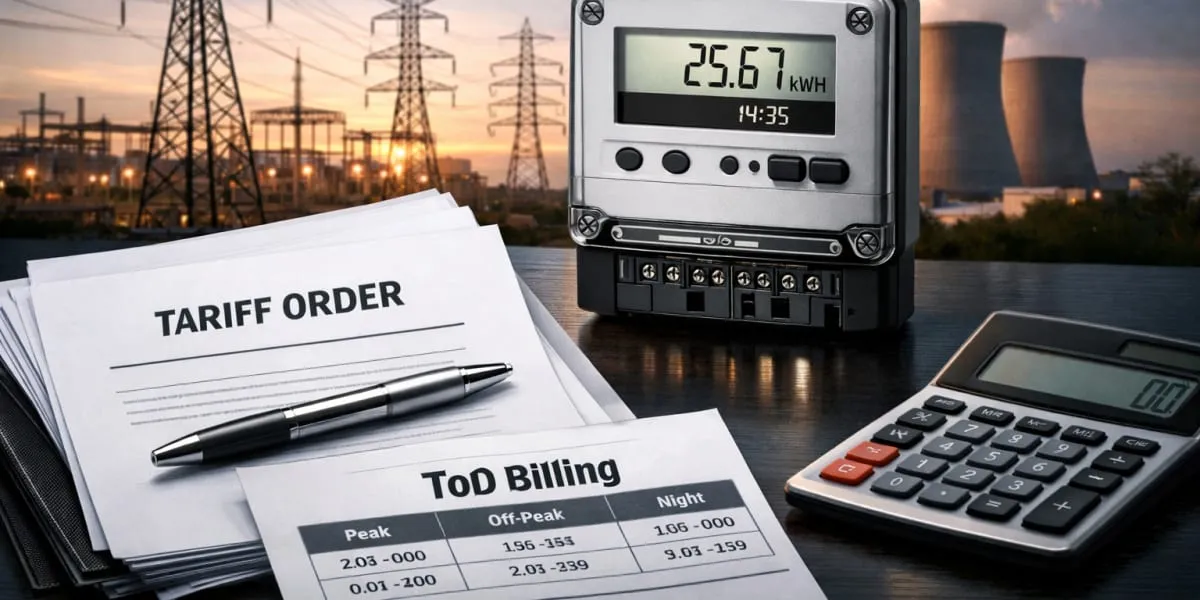
Load management provisions allow upward revision of contracted load when recorded maximum demand exceeds contracted load for three consecutive months and permit downward revision when demand remains lower. Time of Day tariffs are mandatory for most consumers with specified exemptions. Solar hours between nine AM and five PM will be charged at 80 per cent of normal tariff and peak hours at higher rates, with smart meters introduced gradually. A 10 per cent rebate for designated categories and the green tariff of Rs 0.75 per kWh have been retained.

The Tripura Electricity Regulatory Commission approved the electricity tariff for the financial year 2026-27 after reviewing petitions from Tripura State Electricity Corporation Limited covering generation, transmission and distribution. The order dated May four, 2026 included truing up for FY 2024-25, the annual performance review for FY 2025-26 and the determination of the aggregate revenue requirement. The commission framed measures to balance sector finances and consumer protection. TSECL had sought recovery of Rs 17.09 billion (bn) covering past true up gaps, provisional shortfalls and carrying costs. The utility proposed higher fixed charges and a regulatory surcharge to bridge the deficit. The commission approved the gaps and costs but avoided passing the full burden to consumers in a single year. Referring to Supreme Court directions the commission adopted a phased recovery mechanism. Only one fifth of the approved true up gap for FY 2023-24 and one third for FY 2024-25 were included in the ARR for the present year. The method spread impact on tariffs while maintaining a trajectory to financial stability. The revised order introduced moderate increases in energy charges with domestic consumers using up to 150 units facing a rise of 15 paisa per unit and higher domestic consumption, irrigation, public water works, public lighting and special utilities seeing a rise of 20 paisa per unit. All other categories saw an increase of 35 paisa per unit. Fixed charges continue to be billed on connected load per kilowatt (kW). Load management provisions allow upward revision of contracted load when recorded maximum demand exceeds contracted load for three consecutive months and permit downward revision when demand remains lower. Time of Day tariffs are mandatory for most consumers with specified exemptions. Solar hours between nine AM and five PM will be charged at 80 per cent of normal tariff and peak hours at higher rates, with smart meters introduced gradually. A 10 per cent rebate for designated categories and the green tariff of Rs 0.75 per kWh have been retained.

Next Story
Building Material

Enlight Metals to Expand Raipur Plant Capacity

Enlight Metals has announced plans to expand the production capacity of its Raipur manufacturing facility from around 1,200 tonnes to nearly 4,000 tonnes.The expansion is aimed at strengthening the company’s ability to serve rising demand across industrial, infrastructure and contract manufacturing requirements.Located in Raipur, Chhattisgarh, the facility serves as a key manufacturing hub for Enlight Metals. The planned capacity enhancement is expected to improve supply capabilities, operational efficiency and the company’s ability to handle larger project requirements.The facility includ..

Next Story
Infrastructure Urban

Hindustan Zinc Partners Sulfozyme for Zinc Park Project

Hindustan Zinc has signed a Memorandum of Understanding with Sulfozyme Agro India under its Zinc Industrial Park initiative at Khankhala in Bhilwara district, Rajasthan. The partnership aims to strengthen India’s downstream zinc sector through sustainable metal recovery, resource efficiency and industrial development.Under the agreement, Sulfozyme Agro will establish proposed operations at the Zinc Industrial Park to process zinc-based materials into value-added products for industrial and downstream applications.Hindustan Zinc will support the venture through assured raw material linkage an..

Next Story
Infrastructure Urban

Cortec MCI Technology Restores Croatia Monuments

Cortec’s Migrating Corrosion Inhibitor technology has been used in restoration works for historic monuments in Croatia, including the Church of St Donatus in Zadar and the medieval city walls of Ilok.The Church of St Donatus, one of the most significant pre-Romanesque churches in Europe, is listed in the Register of Cultural Goods of the Republic of Croatia and is under UNESCO protection. The monument required urgent rehabilitation after 3D scanning analysis identified critical issues in the church walls, main structure and roof.The reinforced concrete support structure beneath the roof, ins..

Advertisement

Subscribe to Our Newsletter

Get daily newsletters around different themes from Construction world.

STAY CONNECTED

Advertisement

Advertisement

Advertisement