Adani Green Plans Major Battery Storage Expansion
POWER & RENEWABLE ENERGY

Adani Green Plans Major Battery Storage Expansion

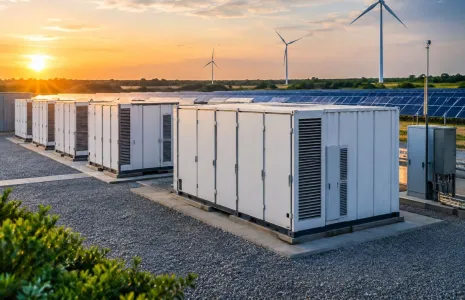
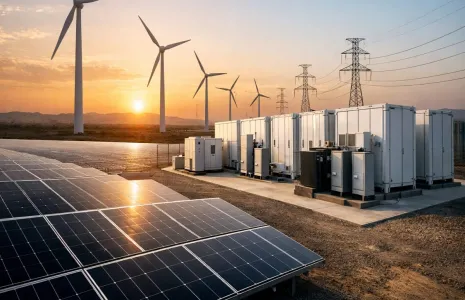
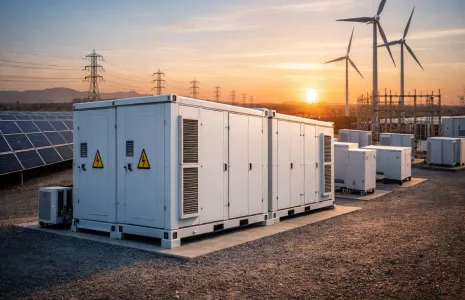
Adani Green Energy Ltd plans to more than double its battery energy storage system (BESS) capacity at the Khavda renewable energy park in Gujarat to over 7 GWh by FY27, supported by a capital expenditure programme of around Rs 250–400 billion.

The company is set to commission 3.5 GWh of storage capacity by the end of the current financial year, which it has described as India’s largest battery storage project. Battery storage has emerged as a strategic priority for Adani Green as delays in grid augmentation continue to constrain power evacuation from Khavda, located near the India–Pakistan border in Kutch district.

Adani Green said battery storage would help absorb power that might otherwise be curtailed in the short term while providing flexibility until long-term evacuation infrastructure is aligned with project commissioning. The company expects to significantly improve revenue realisation by co-locating solar generation with storage, enabling it to dispatch stored energy during peak pricing periods and benefit from arbitrage opportunities.

Grid constraints remain a key near-term challenge at Khavda, where evacuation capacity expansion has lagged expectations due to execution delays, seasonality and right-of-way issues. Adani Green noted that battery storage would play a critical role in mitigating these risks and stabilising generation variability as renewable capacity scales up.

The accelerated rollout of BESS forms a central part of the company’s capital expenditure roadmap for the coming year. Adani Green said funding visibility remains strong, with a significant portion of debt already sanctioned to support the next phase of expansion.

With most near-term growth concentrated in Rajasthan and Khavda, Adani Green expects battery storage to be a crucial enabler of renewable energy integration and grid stability, strengthening its position in India’s energy transition.

Adani Green Energy Ltd plans to more than double its battery energy storage system (BESS) capacity at the Khavda renewable energy park in Gujarat to over 7 GWh by FY27, supported by a capital expenditure programme of around Rs 250–400 billion. The company is set to commission 3.5 GWh of storage capacity by the end of the current financial year, which it has described as India’s largest battery storage project. Battery storage has emerged as a strategic priority for Adani Green as delays in grid augmentation continue to constrain power evacuation from Khavda, located near the India–Pakistan border in Kutch district. Adani Green said battery storage would help absorb power that might otherwise be curtailed in the short term while providing flexibility until long-term evacuation infrastructure is aligned with project commissioning. The company expects to significantly improve revenue realisation by co-locating solar generation with storage, enabling it to dispatch stored energy during peak pricing periods and benefit from arbitrage opportunities. Grid constraints remain a key near-term challenge at Khavda, where evacuation capacity expansion has lagged expectations due to execution delays, seasonality and right-of-way issues. Adani Green noted that battery storage would play a critical role in mitigating these risks and stabilising generation variability as renewable capacity scales up. The accelerated rollout of BESS forms a central part of the company’s capital expenditure roadmap for the coming year. Adani Green said funding visibility remains strong, with a significant portion of debt already sanctioned to support the next phase of expansion. With most near-term growth concentrated in Rajasthan and Khavda, Adani Green expects battery storage to be a crucial enabler of renewable energy integration and grid stability, strengthening its position in India’s energy transition.

Next Story
Real Estate

Housing Sales Dip 7 per cent QoQ Across Top Cities

India’s housing market saw a 7 per cent quarter-on-quarter decline in sales across the top seven cities in Q1 2026, with approximately 1,01,675 units sold compared to 1,08,970 units in Q4 2025, according to ANAROCK Group. However, on a yearly basis, sales rose 9 per cent, indicating continued underlying demand.The total sales value stood at around Rs 1.51 trillion, reflecting a 5 per cent quarterly drop but a 6 per cent annual increase. Mumbai Metropolitan Region and Bengaluru together accounted for nearly 48 per cent of total sales, while Chennai recorded the highest quarterly decline at 18..

Next Story
Real Estate

Birla Estates Enters Mumbai Redevelopment

Birla Estates has announced its entry into Mumbai’s redevelopment segment with a luxury residential project in Khar West, developed in partnership with Parinee Real Estate Builders. The project will redevelop Anmol Co-operative Housing Society and Bhartiya Bhavan Co-operative Housing Society, marking the company’s first redevelopment initiative in the Mumbai Metropolitan Region.Spread across 1.3 acres, the development will offer a saleable area of 2.9 lakh sq ft with an estimated revenue potential of Rs 17 billion. Positioned in one of Mumbai’s prime residential micro-markets, the projec..

Next Story
Infrastructure Urban

Hitachi, MUFG Expand EV Financing Model

Hitachi and MUFG Bank have expanded their NextGen business co-creation model to accelerate decarbonised mobility by financing electric vehicles and charging infrastructure. The renewed collaboration aims to address key barriers to electrification, including limited access to capital and the need for integrated energy solutions.Building on earlier partnerships, the expanded model extends beyond battery-focused solutions to include electric mobility assets, charging systems and energy management infrastructure across global markets. The initiative will leverage structured financing through speci..

Advertisement

Subscribe to Our Newsletter

Get daily newsletters around different themes from Construction world.

STAY CONNECTED

Advertisement

Advertisement

Advertisement