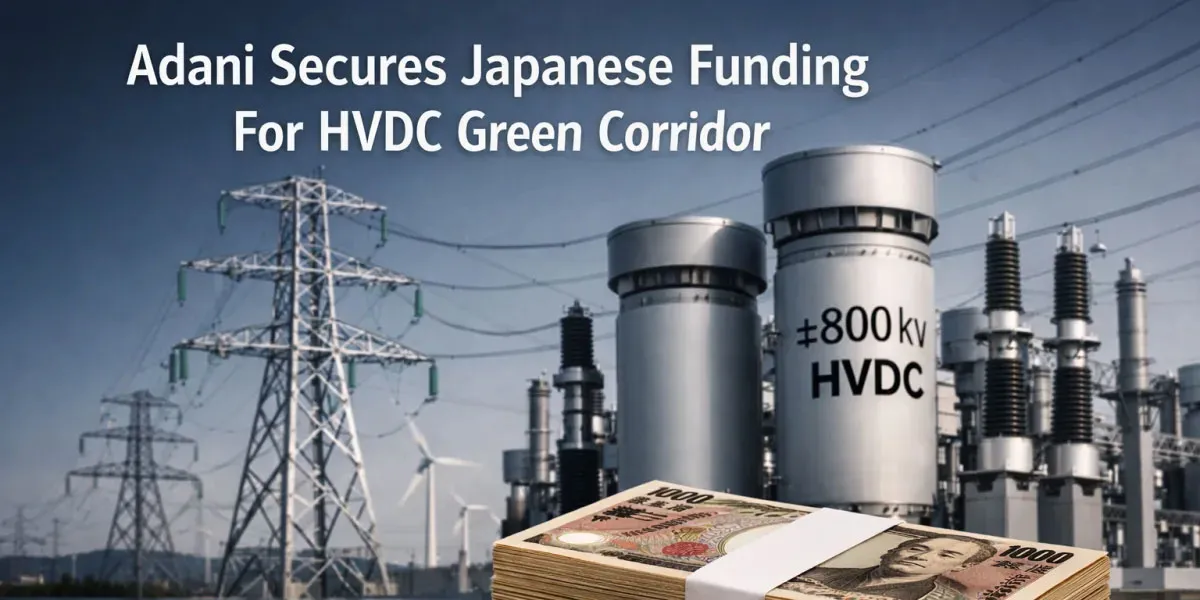
Adani Secures Japanese Funding For HVDC Green Corridor
POWER & RENEWABLE ENERGY

Adani Secures Japanese Funding For HVDC Green Corridor

Adani Energy Solutions Limited has secured long term financing from leading Japanese banks for a high voltage direct current (HVDC) transmission project designed to strengthen evacuation of renewable power across northern India. The financing will support the construction of a high capacity ±800 kV HVDC network that is intended to move large volumes of clean energy from generation centres to demand hubs. The company said the corridor forms a central piece of its transmission strategy to integrate dispersed solar resources into the national grid.

It will carry solar energy from resource rich areas in Rajasthan to the wider network, linking Bhadla in Rajasthan to Fatehpur in Uttar Pradesh over a 950 kilometre corridor scheduled for commissioning by 2029. The route is designed with an evacuation capacity of 6,000 MW to accommodate large scale flows and to reduce transmission bottlenecks. The exact amount of funding secured was not disclosed but the lending group is led by MUFG Bank Ltd and Sumitomo Mitsui Banking Corporation.

Advanced HVDC equipment is to be supplied by Hitachi in partnership with Bharat Heavy Electricals Limited (BHEL), a collaboration that is expected to strengthen domestic manufacturing and engineering content. The asset is part of the Adani Group integrated clean energy platform and complements generation projects in Rajasthan run by Adani Green Energy Limited that already feed renewables into the transmission system. Adani Electricity Mumbai Limited currently integrates over 40 per cent renewable energy into its supply mix, placing Mumbai among the leading cities globally for sustainable power usage.

The corridor is expected to improve grid stability and to enable the large scale integration of renewable energy for major urban and industrial centres as demand rises. By ensuring reliable long distance transmission the project should help balance fluctuating generation with consumption and reduce curtailment of clean output. Commissioning by 2029 will allow the network to support growth in clean power capacity and to facilitate regional energy trade over long distances.

"Join industry leaders at RAHSTA Expo, India's premier platform for roads, highways and traffic infrastructure. Register now to explore innovations, network with experts and shape the future of mobility."

Adani Energy Solutions Limited has secured long term financing from leading Japanese banks for a high voltage direct current (HVDC) transmission project designed to strengthen evacuation of renewable power across northern India. The financing will support the construction of a high capacity ±800 kV HVDC network that is intended to move large volumes of clean energy from generation centres to demand hubs. The company said the corridor forms a central piece of its transmission strategy to integrate dispersed solar resources into the national grid. It will carry solar energy from resource rich areas in Rajasthan to the wider network, linking Bhadla in Rajasthan to Fatehpur in Uttar Pradesh over a 950 kilometre corridor scheduled for commissioning by 2029. The route is designed with an evacuation capacity of 6,000 MW to accommodate large scale flows and to reduce transmission bottlenecks. The exact amount of funding secured was not disclosed but the lending group is led by MUFG Bank Ltd and Sumitomo Mitsui Banking Corporation. Advanced HVDC equipment is to be supplied by Hitachi in partnership with Bharat Heavy Electricals Limited (BHEL), a collaboration that is expected to strengthen domestic manufacturing and engineering content. The asset is part of the Adani Group integrated clean energy platform and complements generation projects in Rajasthan run by Adani Green Energy Limited that already feed renewables into the transmission system. Adani Electricity Mumbai Limited currently integrates over 40 per cent renewable energy into its supply mix, placing Mumbai among the leading cities globally for sustainable power usage. The corridor is expected to improve grid stability and to enable the large scale integration of renewable energy for major urban and industrial centres as demand rises. By ensuring reliable long distance transmission the project should help balance fluctuating generation with consumption and reduce curtailment of clean output. Commissioning by 2029 will allow the network to support growth in clean power capacity and to facilitate regional energy trade over long distances.

Next Story
Real Estate

Pecan Realty Completes Rs 1.5 Billion Transactions

Pecan Realty has recently completed four institutional transactions worth over Rs 1.5 billion over the past two years, strengthening its position as an execution-led real estate platform. The deals include resolution-led acquisitions, structured finance transactions and capital partnerships across its development portfolio.The transactions covered acquisitions through the National Company Law Tribunal process and helped provide repayment or exits to both private and public sector lenders. The company said the deals demonstrate its ability to resolve complex project situations, work with instit..

Next Story
Real Estate

SNN Estates Expands North Bengaluru Housing Project

SNN Estates has announced an expansion of its SNN Estates Felicity residential project in North Bengaluru following strong buyer demand, with 75 per cent of the first-phase inventory sold within three days of launch.The developer will add 76 apartments in the new phase, taking the project's estimated revenue potential to around Rs 1,000 crore upon completion of Phase 2.Spread across 6.5 acres in Rachenahalli, near Manyata Tech Park, the project comprises 604 apartments in 1.5, 2, 2.5, 3 and 4 BHK configurations. The development includes a 50,000-sq-ft clubhouse with amenities such as sports co..

Next Story
Infrastructure Urban

SCG Drives ASEAN Industrial Transformation Strategy

SCG is strengthening its focus on ASEAN as a key growth region by advancing industrial transformation, enhancing competitiveness and building resilient regional value chains. Thammasak Sethaudom, President and Chief Executive Officer, SCG, highlighted the need for industries to continuously develop capabilities, strengthen resilience and deepen regional cooperation to achieve sustainable long-term growth.SCG views ASEAN as an important growth engine alongside China, supported by favourable demographics, trade connectivity and investment flows. With ASEAN’s GDP projected to grow by around 4.7..

Advertisement

Subscribe to Our Newsletter

Get daily newsletters around different themes from Construction world.

STAY CONNECTED

Advertisement

Advertisement

Advertisement