Cabinet Approves Rs141,058.3 mn for 1,200 MW Kalai-II Hydro Project
POWER & RENEWABLE ENERGY

Cabinet Approves Rs141,058.3 mn for 1,200 MW Kalai-II Hydro Project

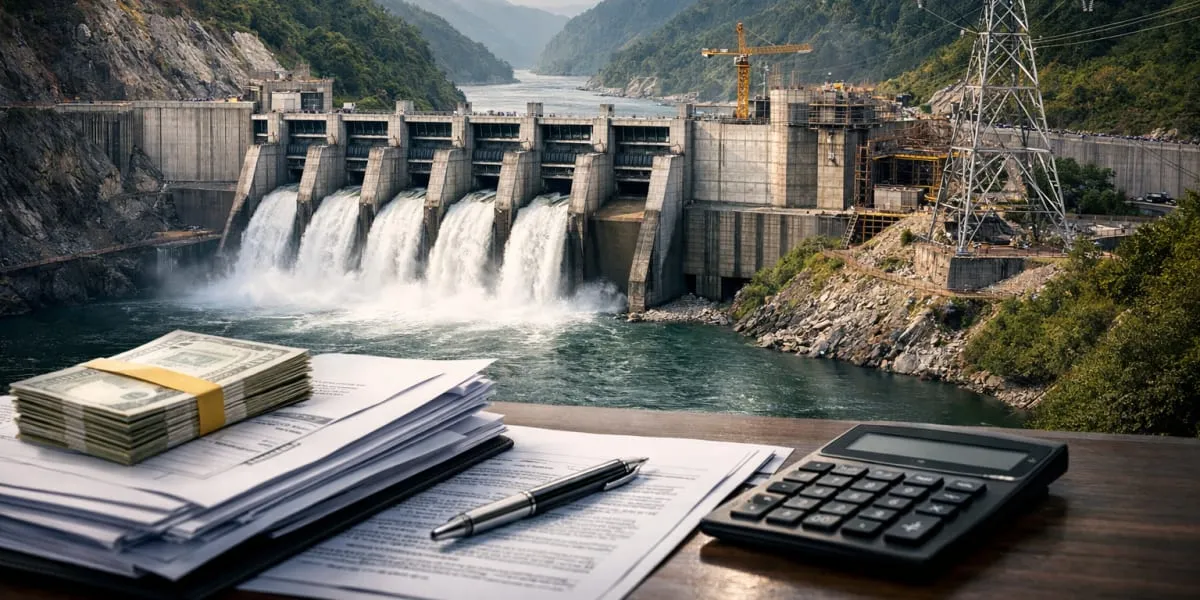
The Cabinet Committee on Economic Affairs, chaired by the Prime Minister, approved an investment of Rs141,058.3 million (mn) for construction of the Kalai-II hydro electric project on the Lohit river in Anjaw District, Arunachal Pradesh. The project has an installed capacity of 1,200 megawatt (MW) comprising six units of 190 MW and one unit of 60 MW and is expected to be completed in 78 months. It is projected to generate 4,852.95 million units annually, strengthening state power supply and aiding peak demand management. As the first hydro project in the Lohit Basin it will contribute to balancing the national grid.

The project will be implemented through a joint venture company between THDC India Limited and the government of Arunachal Pradesh. The Government of India will extend Rs5,998.8 million as budgetary support for construction of roads, bridges and associated transmission line under enabling infrastructure and will provide Rs7,500 million as central financial assistance for the state equity. The structure is intended to mobilise resources and reduce the upfront burden on the state. The estimated completion period remains 78 months.

The state will receive 12 per cent free power and an additional one per cent earmarked for the Local Area Development Fund, alongside infrastructure development and socio-economic benefits for the region. The scheme anticipates significant improvement in local infrastructure including development of around 29 kilometres of roads and bridges which will be available for local use. Local communities are expected to benefit from compensation, employment and corporate social responsibility activities linked to the project. These measures are planned to support regional development and livelihoods.

Implementation of the Kalai-II hydro electric project is expected to support national energy objectives by adding substantial regulated capacity and improving grid stability. The joint venture approach is designed to combine central and state resources to deliver complex infrastructure in a challenging terrain. Monitoring and phased execution are expected to align construction with environmental and social safeguards and local needs. The project timeline and financial support aim to ensure timely delivery and long-term benefits for Arunachal Pradesh.

The Cabinet Committee on Economic Affairs, chaired by the Prime Minister, approved an investment of Rs141,058.3 million (mn) for construction of the Kalai-II hydro electric project on the Lohit river in Anjaw District, Arunachal Pradesh. The project has an installed capacity of 1,200 megawatt (MW) comprising six units of 190 MW and one unit of 60 MW and is expected to be completed in 78 months. It is projected to generate 4,852.95 million units annually, strengthening state power supply and aiding peak demand management. As the first hydro project in the Lohit Basin it will contribute to balancing the national grid. The project will be implemented through a joint venture company between THDC India Limited and the government of Arunachal Pradesh. The Government of India will extend Rs5,998.8 million as budgetary support for construction of roads, bridges and associated transmission line under enabling infrastructure and will provide Rs7,500 million as central financial assistance for the state equity. The structure is intended to mobilise resources and reduce the upfront burden on the state. The estimated completion period remains 78 months. The state will receive 12 per cent free power and an additional one per cent earmarked for the Local Area Development Fund, alongside infrastructure development and socio-economic benefits for the region. The scheme anticipates significant improvement in local infrastructure including development of around 29 kilometres of roads and bridges which will be available for local use. Local communities are expected to benefit from compensation, employment and corporate social responsibility activities linked to the project. These measures are planned to support regional development and livelihoods. Implementation of the Kalai-II hydro electric project is expected to support national energy objectives by adding substantial regulated capacity and improving grid stability. The joint venture approach is designed to combine central and state resources to deliver complex infrastructure in a challenging terrain. Monitoring and phased execution are expected to align construction with environmental and social safeguards and local needs. The project timeline and financial support aim to ensure timely delivery and long-term benefits for Arunachal Pradesh.

Next Story
Infrastructure Energy

India Adds Record 44.61 GW Solar Capacity in FY2026

India’s solar sector reached a milestone in FY2026, with cumulative installed capacity crossing 150 GW and annual additions hitting a record 44.61 GW, exceeding the government target of 34 GW and nearly doubling FY2025’s 23.83 GW. Distributed Renewable Energy contributed 16.3 GW, while PPA and C&I segments accounted for 34 per cent and 30 per cent, respectively.India has risen from 9th globally in 2015 to 3rd in cumulative solar capacity by 2025 and is set to become the world’s second-largest solar market in annual installations in 2026. Seven states, led by Rajasthan and Gujarat, ac..

Next Story
Real Estate

Abhee Ventures unveils Scottish-themed 45-acre township in Bengaluru

Abhee Ventures, a leading South Indian real estate developer, has announced “Codename New Dimension,” a 45-acre Scottish-themed residential township at Gunjur on Whitefield–Sarjapur Road, Bengaluru. Strategically located between Whitefield and Sarjapur Road, Gunjur benefits from strong connectivity to the Outer Ring Road IT corridor, ITPL, EPIP, the upcoming Dommasandra Metro Station, and the proposed SWIFT City and Peripheral Ring Road.The township, designed in collaboration with London-based UHA London and India’s RSP Architects, offers low-density living with 85 per cent open spaces..

Next Story
Infrastructure Urban

BPE launches world’s thinnest Active Tile for legacy data centres

Best Power Equipments (India) Pvt Ltd (BPE), a leading provider of power solutions, data centre systems, and Battery Energy Storage Systems (BESS), has launched the BPE Active Tile, the world’s thinnest active tile designed for legacy data centres and telecom infrastructure. At just 65 mm thick, the tile requires significantly less space than conventional active tiles, which need nearly 450 mm floor depth.“Most legacy data centres were built decades ago for lower IT loads and traditional airflow patterns,” said A Prabhu, Executive Director – Technical (Global Operations), BPE. “As ra..

Advertisement

Subscribe to Our Newsletter

Get daily newsletters around different themes from Construction world.

STAY CONNECTED

Advertisement

Advertisement

Advertisement