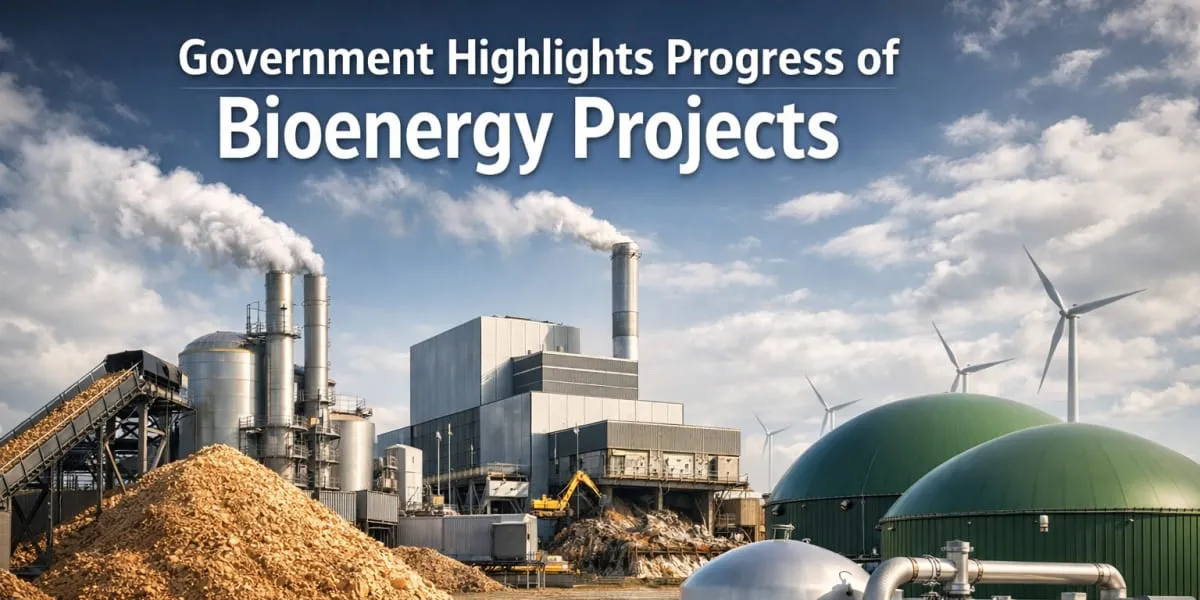
Government Highlights Progress of Bioenergy Projects
POWER & RENEWABLE ENERGY

Government Highlights Progress of Bioenergy Projects

The Ministry of New and Renewable Energy outlined progress of bioenergy projects and provided year-wise data as of 28 February 2026 based on information from the Central Electricity Authority. The ministry defined megawatt (MW) as the unit for installed capacity and million (mn) for large energy and emission quantities. Installed biomass capacity rose to 387.8 MW in financial year 2024-25 while waste to energy capacity reached 254.41 MW and biogas plants numbered 12,067.

Annual generation in million (mn) units showed variation across the five years covered by the authority, with biomass generation recorded at 3,738.674 mn units and bagasse generation at 9,335.316625 mn units in 2024-25. Earlier years showed biomass generation of 3,512.978 mn units in 2020-21 and 3,161.323 mn units in 2022-23, reflecting a mixed trend. The data emphasised the role of different bioenergy streams in augmenting the country’s renewable mix.

The authority said co-firing of carbon neutral biomass pellets with coal in thermal power plants prevented about five point seven million (mn) tonnes (t) of carbon dioxide since the initiative began in financial year 2019–20. Benefits included reduced fossil fuel use, avoidance of open burning of agricultural residues and improved regional air quality through lower particulate emissions. Key barriers to scaling were aggregation and year round storage of feedstock and relatively high capital cost per megawatt compared with solar and wind.

The ministry outlined initiatives under the National Bioenergy Programme and support for briquette, pellet and compressed biogas plants, and incentives under the Crop Residue Management scheme that provide financial assistance of fifty per cent to farmers and eighty per cent to rural entrepreneurs and cooperatives. Financial support of Rs. 15.0 mn for paddy supply chain projects was noted and the scheme is not applicable in Maharashtra. Additional support from the Central Pollution Control Board, the Ministry of Petroleum and Natural Gas and the Ministry of Housing and Urban Affairs was set out to promote pelletisation, biomass aggregation and urban waste to energy facilities, and the minister presented the information to the Rajya Sabha.

The Ministry of New and Renewable Energy outlined progress of bioenergy projects and provided year-wise data as of 28 February 2026 based on information from the Central Electricity Authority. The ministry defined megawatt (MW) as the unit for installed capacity and million (mn) for large energy and emission quantities. Installed biomass capacity rose to 387.8 MW in financial year 2024-25 while waste to energy capacity reached 254.41 MW and biogas plants numbered 12,067. Annual generation in million (mn) units showed variation across the five years covered by the authority, with biomass generation recorded at 3,738.674 mn units and bagasse generation at 9,335.316625 mn units in 2024-25. Earlier years showed biomass generation of 3,512.978 mn units in 2020-21 and 3,161.323 mn units in 2022-23, reflecting a mixed trend. The data emphasised the role of different bioenergy streams in augmenting the country’s renewable mix. The authority said co-firing of carbon neutral biomass pellets with coal in thermal power plants prevented about five point seven million (mn) tonnes (t) of carbon dioxide since the initiative began in financial year 2019–20. Benefits included reduced fossil fuel use, avoidance of open burning of agricultural residues and improved regional air quality through lower particulate emissions. Key barriers to scaling were aggregation and year round storage of feedstock and relatively high capital cost per megawatt compared with solar and wind. The ministry outlined initiatives under the National Bioenergy Programme and support for briquette, pellet and compressed biogas plants, and incentives under the Crop Residue Management scheme that provide financial assistance of fifty per cent to farmers and eighty per cent to rural entrepreneurs and cooperatives. Financial support of Rs. 15.0 mn for paddy supply chain projects was noted and the scheme is not applicable in Maharashtra. Additional support from the Central Pollution Control Board, the Ministry of Petroleum and Natural Gas and the Ministry of Housing and Urban Affairs was set out to promote pelletisation, biomass aggregation and urban waste to energy facilities, and the minister presented the information to the Rajya Sabha.

Next Story
Infrastructure Transport

Noida Emerges as Key Economic Hub: Cushman Report

Cushman & Wakefield’s recent report, Noida Runway for Growth, highlights the city’s emergence as a major economic and real estate hub contributing nearly 10 per cent to Uttar Pradesh’s GSDP. A key driver is the upcoming Noida International Airport, which will be inaugurated by Prime Minister Narendra Modi on March 28 in Gautam Buddha Nagar's Jewar. The project is set to enhance connectivity and reshape the region’s economic and real estate landscape. Noida’s office market has expanded to 43.4 million sq ft, including 26.6 million sq ft of Grade A+ assets, with a 40 per cent..

Next Story
Real Estate

Bent Collective Unveils Sculptural Ravon Chair

Bent Collective has recently introduced the Ravon Chair, a striking design piece that redefines the intersection of art and functionality. Characterised by sharp geometry, bold angles, and a vivid marbled finish, the chair stands out as a sculptural element rather than conventional seating.Designed with a strong architectural language, the Ravon Chair features clean lines and intersecting planes that create a dynamic silhouette. Its distinctive triangular cut-out detail enhances depth and asymmetry, allowing light and shadow to interact across its surface. Finished in a rich red marbled patter..

Next Story
Infrastructure Transport

DP World Opens Golf Clubhouse in Gurugram

DP World has delivered a permanent clubhouse to ZEN Golf Range & Academy in Gurugram, strengthening grassroots golf development in India ahead of the Hero Indian Open. The facility marks the second under its global clubhouse programme, following the first in Cape Town in 2025.Constructed using a repurposed shipping container, the clubhouse provides golf equipment, sheltered training areas, and a dedicated space for young players to build both sporting and life skills. The initiative aligns with DP World’s broader commitment to community development across its global operations.India cont..

Advertisement

Subscribe to Our Newsletter

Get daily newsletters around different themes from Construction world.

STAY CONNECTED

Advertisement

Advertisement

Advertisement