India’s Solar Module Capacity Faces Cell Supply Gap
POWER & RENEWABLE ENERGY

India’s Solar Module Capacity Faces Cell Supply Gap

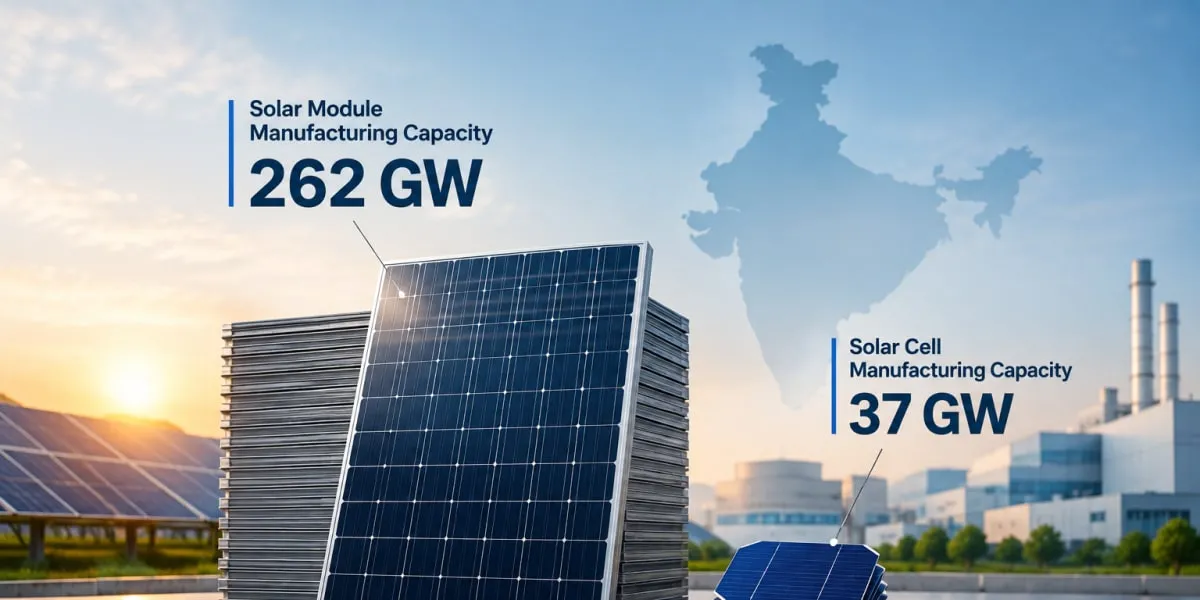
India has reported solar module manufacturing capacity of about 262 GW, compared with around 37 GW of cell capacity as of October 2026, highlighting a significant imbalance in the renewable-energy supply chain. The gap has emerged as manufacturers expand module production while domestic availability of cells and upstream components remains more limited.

Solex Energy is considering investments in the United States as part of a $1.5 bn roadmap through 2030, according to chairman and managing director Chetan Shah. The Gujarat-based company currently operates a 4 GW module facility and plans to increase module capacity to 10 GW. It is also establishing 10 GW of cell capacity and 2 GW of ingot and wafer production.

The proposed US facilities remain under evaluation, with locations, investment requirements and other details yet to be disclosed. Solex is assessing the opportunities in response to US demand for clean-energy components and trade conditions affecting Chinese imports. The company has not announced a construction schedule or final investment allocation between India and the US.

The capacity figures require caution because installed capacity does not necessarily represent operating output. Shah said much of India’s module capacity uses older mono PERC technology and that several facilities are non-operational, while newer plants have been established for TOPCon modules. The information available does not provide utilisation rates, production volumes or a technology-wise breakdown of functioning plants, preventing a precise assessment of the effective gap.

The issue also has implications for India’s Approved List of Models and Manufacturers framework, or ALMM-II, which links solar deployment to approved domestic sourcing. Shah said the industry supports the government’s objectives but has sought an extension of ALMM-II by at least 12 months because of current cell availability. That remains an industry request rather than a government decision.

Solex’s plans illustrate the need to assess manufacturing strength by operational capacity and supply-chain depth rather than headline announcements alone. The company’s next disclosures will need to clarify the commissioning timeline for its Indian facilities, the usability of existing module capacity and the location and scale of its proposed US projects.

India has reported solar module manufacturing capacity of about 262 GW, compared with around 37 GW of cell capacity as of October 2026, highlighting a significant imbalance in the renewable-energy supply chain. The gap has emerged as manufacturers expand module production while domestic availability of cells and upstream components remains more limited. Solex Energy is considering investments in the United States as part of a $1.5 bn roadmap through 2030, according to chairman and managing director Chetan Shah. The Gujarat-based company currently operates a 4 GW module facility and plans to increase module capacity to 10 GW. It is also establishing 10 GW of cell capacity and 2 GW of ingot and wafer production. The proposed US facilities remain under evaluation, with locations, investment requirements and other details yet to be disclosed. Solex is assessing the opportunities in response to US demand for clean-energy components and trade conditions affecting Chinese imports. The company has not announced a construction schedule or final investment allocation between India and the US. The capacity figures require caution because installed capacity does not necessarily represent operating output. Shah said much of India’s module capacity uses older mono PERC technology and that several facilities are non-operational, while newer plants have been established for TOPCon modules. The information available does not provide utilisation rates, production volumes or a technology-wise breakdown of functioning plants, preventing a precise assessment of the effective gap. The issue also has implications for India’s Approved List of Models and Manufacturers framework, or ALMM-II, which links solar deployment to approved domestic sourcing. Shah said the industry supports the government’s objectives but has sought an extension of ALMM-II by at least 12 months because of current cell availability. That remains an industry request rather than a government decision. Solex’s plans illustrate the need to assess manufacturing strength by operational capacity and supply-chain depth rather than headline announcements alone. The company’s next disclosures will need to clarify the commissioning timeline for its Indian facilities, the usability of existing module capacity and the location and scale of its proposed US projects.

Related Stories

Gold Stories

Next Story
Real Estate

WSB Real Estate Partners Exits Six Housing Investments

WSB Real Estate Partners recently announced the successful exit of six residential investments across Bengaluru, Mumbai Metropolitan Region (MMR) and National Capital Region (NCR), delivering an average internal rate of return (IRR) of 19–21 per cent and an overall investment return of 1.4 times.The real estate-focused investment firm invested approximately Rs 7 billion across six mid-affordable housing projects over the past four years. All six investments were fully repaid between April and November 2026, several months ahead of their original investment tenures.WSB collaborated with sever..

Next Story
Infrastructure Transport

Aluminium Industry Seeks Policy Support for Rs 4 Trillion Investment

The Aluminium Association of India (AAI) has recently urged the government to introduce supportive policy measures to safeguard the sector’s proposed Rs 4 trillion investment pipeline. The association highlighted the need for a predictable policy framework to strengthen domestic manufacturing, expand production capacity and reduce import dependence.AAI submitted its recommendations for the Union Budget 2027-28 to the Ministries of Finance, Commerce and Industry, and Mines, along with the Department for Promotion of Industry and Internal Trade (DPIIT).India’s aluminium demand is projected t..

Next Story
Technology

ABB Unveils Intelligent Motor to Accelerate Industrial AI Adoption

ABB recently launched Intelleqt, which it describes as the world’s first low-voltage motor with factory-integrated intelligence, at the SPS trade fair in Germany. Designed to deliver real-time operational insights from its first rotation, the motor enables industrial operators to integrate equipment-level data into existing digital platforms while retaining full ownership of their data.The launch addresses growing challenges in scaling artificial intelligence (AI) across industrial operations, particularly data quality and availability. According to Deloitte, while 84 per cent of manufacture..

Advertisement

Subscribe to Our Newsletter

Get daily newsletters around different themes from Construction world.

STAY CONNECTED

Advertisement

SPECIAL OFFER
QR Code