

Initiatives For Uninterrupted Power Supply
POWER & RENEWABLE ENERGY

Initiatives For Uninterrupted Power Supply

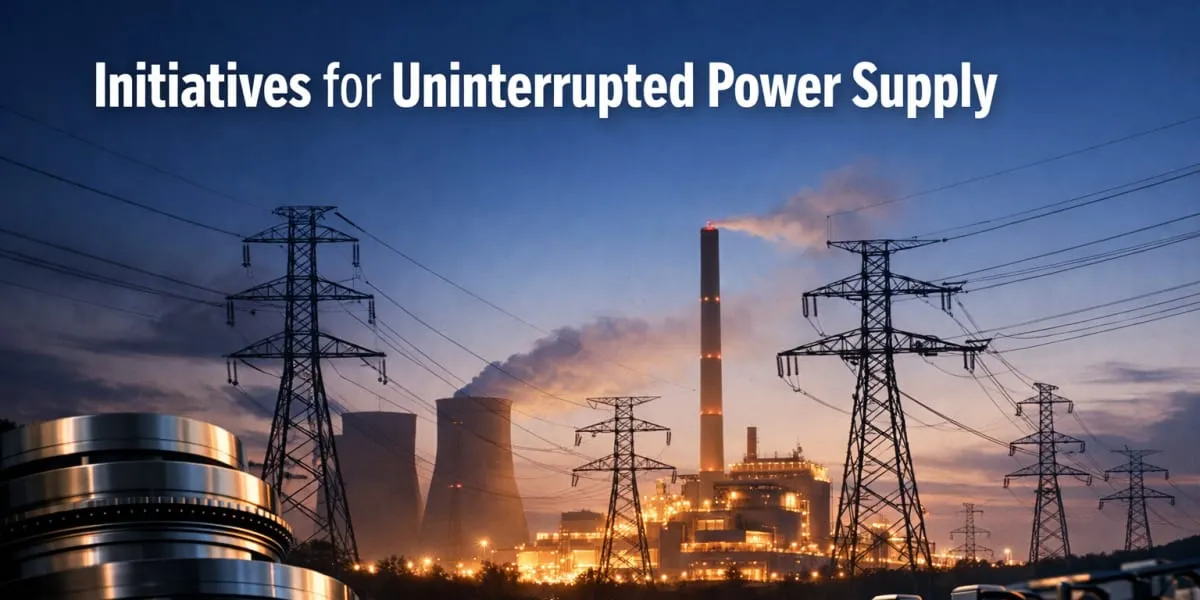
Electricity is a concurrent subject and supply and distribution remain the responsibility of State Governments and distribution utilities. The Electricity (Rights of Consumers) Rules, 2020 require distribution licensees to supply 24x7 power to all consumers while commissions may specify lower hours for some categories. The Ministry of Power outlined initiatives to achieve uninterrupted supply nationwide.

Since 2014, 296,388 MW of generation capacity has been added and total installed generation reached 520,511 MW by January 2026. Transmission additions include 212,325 circuit kilometre of lines and inter regional capacity additions of 84,390 MW, while renewable energy capacity commissioned stood at around 263 GW. The national grid and intra state transmission are being strengthened to integrate growing renewable capacity.

In distribution, projects worth Rs 1.85 tn were executed under DDUGJY, SAUBHAGYA and IPDS, adding substations, upgrading existing stations, installing 696,302 distribution transformers, separating 7,833 feeders and adding or upgrading 840,000 circuit kilometre of HT and LT lines. The schemes closed on 31 March 2022. Under the Revamped Distribution Sector Scheme, Rs 2.83 tn has been sanctioned for loss reduction and smart metering linked to state performance, and AT&C losses fell from 21.91 per cent in FY21 to 15.04 per cent in FY25.

Availability of supply in rural areas rose from 12.5 hours in FY2015 to 22.6 hours in FY2025 while urban availability reached 23.6 hours in FY2025. The National Electricity Plan projects expansion of the 220 kV and above network to 648,000 circuit kilometre with transformation capacity rising to 2,345 Giga Volt Ampere (GVA) by 2031–32 and inter regional transmission capacity planned to increase from 120 GW in January 2026 to 168 GW by 2032. The Ministry is administering a viability gap funding scheme for 13,850 MWh of battery energy storage system (BESS) capacity with budgetary support of Rs 37.6 bn and has approved support for 30 GWh through the Power System Development Fund, with advanced Flexible Alternating Current Transmission Systems (FACTS) devices and synchronous condensers to address dynamic grid needs.

Electricity is a concurrent subject and supply and distribution remain the responsibility of State Governments and distribution utilities. The Electricity (Rights of Consumers) Rules, 2020 require distribution licensees to supply 24x7 power to all consumers while commissions may specify lower hours for some categories. The Ministry of Power outlined initiatives to achieve uninterrupted supply nationwide. Since 2014, 296,388 MW of generation capacity has been added and total installed generation reached 520,511 MW by January 2026. Transmission additions include 212,325 circuit kilometre of lines and inter regional capacity additions of 84,390 MW, while renewable energy capacity commissioned stood at around 263 GW. The national grid and intra state transmission are being strengthened to integrate growing renewable capacity. In distribution, projects worth Rs 1.85 tn were executed under DDUGJY, SAUBHAGYA and IPDS, adding substations, upgrading existing stations, installing 696,302 distribution transformers, separating 7,833 feeders and adding or upgrading 840,000 circuit kilometre of HT and LT lines. The schemes closed on 31 March 2022. Under the Revamped Distribution Sector Scheme, Rs 2.83 tn has been sanctioned for loss reduction and smart metering linked to state performance, and AT&C losses fell from 21.91 per cent in FY21 to 15.04 per cent in FY25. Availability of supply in rural areas rose from 12.5 hours in FY2015 to 22.6 hours in FY2025 while urban availability reached 23.6 hours in FY2025. The National Electricity Plan projects expansion of the 220 kV and above network to 648,000 circuit kilometre with transformation capacity rising to 2,345 Giga Volt Ampere (GVA) by 2031–32 and inter regional transmission capacity planned to increase from 120 GW in January 2026 to 168 GW by 2032. The Ministry is administering a viability gap funding scheme for 13,850 MWh of battery energy storage system (BESS) capacity with budgetary support of Rs 37.6 bn and has approved support for 30 GWh through the Power System Development Fund, with advanced Flexible Alternating Current Transmission Systems (FACTS) devices and synchronous condensers to address dynamic grid needs.

Next Story
Real Estate

ONE Atmosphere Launches Luxury Suites in Gurugram

M3M India, in collaboration with global hospitality brand ONE Atmosphere, has launched the ‘ONE Atmosphere Suites – Corner Walk’ in Gurugram. This debut development in India will feature 256 fully serviced luxury suites, with operations set to begin in winter 2026.The project combines residential living with top-tier hospitality services, designed for business travellers, project professionals, and long-stay guests. It emphasises flexibility, space, and efficiency, reflecting Atmosphere Core’s award-winning Maldives-born hospitality philosophy.Salil Panigrahi, Co-Founder and Managing D..

Next Story
Infrastructure Urban

Tembo Global Signs NDA with Defence PSU for Engineering Collaboration

Tembo Global Industries (NSE: TEMBO) has announced that its subsidiary, Tembo Classic Engineering Private, has signed a Non-Disclosure Agreement (NDA) with a prominent Public Sector Undertaking (PSU) in India's defence sector.This strategic move aims to explore opportunities for the design, development, and manufacturing of engineering products tailored for defence applications, aligning with the Government of India’s Atmanirbhar Bharat initiative to strengthen self-reliance in defence manufacturing. The discussions are exploratory and do not guarantee any future business agreements.“We ar..

Next Story
Infrastructure Energy

Hitachi Launches Plant-Based "GREEN SCREW OIL" for Air Compressors

Hitachi Industrial Equipment Systems (HIES) has introduced ""GREEN SCREW OIL,"" a plant-based lubricant designed for oil-flooded screw air compressors. By utilising plant-derived raw materials that absorb CO? during growth, this lubricant reduces CO? emissions during manufacturing by approximately 90 per cent. Over its entire lifecycle, including disposal, CO? emissions are reduced by 40 per cent compared to conventional synthetic oils.This product aligns with Hitachi's sustainability strategy, supporting decarbonisation under the ""PLEDGES"" framework and enhancing the environmental value of ..

Advertisement

Subscribe to Our Newsletter

Get daily newsletters around different themes from Construction world.

STAY CONNECTED

Advertisement

Advertisement

Advertisement