IRM Energy Commissions 150th CNG Station At Banaskantha
POWER & RENEWABLE ENERGY

IRM Energy Commissions 150th CNG Station At Banaskantha

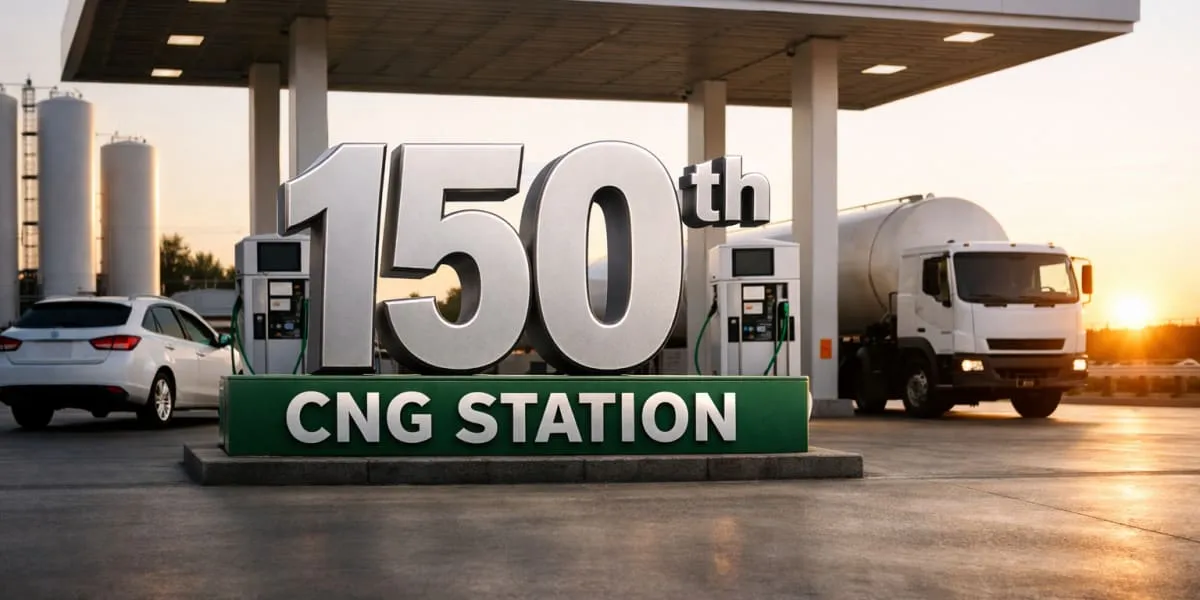
IRM Energy Limited (IRMEL) announced the commissioning of its 150th Compressed Natural Gas (CNG) station at Banaskantha on 31 March 2026, a milestone that underscores the company's expansion in the city gas distribution sector. The company said that a total of 39 CNG stations were commissioned during the financial year 2026, reflecting an accelerated deployment pace. The development is presented as part of a broader strategy to strengthen green energy infrastructure and to promote sustainable and eco-friendly transportation solutions across its authorised territories.

IRMEL is an Indian City Gas Distribution company operating under authorisations granted by the Petroleum and Natural Gas Regulatory Board. It supplies Compressed Natural Gas for the transport segment and Piped Natural Gas (PNG) for domestic, commercial and industrial customers, with CNG identified as the primary growth driver. The company indicated that expansion of its CNG network is intended to enhance fuel access for consumers and to support a modal shift towards lower emission transport.

The firm holds authorisation for four Geographical Areas: Banaskantha in Gujarat; Fatehgarh Sahib in Punjab; Diu and Gir Somnath in Gujarat; and Namakkal and Tiruchirappalli in Tamil Nadu, and it is pursuing network densification within these zones. CNG contributes about 60 per cent of volumes, demonstrating its central role in the company's operational mix. Continued commissioning of stations is expected to improve last mile connectivity and operational resilience across the authorised areas.

The commissioning of the 150th station is described by the company as a step on a sustained growth trajectory that seeks to scale up distribution capacity while adhering to regulatory frameworks. The recent additions during the financial year are intended to improve customer convenience, increase network coverage and support broader decarbonisation objectives in the transport sector. The company said it will continue to expand its footprint expeditiously in its authorised geographical areas.

IRM Energy Limited (IRMEL) announced the commissioning of its 150th Compressed Natural Gas (CNG) station at Banaskantha on 31 March 2026, a milestone that underscores the company's expansion in the city gas distribution sector. The company said that a total of 39 CNG stations were commissioned during the financial year 2026, reflecting an accelerated deployment pace. The development is presented as part of a broader strategy to strengthen green energy infrastructure and to promote sustainable and eco-friendly transportation solutions across its authorised territories. IRMEL is an Indian City Gas Distribution company operating under authorisations granted by the Petroleum and Natural Gas Regulatory Board. It supplies Compressed Natural Gas for the transport segment and Piped Natural Gas (PNG) for domestic, commercial and industrial customers, with CNG identified as the primary growth driver. The company indicated that expansion of its CNG network is intended to enhance fuel access for consumers and to support a modal shift towards lower emission transport. The firm holds authorisation for four Geographical Areas: Banaskantha in Gujarat; Fatehgarh Sahib in Punjab; Diu and Gir Somnath in Gujarat; and Namakkal and Tiruchirappalli in Tamil Nadu, and it is pursuing network densification within these zones. CNG contributes about 60 per cent of volumes, demonstrating its central role in the company's operational mix. Continued commissioning of stations is expected to improve last mile connectivity and operational resilience across the authorised areas. The commissioning of the 150th station is described by the company as a step on a sustained growth trajectory that seeks to scale up distribution capacity while adhering to regulatory frameworks. The recent additions during the financial year are intended to improve customer convenience, increase network coverage and support broader decarbonisation objectives in the transport sector. The company said it will continue to expand its footprint expeditiously in its authorised geographical areas.

Next Story
Infrastructure Transport

Contracts, Corridors and Cash Flows

India’s roads sector enters 2026 at a decisive junction, where the conversation is no longer about kilometres alone but contracts that allocate risk wisely, corridors that unlock economic value, and cash flows that remain credible over the long term. After more than a decade of relentless expansion, India’s road-building ecosystem is moving into a phase of maturity – where engineering complexity, financial discipline and institutional coordination matter more than sheer scale.Between 2014 and 2024, India built highways at a pace few nations have ever matched. National Highway length expa..

Next Story
Real Estate

The Walled Garden

I am not suggesting Indian architects are inadequate. The profession has produced extraordinary work – from Charles Correa's quiet humanism to Balkrishna Doshi's Nobel-recognised genius. However, the regulatory barriers meant to protect the profession are holding it back. It is time for an honest conversation about this.The Architects Act of 1972 established the Council of Architecture (COA) as the statutory body regulating architecture practice in India. Its founding logic was sound: to ensure those calling themselves architects meet a minimum standard of competence and to protect the publi..

Next Story
Real Estate

We completed a 1BHK home on a private island in 7 days!

Reimagining construction through a ‘War on Waste’, Circato founders T Paul Koshy, Sushma Joseph and Praveen Crasta speak to CW on turning single-use plastic into high-performance building systems – demonstrated at Bengaluru International Airport with a 16-ft wall installed in just 48 hours.What specific gap in the construction ecosystem led to the creation of Circato?Sushma Joseph: We felt the industry had normalised inefficiency. In construction, timelines, costs and outcomes often remain uncertain, yet that is widely accepted. We wanted to show that inefficiencies can be..

Advertisement

Subscribe to Our Newsletter

Get daily newsletters around different themes from Construction world.

STAY CONNECTED

Advertisement

Advertisement

Advertisement