+
MNRE Amends ALMM Procedure For Wind Turbines
POWER & RENEWABLE ENERGY

MNRE Amends ALMM Procedure For Wind Turbines

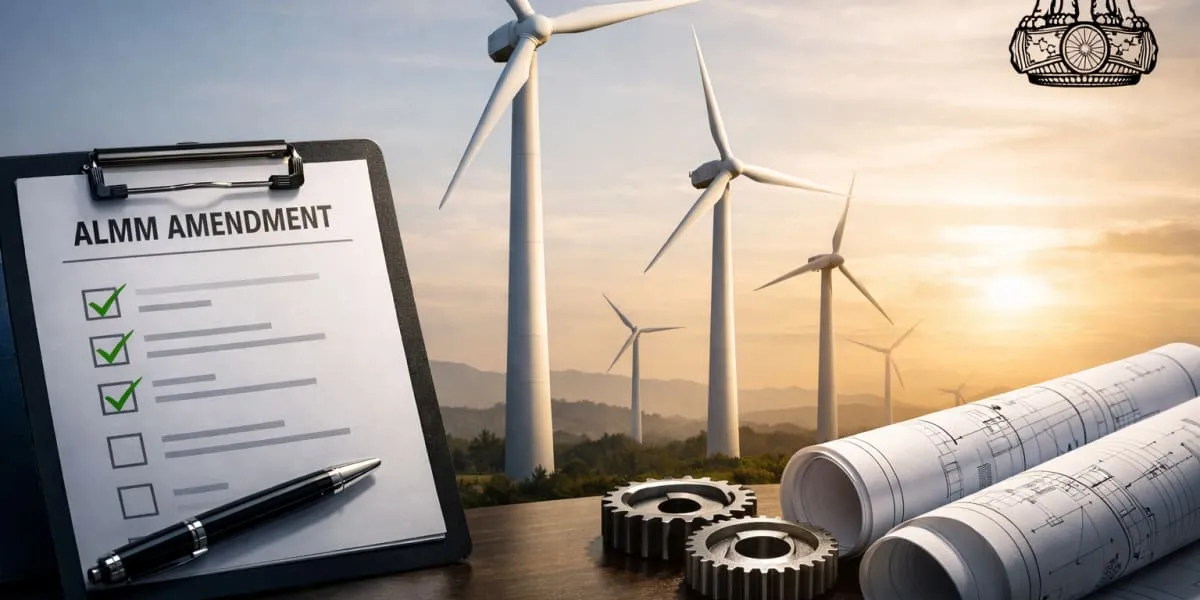
The Ministry of New and Renewable Energy (MNRE) has issued an amendment to the procedure for inclusion and updating of Wind Turbine Models in the Approved List of Models and Manufacturers (ALMM) for wind turbines. The amendment is designed to provide relief to ongoing wind power projects in India in light of persistent supply chain constraints. The ministry framed the amendment to offer temporary regulatory flexibility while preserving long-term safety and performance expectations for turbines. The ministry said the measure seeks to balance technical compliance with practical project execution needs.

The amendment modifies provisions of an earlier order issued on 31 July 2025 and focuses on compliance requirements for critical components. The revised procedure clarifies standards and timelines related to main bearings, yaw bearings and pitch bearings while seeking to avoid disrupting project schedules. The clarification also aims to give developers greater predictability when planning procurement and construction schedules.

Projects where bids were closed before 31 July 2025 and that are scheduled to be commissioned within three years of the issuance of the earlier order will be exempted from compliance with the amended requirements. The main bearings requirement will not apply to projects already bid or to be bid before 31 July 2027 and the mandate will be implemented only after a review of supply chain conditions. The approach is intended to protect projects that are already in advanced stages of procurement and construction. Developers and manufacturers are expected to coordinate closely to align supply with revised compliance windows.

Additional exemptions will apply to wind projects to be commissioned within 18 months from 31 July 2025 under captive, open access or third-party sale modes. Those projects will receive a one-year exemption for compliance related to yaw and pitch bearings until 31 January 2028 and a two-year exemption for main bearing requirements until 31 January 2029. All other provisions of the 31 July 2025 order remain unchanged and the amendment has been issued with the approval of the competent authority to support project execution timelines while addressing supply chain challenges.

The Ministry of New and Renewable Energy (MNRE) has issued an amendment to the procedure for inclusion and updating of Wind Turbine Models in the Approved List of Models and Manufacturers (ALMM) for wind turbines. The amendment is designed to provide relief to ongoing wind power projects in India in light of persistent supply chain constraints. The ministry framed the amendment to offer temporary regulatory flexibility while preserving long-term safety and performance expectations for turbines. The ministry said the measure seeks to balance technical compliance with practical project execution needs. The amendment modifies provisions of an earlier order issued on 31 July 2025 and focuses on compliance requirements for critical components. The revised procedure clarifies standards and timelines related to main bearings, yaw bearings and pitch bearings while seeking to avoid disrupting project schedules. The clarification also aims to give developers greater predictability when planning procurement and construction schedules. Projects where bids were closed before 31 July 2025 and that are scheduled to be commissioned within three years of the issuance of the earlier order will be exempted from compliance with the amended requirements. The main bearings requirement will not apply to projects already bid or to be bid before 31 July 2027 and the mandate will be implemented only after a review of supply chain conditions. The approach is intended to protect projects that are already in advanced stages of procurement and construction. Developers and manufacturers are expected to coordinate closely to align supply with revised compliance windows. Additional exemptions will apply to wind projects to be commissioned within 18 months from 31 July 2025 under captive, open access or third-party sale modes. Those projects will receive a one-year exemption for compliance related to yaw and pitch bearings until 31 January 2028 and a two-year exemption for main bearing requirements until 31 January 2029. All other provisions of the 31 July 2025 order remain unchanged and the amendment has been issued with the approval of the competent authority to support project execution timelines while addressing supply chain challenges.

Next Story
Building Material

NITI Aayog Unveils Cement Decarbonisation Roadmap

NITI Aayog has released a sector-specific decarbonisation roadmap for cement as part of three green transition reports covering cement, aluminium and MSMEs. The report projects cement production rising to around 2,100 million tonnes by 2070 from 391 million tonnes in 2023, while targeting a reduction in carbon intensity to 0.09–0.13 tCO₂e per tonne. It recommends clinker substitution, refuse-derived fuels, CCUS adoption and carbon trading mechanisms to enable deep decarbonisation. ..

Next Story
Technology

Genesys Launches Advanced GeoRadar System

Genesys International Corporation has launched an advanced Ground Penetrating Radar (GPR) solution from IDS GeoRadar for underground utility mapping in India. The system uses patented Equalised Scrambling Technology (EST) and Wide/Multi-Array Antenna Technology to deliver high-resolution three-dimensional imaging of subsurface infrastructure. The technology enables the detection and mapping of buried assets such as water pipelines, sewer networks, telecom cables and power lines. By providing detailed subsurface insights, the system aims to help urban authorities and infrastructure developers ..

Next Story
Infrastructure Urban

Hindustan Zinc Partners Virginia Tech to Boost Silver Recovery

Hindustan Zinc Limited recently signed a Memorandum of Understanding (MoU) with Virginia Tech to advance research aimed at improving silver recovery across its lead–zinc (Pb–Zn) concentrators. The collaboration will focus on refining flotation techniques and optimising reagent usage to improve concentrate quality and operational efficiency at processing plants.Virginia Tech, based in Blacksburg, Virginia, is globally recognised for its expertise in mining engineering, mineral processing and applied metallurgical research. Through this partnership, Hindustan Zinc will leverage global resear..

Advertisement

Subscribe to Our Newsletter

Get daily newsletters around different themes from Construction world.

STAY CONNECTED

Advertisement

Advertisement

Advertisement

Open In App