



NFR Achieves Record Rooftop Solar Capacity
POWER & RENEWABLE ENERGY

NFR Achieves Record Rooftop Solar Capacity

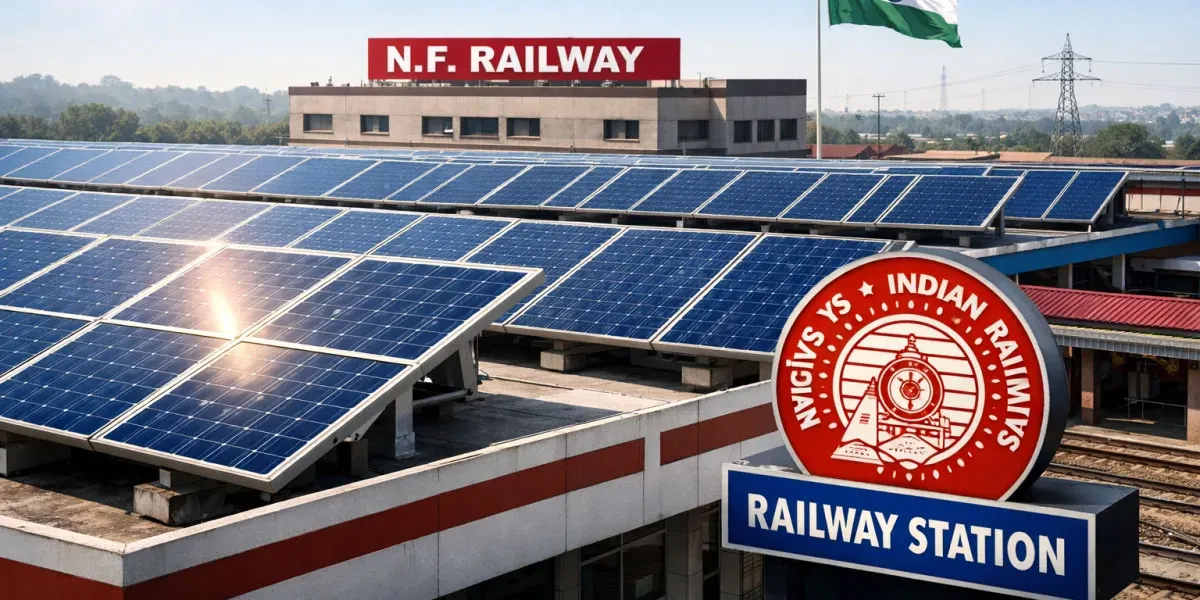
Northeast Frontier Railway has achieved a record rooftop solar capacity, marking a significant advance in its transition to renewable energy. The railway reported that the milestone reflects accelerated installation of solar panels across stations, service buildings and administrative offices and forms part of a broader Indian Railways initiative to reduce dependence on conventional power sources. The achievement is presented as improving operational resilience while supporting national objectives on clean energy. The move follows strategic planning and coordination with energy agencies and vendors.

Deployments have been spread across passenger stations, crew quarters and traction substations to harness rooftop area efficiently. The programme includes the addition of megawatt (MW) scale systems at selected facilities and smaller rooftop arrays at local stations to balance generation and demand. Officials indicated that on-site generation has reduced reliance on grid power during peak hours and has lowered energy expenditure for daily operations. Maintenance protocols have been standardised to ensure longevity and safety of installations.

The installations are expected to enhance energy security for critical services and to reduce greenhouse gas emissions linked to station operations. There is scope for integrating battery storage and for feeding surplus power into local grids where regulatory frameworks permit, thereby improving utilisation. Local contracting and training of technicians has been used to support the roll-out and to encourage skills development in surrounding communities. Monitoring systems and data collection have been deployed to measure performance and to inform scaling decisions.

Officials framed the achievement as aligned with wider governmental targets for sustainable transport and energy transition and said continued investments are anticipated. Future phases are expected to focus on optimisation of generation, adoption of energy efficiency measures and closer coordination with state utilities. The railway intends to publish periodic updates on capacity additions and operational outcomes to maintain transparency and to attract further investment in decentralised renewable projects. Observers noted that the progress may serve as a model for other zonal railways seeking to expand clean energy deployment.

Northeast Frontier Railway has achieved a record rooftop solar capacity, marking a significant advance in its transition to renewable energy. The railway reported that the milestone reflects accelerated installation of solar panels across stations, service buildings and administrative offices and forms part of a broader Indian Railways initiative to reduce dependence on conventional power sources. The achievement is presented as improving operational resilience while supporting national objectives on clean energy. The move follows strategic planning and coordination with energy agencies and vendors. Deployments have been spread across passenger stations, crew quarters and traction substations to harness rooftop area efficiently. The programme includes the addition of megawatt (MW) scale systems at selected facilities and smaller rooftop arrays at local stations to balance generation and demand. Officials indicated that on-site generation has reduced reliance on grid power during peak hours and has lowered energy expenditure for daily operations. Maintenance protocols have been standardised to ensure longevity and safety of installations. The installations are expected to enhance energy security for critical services and to reduce greenhouse gas emissions linked to station operations. There is scope for integrating battery storage and for feeding surplus power into local grids where regulatory frameworks permit, thereby improving utilisation. Local contracting and training of technicians has been used to support the roll-out and to encourage skills development in surrounding communities. Monitoring systems and data collection have been deployed to measure performance and to inform scaling decisions. Officials framed the achievement as aligned with wider governmental targets for sustainable transport and energy transition and said continued investments are anticipated. Future phases are expected to focus on optimisation of generation, adoption of energy efficiency measures and closer coordination with state utilities. The railway intends to publish periodic updates on capacity additions and operational outcomes to maintain transparency and to attract further investment in decentralised renewable projects. Observers noted that the progress may serve as a model for other zonal railways seeking to expand clean energy deployment.

Next Story
Real Estate

Housing Sales Dip 7 per cent QoQ Across Top Cities

India’s housing market saw a 7 per cent quarter-on-quarter decline in sales across the top seven cities in Q1 2026, with approximately 1,01,675 units sold compared to 1,08,970 units in Q4 2025, according to ANAROCK Group. However, on a yearly basis, sales rose 9 per cent, indicating continued underlying demand.The total sales value stood at around Rs 1.51 trillion, reflecting a 5 per cent quarterly drop but a 6 per cent annual increase. Mumbai Metropolitan Region and Bengaluru together accounted for nearly 48 per cent of total sales, while Chennai recorded the highest quarterly decline at 18..

Next Story
Real Estate

Birla Estates Enters Mumbai Redevelopment

Birla Estates has announced its entry into Mumbai’s redevelopment segment with a luxury residential project in Khar West, developed in partnership with Parinee Real Estate Builders. The project will redevelop Anmol Co-operative Housing Society and Bhartiya Bhavan Co-operative Housing Society, marking the company’s first redevelopment initiative in the Mumbai Metropolitan Region.Spread across 1.3 acres, the development will offer a saleable area of 2.9 lakh sq ft with an estimated revenue potential of Rs 17 billion. Positioned in one of Mumbai’s prime residential micro-markets, the projec..

Next Story
Infrastructure Urban

Hitachi, MUFG Expand EV Financing Model

Hitachi and MUFG Bank have expanded their NextGen business co-creation model to accelerate decarbonised mobility by financing electric vehicles and charging infrastructure. The renewed collaboration aims to address key barriers to electrification, including limited access to capital and the need for integrated energy solutions.Building on earlier partnerships, the expanded model extends beyond battery-focused solutions to include electric mobility assets, charging systems and energy management infrastructure across global markets. The initiative will leverage structured financing through speci..

Advertisement

Subscribe to Our Newsletter

Get daily newsletters around different themes from Construction world.

STAY CONNECTED

Advertisement

Advertisement

Advertisement