+
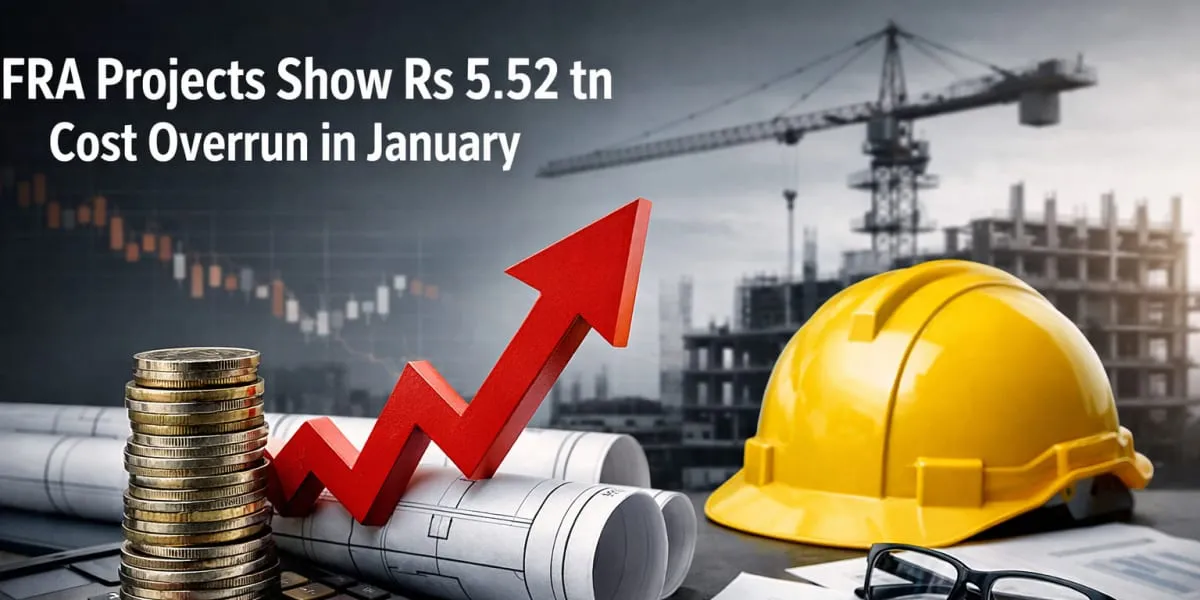
NFRA Projects Show Rs 5.52 tn Cost Overrun in January
POWER & RENEWABLE ENERGY

NFRA Projects Show Rs 5.52 tn Cost Overrun in January

A government report showed that NFRA projects recorded a cost overrun of Rs 5.52 trillion (tn) in January. The figures were published in the latest NFRA monthly update compiled by the Ministry of Statistics and Programme Implementation. The overrun reflected revised project costs across multiple ministries and sectors.

The remaining 149 projects, representing nine per cent of the project count, carried a combined revised cost of Rs 3.98 trillion (tn), equal to 10 per cent of the aggregated value, and were spread across higher education, civil aviation, steel, telecommunications, labour and employment, ports, shipping and waterways, health and family welfare, mines, DPIIT and sports. This spread underlines the cross-ministerial nature of the programme.

Transport and logistics accounted for the largest share of revised costs, amounting to Rs 20.65 trillion (tn) across 1,180 projects. The energy sector followed with Rs 10.84 trillion (tn) across 218 projects, representing 28 per cent of the aggregated revised cost, and thus drove a significant portion of the aggregate increase.

Communication infrastructure projects had a combined revised cost of Rs 2.74 trillion (tn) across 14 projects, while water and sanitation projects accounted for Rs 2.03 trillion (tn) across 70 projects. Social and commercial infrastructure comprised 74 projects with a revised cost of Rs 0.79 trillion (tn), and projects classified as others totalled Rs 2.18 trillion (tn) across 146 projects.

Three projects were commissioned during January 2026, including major works in the railway, power and petroleum and natural gas sectors. Notable commissioned schemes included the third railway line of 291 km between Patratu and Sonnagar with a revised cost of Rs 89.75 billion (bn), and a transmission scheme for evacuation of a 4.5 gigawatt (GW) injection at Khavda PS under Phase II?Part C valued at Rs 28.21 billion (bn). The commissioning activity was presented as part of ongoing efforts to speed project delivery.

A government report showed that NFRA projects recorded a cost overrun of Rs 5.52 trillion (tn) in January. The figures were published in the latest NFRA monthly update compiled by the Ministry of Statistics and Programme Implementation. The overrun reflected revised project costs across multiple ministries and sectors. The remaining 149 projects, representing nine per cent of the project count, carried a combined revised cost of Rs 3.98 trillion (tn), equal to 10 per cent of the aggregated value, and were spread across higher education, civil aviation, steel, telecommunications, labour and employment, ports, shipping and waterways, health and family welfare, mines, DPIIT and sports. This spread underlines the cross-ministerial nature of the programme. Transport and logistics accounted for the largest share of revised costs, amounting to Rs 20.65 trillion (tn) across 1,180 projects. The energy sector followed with Rs 10.84 trillion (tn) across 218 projects, representing 28 per cent of the aggregated revised cost, and thus drove a significant portion of the aggregate increase. Communication infrastructure projects had a combined revised cost of Rs 2.74 trillion (tn) across 14 projects, while water and sanitation projects accounted for Rs 2.03 trillion (tn) across 70 projects. Social and commercial infrastructure comprised 74 projects with a revised cost of Rs 0.79 trillion (tn), and projects classified as others totalled Rs 2.18 trillion (tn) across 146 projects. Three projects were commissioned during January 2026, including major works in the railway, power and petroleum and natural gas sectors. Notable commissioned schemes included the third railway line of 291 km between Patratu and Sonnagar with a revised cost of Rs 89.75 billion (bn), and a transmission scheme for evacuation of a 4.5 gigawatt (GW) injection at Khavda PS under Phase II?Part C valued at Rs 28.21 billion (bn). The commissioning activity was presented as part of ongoing efforts to speed project delivery.

Next Story
Infrastructure Urban

Implementation Status of Jal Jeevan Mission

Since August 2019 the Government has implemented Jal Jeevan Mission to provide assured potable water through household tap connections in rural India. At the start of the mission only 32.3 million (mn) rural households, representing 16.7 per cent, were reported to have tap water connections. States and union territories have reported that 125.8 mn additional rural households have since been provided with tap connections. As a result, of about 193.6 mn rural households roughly 158.2 mn, or 81.71 per cent, are reported to have tap water supply at home.\n\nThe State, district and village level st..

Next Story
Infrastructure Urban

Jal Jeevan Mission Reaches Eighty One Per Cent Rural Coverage

The Government reported substantial progress under the Jal Jeevan Mission, launched in August 2019 to provide tap water to every rural household. At launch only 32.3 million (mn) rural households had tap connections and states and Union territories reported provision of 125.8 mn additional households by March 2026. Consequently, out of about 193.6 mn rural households around 158.2 mn, or 81.71 per cent, are reported to have tap water at home. The Finance Minister announced extension of the mission until 2028 in the 2025-26 budget speech. The Swachh Bharat Mission Grameen, launched in October 20..

Next Story
Infrastructure Urban

Empowering Local Governance for Sustainable Rural Water Supply

The Ministry of Jal Shakti has aligned the Jal Jeevan Mission (JJM) with the 73rd Amendment to strengthen village level planning and community ownership of water supply. Gram Panchayats, village water and sanitation committees and Pani Samitis are to plan, implement, manage and maintain piped water systems, with gram sabha processes formalising handover and oversight. Implementation support agencies including non government organisations, community based organisations and self help groups have been empanelled to train local committees and promote women participation. Under JJM, the department ..

Advertisement

Subscribe to Our Newsletter

Get daily newsletters around different themes from Construction world.

STAY CONNECTED

Advertisement

Advertisement

Advertisement