QCIL Begins Solar Shift Across Five Hospital Facilities
POWER & RENEWABLE ENERGY

QCIL Begins Solar Shift Across Five Hospital Facilities

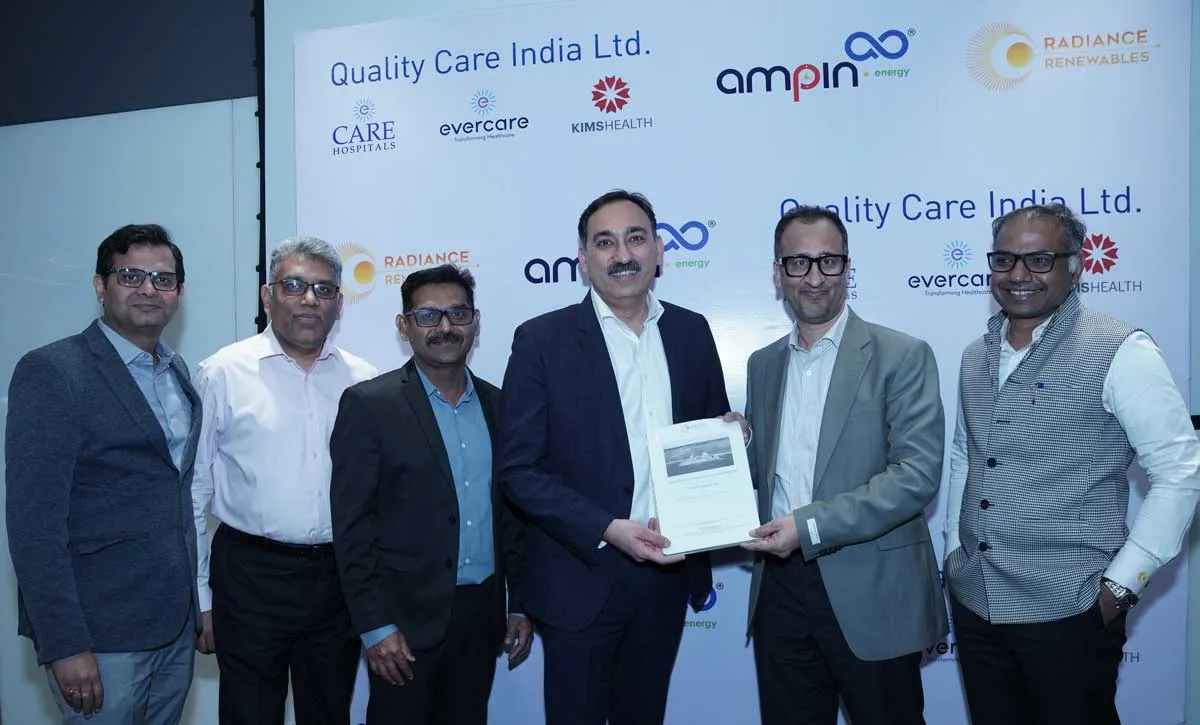
Quality Care India (QCIL) has signed agreements with AMPIN Energy and Radiance Renewables under its Group Captive Solar Initiative to procure renewable solar power for five facilities across Odisha, Chhattisgarh and Maharashtra. The move marks the first phase of the healthcare platform’s structured transition to sustainable energy.
The initiative forms part of QCIL’s broader plan to shift 19 hospitals under CARE Hospitals and KIMS Health to renewable energy in phases. Phase I covers Odisha, Chhattisgarh and Maharashtra, followed by Andhra Pradesh and Tamil Nadu in Phase II, Kerala in Phase III, and Madhya Pradesh and Telangana in Phase IV.
QCIL is targeting around 30 MW of renewable capacity across its network, with nearly 6 MWp planned under Phase I. Over the long term, the group aims to meet close to 80 per cent of its total energy consumption through renewable sources, supported by a hybrid model combining solar, wind and battery energy storage systems.
The transition is expected to reduce annual electricity costs by about 20 per cent, while improving cost visibility and reducing exposure to tariff volatility. Phase I is also projected to cut carbon emissions by around 8,000 tonnes annually, with the full rollout expected to offset nearly 40,000 tonnes per year.
The projects will be implemented under the group captive model, which combines long-term renewable power procurement with equity participation. AMPIN Energy will service QCIL’s facilities in Odisha and Chhattisgarh, while Radiance Renewables will execute the Maharashtra projects.
 “As we scale our network, sustainability is no longer optional, it is foundational to resilience and efficiency. The Group Captive Solar model allows us to move from being passive consumers of power to active participants in the energy ecosystem, with greater control over cost, reliability, and environmental impact. This is the beginning of a larger shift to embed sustainability into the core of how we build and operate healthcare,” said Varun Khanna, Group Managing Director, Quality Care India.

Quality Care India (QCIL) has signed agreements with AMPIN Energy and Radiance Renewables under its Group Captive Solar Initiative to procure renewable solar power for five facilities across Odisha, Chhattisgarh and Maharashtra. The move marks the first phase of the healthcare platform’s structured transition to sustainable energy.The initiative forms part of QCIL’s broader plan to shift 19 hospitals under CARE Hospitals and KIMS Health to renewable energy in phases. Phase I covers Odisha, Chhattisgarh and Maharashtra, followed by Andhra Pradesh and Tamil Nadu in Phase II, Kerala in Phase III, and Madhya Pradesh and Telangana in Phase IV.QCIL is targeting around 30 MW of renewable capacity across its network, with nearly 6 MWp planned under Phase I. Over the long term, the group aims to meet close to 80 per cent of its total energy consumption through renewable sources, supported by a hybrid model combining solar, wind and battery energy storage systems.The transition is expected to reduce annual electricity costs by about 20 per cent, while improving cost visibility and reducing exposure to tariff volatility. Phase I is also projected to cut carbon emissions by around 8,000 tonnes annually, with the full rollout expected to offset nearly 40,000 tonnes per year.The projects will be implemented under the group captive model, which combines long-term renewable power procurement with equity participation. AMPIN Energy will service QCIL’s facilities in Odisha and Chhattisgarh, while Radiance Renewables will execute the Maharashtra projects. “As we scale our network, sustainability is no longer optional, it is foundational to resilience and efficiency. The Group Captive Solar model allows us to move from being passive consumers of power to active participants in the energy ecosystem, with greater control over cost, reliability, and environmental impact. This is the beginning of a larger shift to embed sustainability into the core of how we build and operate healthcare,” said Varun Khanna, Group Managing Director, Quality Care India.

Next Story
Infrastructure Transport

Contracts, Corridors and Cash Flows

India’s roads sector enters 2026 at a decisive junction, where the conversation is no longer about kilometres alone but contracts that allocate risk wisely, corridors that unlock economic value, and cash flows that remain credible over the long term. After more than a decade of relentless expansion, India’s road-building ecosystem is moving into a phase of maturity – where engineering complexity, financial discipline and institutional coordination matter more than sheer scale.Between 2014 and 2024, India built highways at a pace few nations have ever matched. National Highway length expa..

Next Story
Real Estate

The Walled Garden

I am not suggesting Indian architects are inadequate. The profession has produced extraordinary work – from Charles Correa's quiet humanism to Balkrishna Doshi's Nobel-recognised genius. However, the regulatory barriers meant to protect the profession are holding it back. It is time for an honest conversation about this.The Architects Act of 1972 established the Council of Architecture (COA) as the statutory body regulating architecture practice in India. Its founding logic was sound: to ensure those calling themselves architects meet a minimum standard of competence and to protect the publi..

Next Story
Real Estate

We completed a 1BHK home on a private island in 7 days!

Reimagining construction through a ‘War on Waste’, Circato founders T Paul Koshy, Sushma Joseph and Praveen Crasta speak to CW on turning single-use plastic into high-performance building systems – demonstrated at Bengaluru International Airport with a 16-ft wall installed in just 48 hours.What specific gap in the construction ecosystem led to the creation of Circato?Sushma Joseph: We felt the industry had normalised inefficiency. In construction, timelines, costs and outcomes often remain uncertain, yet that is widely accepted. We wanted to show that inefficiencies can be..

Advertisement

Subscribe to Our Newsletter

Get daily newsletters around different themes from Construction world.

STAY CONNECTED

Advertisement

Advertisement

Advertisement