Serentica, ACME, AMPIN And Adyant Win SECI FDRE Peak Supply Tender
POWER & RENEWABLE ENERGY

Serentica, ACME, AMPIN And Adyant Win SECI FDRE Peak Supply Tender

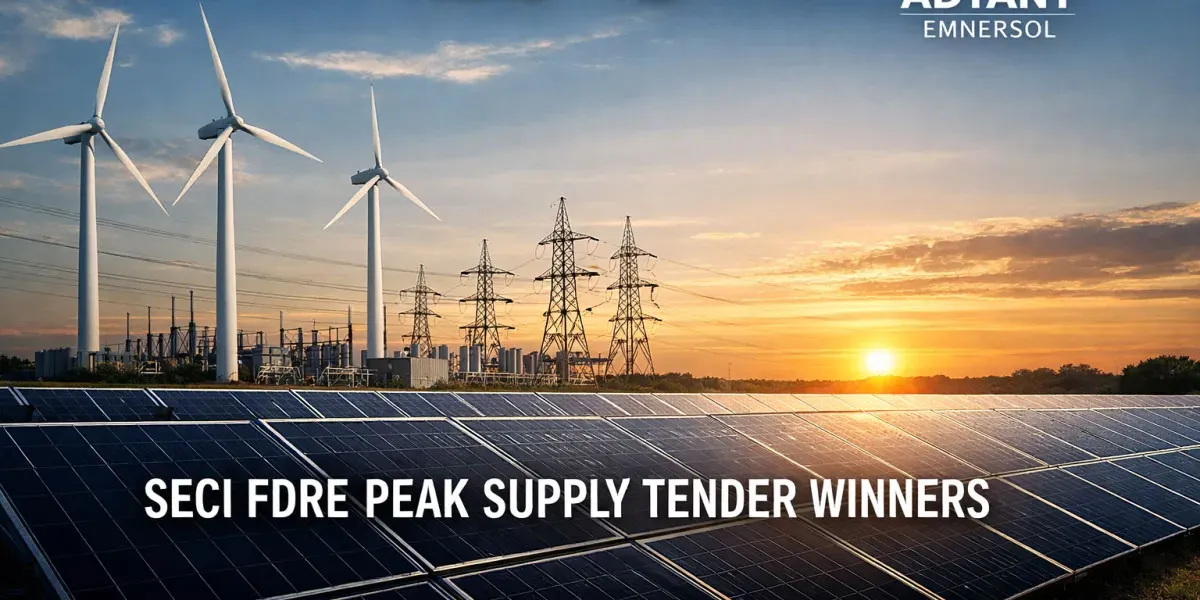
Solar Energy Corporation of India Limited (SECI) has declared the winners of its Inter-State Transmission System connected firm and dispatchable renewable energy tender, awarding a set of capacities to multiple developers. Leading renewable companies Serentica Renewables and ACME Solar emerged as the largest winners, each securing 600 Megawatt (MW) at a tariff of Rs6.28/kWh, while AMPIN Energy Transition secured 199 MW at the same tariff and Adyant Emnersol Private Limited, a subsidiary of Datta Infra, won 100 MW at Rs6.27/kWh. The announcement followed the competitive SECI-FDRE-VII auction and was presented as part of SECI's effort to scale dispatchable clean power. The published results also stated that the awarded capacity totals 899 MW.

SECI had issued the tender for 1,200 MW of ISTS-connected renewable energy projects with assured peak supply, designed to provide 4,800 Megawatt-hour (MWh) of electricity daily during high demand hours. The framework requires developers to supply power during peak hours for four hours each day and sets a minimum project size of 50 MW and a maximum of 600 MW. The tender aligns with procurement guidelines from the Ministry of Power and the clean energy expansion goals of the Ministry of New and Renewable Energy. Under the scheme SECI will act as an intermediary nodal agency and sign 25-year power purchase agreements with successful bidders.

The tender mandates that projects integrate Energy Storage Systems (ESS) and deliver 4,000 kWh per MW of contracted capacity during the daily peak hours selected by buying entities, typically during non-solar evening and morning periods. Developers are required to build projects on a Build-Own-Operate basis, including land acquisition, project installation and transmission infrastructure up to the interconnection point. Co-location of renewable generation and storage assets is required to ensure reliable peak power delivery. The design aims to enable renewable generation to meet firm demand in non-solar hours.

The closely clustered winning tariffs indicate increasing maturity in India's firm and dispatchable renewable energy market as developers combine renewable generation with storage to supply peak hour electricity. SECI's awards form part of a broader push to scale dispatchable clean power and support procurement across buying entities nationwide.

Solar Energy Corporation of India Limited (SECI) has declared the winners of its Inter-State Transmission System connected firm and dispatchable renewable energy tender, awarding a set of capacities to multiple developers. Leading renewable companies Serentica Renewables and ACME Solar emerged as the largest winners, each securing 600 Megawatt (MW) at a tariff of Rs6.28/kWh, while AMPIN Energy Transition secured 199 MW at the same tariff and Adyant Emnersol Private Limited, a subsidiary of Datta Infra, won 100 MW at Rs6.27/kWh. The announcement followed the competitive SECI-FDRE-VII auction and was presented as part of SECI's effort to scale dispatchable clean power. The published results also stated that the awarded capacity totals 899 MW. SECI had issued the tender for 1,200 MW of ISTS-connected renewable energy projects with assured peak supply, designed to provide 4,800 Megawatt-hour (MWh) of electricity daily during high demand hours. The framework requires developers to supply power during peak hours for four hours each day and sets a minimum project size of 50 MW and a maximum of 600 MW. The tender aligns with procurement guidelines from the Ministry of Power and the clean energy expansion goals of the Ministry of New and Renewable Energy. Under the scheme SECI will act as an intermediary nodal agency and sign 25-year power purchase agreements with successful bidders. The tender mandates that projects integrate Energy Storage Systems (ESS) and deliver 4,000 kWh per MW of contracted capacity during the daily peak hours selected by buying entities, typically during non-solar evening and morning periods. Developers are required to build projects on a Build-Own-Operate basis, including land acquisition, project installation and transmission infrastructure up to the interconnection point. Co-location of renewable generation and storage assets is required to ensure reliable peak power delivery. The design aims to enable renewable generation to meet firm demand in non-solar hours. The closely clustered winning tariffs indicate increasing maturity in India's firm and dispatchable renewable energy market as developers combine renewable generation with storage to supply peak hour electricity. SECI's awards form part of a broader push to scale dispatchable clean power and support procurement across buying entities nationwide.

Next Story
Real Estate

Housing Sales Dip 7 per cent QoQ Across Top Cities

India’s housing market saw a 7 per cent quarter-on-quarter decline in sales across the top seven cities in Q1 2026, with approximately 1,01,675 units sold compared to 1,08,970 units in Q4 2025, according to ANAROCK Group. However, on a yearly basis, sales rose 9 per cent, indicating continued underlying demand.The total sales value stood at around Rs 1.51 trillion, reflecting a 5 per cent quarterly drop but a 6 per cent annual increase. Mumbai Metropolitan Region and Bengaluru together accounted for nearly 48 per cent of total sales, while Chennai recorded the highest quarterly decline at 18..

Next Story
Real Estate

Birla Estates Enters Mumbai Redevelopment

Birla Estates has announced its entry into Mumbai’s redevelopment segment with a luxury residential project in Khar West, developed in partnership with Parinee Real Estate Builders. The project will redevelop Anmol Co-operative Housing Society and Bhartiya Bhavan Co-operative Housing Society, marking the company’s first redevelopment initiative in the Mumbai Metropolitan Region.Spread across 1.3 acres, the development will offer a saleable area of 2.9 lakh sq ft with an estimated revenue potential of Rs 17 billion. Positioned in one of Mumbai’s prime residential micro-markets, the projec..

Next Story
Infrastructure Urban

Hitachi, MUFG Expand EV Financing Model

Hitachi and MUFG Bank have expanded their NextGen business co-creation model to accelerate decarbonised mobility by financing electric vehicles and charging infrastructure. The renewed collaboration aims to address key barriers to electrification, including limited access to capital and the need for integrated energy solutions.Building on earlier partnerships, the expanded model extends beyond battery-focused solutions to include electric mobility assets, charging systems and energy management infrastructure across global markets. The initiative will leverage structured financing through speci..

Advertisement

Subscribe to Our Newsletter

Get daily newsletters around different themes from Construction world.

STAY CONNECTED

Advertisement

Advertisement

Advertisement