Strengthening Transmission Infrastructure For Renewable Integration
POWER & RENEWABLE ENERGY

Strengthening Transmission Infrastructure For Renewable Integration

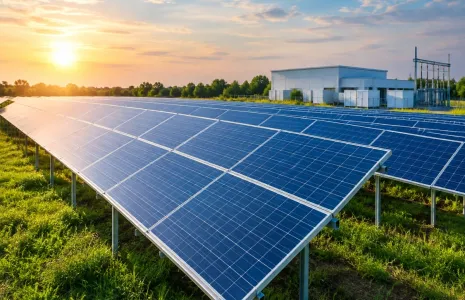
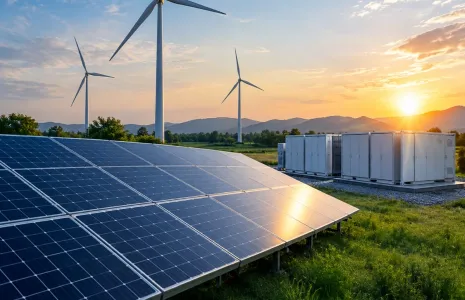
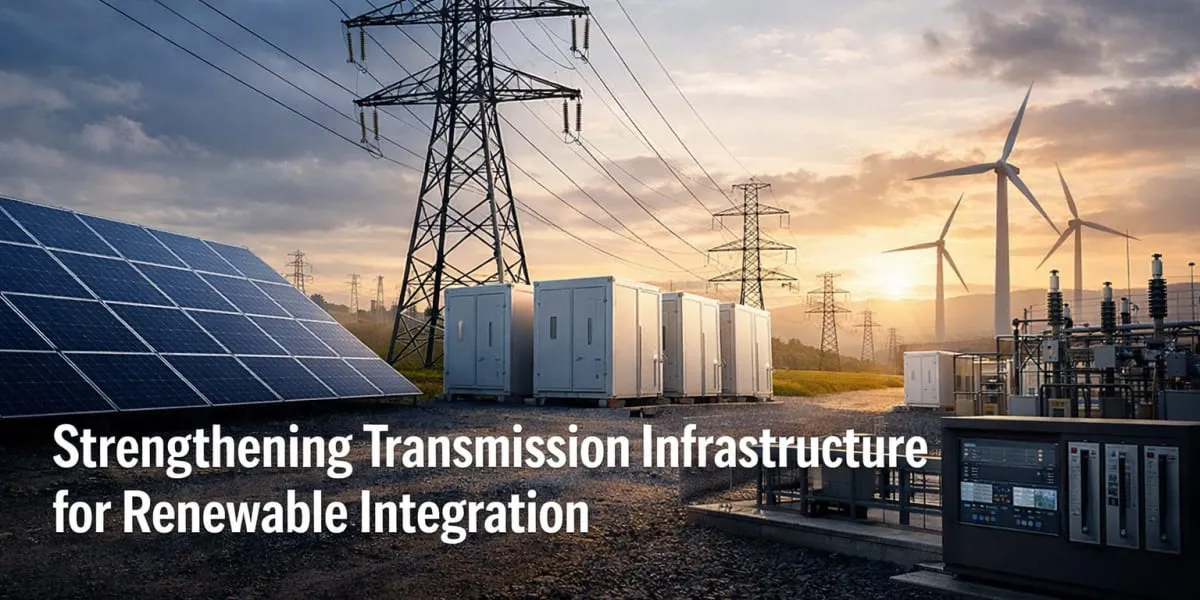
The Government has adopted a planning and implementation approach that prioritises grid readiness, transmission expansion and energy storage as integral elements of Renewable Energy (RE) development. The objective is to integrate RE while expanding capacity to ensure energy security and a managed transition. Measures include strengthening transmission infrastructure, improving grid operation, deploying smart grid technologies and expanding energy storage to manage intermittency and enable round-the-clock supply.

Transmission planning covers the Inter-State Transmission System (ISTS) and Intra-State Transmission System (InSTS) for RE evacuation, with systems planned for integration of over 500 GW by 2030. The transmission network is projected to expand from about 5.04 lakh circuit km to 6.48 lakh circuit km, equivalent to 0.504 mn and 0.648 mn circuit km, and inter-regional capacity is due to rise from 120 GW to 143 GW by 2027 and to 168 GW by 2032. The Ministry of New and Renewable Energy (MNRE) is implementing the Green Energy Corridor (GEC) in 10 States to evacuate 44 GW.

Dedicated high voltage direct current links with bi-directional flow are planned for efficient long-distance transfer and greater controllability. The Central Electricity Regulatory Commission introduced solar-hour and non-solar-hour connectivity to optimise transmission and promote hybrid projects combining solar, wind and Battery Energy Storage Systems (BESS). The Central Electricity Authority has notified technical standards for connectivity and thermal flexibilisation is mandated to address variability.

The Government has set up thirteen Renewable Energy Management Centres and the National Centre for Medium Range Weather Forecasting, with inputs from the Indian Space Research Organisation, provides forecasting support. Smart grid devices and Automatic Generation Control with ancillary services are being promoted to improve system strength and frequency regulation. Two viability gap funding schemes target about 43.8 GWh of BESS, the government has extended a 100 per cent waiver of ISTS charges for co-located BESS and hydro Pumped Storage Plants (PSP) commissioned or awarded by June, 2028, and a Production-Linked Incentive scheme has an outlay of Rs 181 bn for 50 GWh of Advanced Chemistry Cell manufacturing with 10 GWh for grid storage.

The Government has adopted a planning and implementation approach that prioritises grid readiness, transmission expansion and energy storage as integral elements of Renewable Energy (RE) development. The objective is to integrate RE while expanding capacity to ensure energy security and a managed transition. Measures include strengthening transmission infrastructure, improving grid operation, deploying smart grid technologies and expanding energy storage to manage intermittency and enable round-the-clock supply. Transmission planning covers the Inter-State Transmission System (ISTS) and Intra-State Transmission System (InSTS) for RE evacuation, with systems planned for integration of over 500 GW by 2030. The transmission network is projected to expand from about 5.04 lakh circuit km to 6.48 lakh circuit km, equivalent to 0.504 mn and 0.648 mn circuit km, and inter-regional capacity is due to rise from 120 GW to 143 GW by 2027 and to 168 GW by 2032. The Ministry of New and Renewable Energy (MNRE) is implementing the Green Energy Corridor (GEC) in 10 States to evacuate 44 GW. Dedicated high voltage direct current links with bi-directional flow are planned for efficient long-distance transfer and greater controllability. The Central Electricity Regulatory Commission introduced solar-hour and non-solar-hour connectivity to optimise transmission and promote hybrid projects combining solar, wind and Battery Energy Storage Systems (BESS). The Central Electricity Authority has notified technical standards for connectivity and thermal flexibilisation is mandated to address variability. The Government has set up thirteen Renewable Energy Management Centres and the National Centre for Medium Range Weather Forecasting, with inputs from the Indian Space Research Organisation, provides forecasting support. Smart grid devices and Automatic Generation Control with ancillary services are being promoted to improve system strength and frequency regulation. Two viability gap funding schemes target about 43.8 GWh of BESS, the government has extended a 100 per cent waiver of ISTS charges for co-located BESS and hydro Pumped Storage Plants (PSP) commissioned or awarded by June, 2028, and a Production-Linked Incentive scheme has an outlay of Rs 181 bn for 50 GWh of Advanced Chemistry Cell manufacturing with 10 GWh for grid storage.

Next Story
Infrastructure Urban

Flender Unveils N-ZAPEX Gear Couplings for Cost-Effective Operation

Flender has unveiled its new N-ZAPEX gear couplings, setting a new industry standard for drive applications in harsh conditions, such as those found in steel, cement, mining, and oil & gas industries. Designed to deliver economic benefits over the entire lifecycle, the N-ZAPEX series offers the highest torque density and misalignment capacities on the market.The N-ZAPEX is available in two versions, XN and XW, each tailored to meet different customer requirements. The XN variant focuses on standardisation, reduced complexity, and cost-effectiveness for smaller sizes, featuring reusable com..

Next Story
Infrastructure Urban

Anil Agarwal Calls for Entrepreneurial Role in Natural Resource PSUs

Anil Agarwal, Chairman of Vedanta, has highlighted the transformative potential of greater entrepreneurial involvement in India's public sector companies within the natural resources space. In a LinkedIn post, he emphasised the importance of empowering India’s pool of entrepreneurs alongside skilled public-sector talent to strengthen domestic production and reduce the country’s reliance on imports.Agarwal drew comparisons with India’s agricultural success, where self-sufficiency and surplus production were achieved. He suggested that a similar approach could unlock substantial value in p..

Next Story
Technology

Advaiya Launches Change Log Archival App for Microsoft Dynamics 365

Advaiya has launched its Change Log Archival app for Microsoft Dynamics 365 Business Central on the Microsoft Marketplace. The app enables organisations to securely archive large volumes of change log data outside the core ERP system while ensuring auditability, compliance, and traceability.As organisations face growing change log records that increase database size and impact system performance, the Change Log Archival app addresses these challenges by archiving historical logs to Azure Blob Storage. This solution optimises storage, maintains data integrity, and ensures accessibility, allowin..

Advertisement

Subscribe to Our Newsletter

Get daily newsletters around different themes from Construction world.

STAY CONNECTED

Advertisement

Advertisement

Advertisement