Study Links Solar Burst Emission Strength To Source Longitude
POWER & RENEWABLE ENERGY

Study Links Solar Burst Emission Strength To Source Longitude

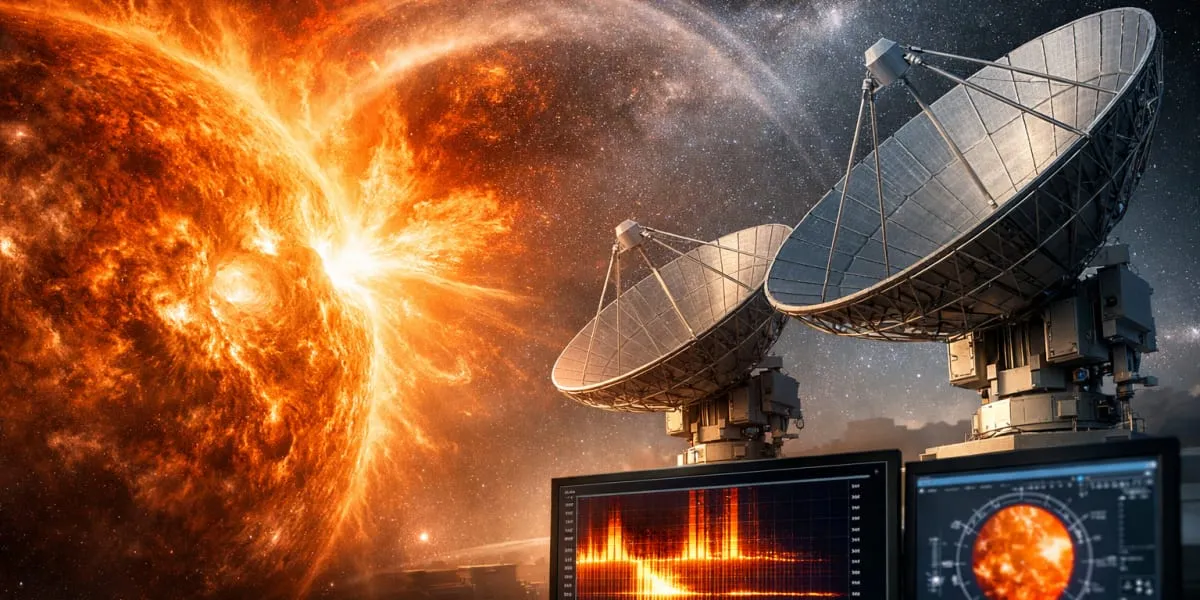
Researchers at the Indian Institute of Astrophysics have resolved a long-standing puzzle about the relative strengths of fundamental and harmonic components in type II solar radio bursts. The study examined radio emissions produced by coronal shocks triggered by solar flares and coronal mass ejections and aimed to explain occasions when the harmonic appears stronger than the fundamental. Type II bursts are slow-drifting radio emissions that typically move outward through the solar corona at about 1000 km/s.

The team analysed data from global Compound Astronomical Low Frequency Low Cost Instrument for Spectroscopy and Transportable Observatory (CALLISTO) spectrometers and used observations from the Gauribidanur Low Frequency Solar Spectrograph (GLOSS) at Gauribidanur Radio Observatory to trace the origin and characteristics of 58 type II bursts. The combined dataset provided diverse viewing angles and detailed local spectral measurements. Analysis concentrated on how propagation and refractive effects in the corona affect the visibility of fundamental and harmonic components.

The study found that events originating from active regions with heliographic longitudes greater than 75° tend to show stronger harmonic emissions, whereas events nearer the solar disk centre with longitudes less than 75° exhibit stronger fundamental emissions. The pattern was attributed to refractive effects, directivity and viewing angle in the solar corona, which can render the fundamental weaker or missing at Earth for limb events. Harmonic emission was reported to have a broader cone angle and so can be detected from far-side sources.

The findings improve understanding of how shocks generate radio waves and how those waves travel through the corona and could aid prediction of space weather and related effects on Earth. The researchers indicated that the large CALLISTO dataset is amenable to further study and that machine learning techniques could be applied to probe the data more deeply. The work was published in Solar Physics and involved collaborators from the Indian Institute of Astrophysics and IRSOL in Switzerland.

Researchers at the Indian Institute of Astrophysics have resolved a long-standing puzzle about the relative strengths of fundamental and harmonic components in type II solar radio bursts. The study examined radio emissions produced by coronal shocks triggered by solar flares and coronal mass ejections and aimed to explain occasions when the harmonic appears stronger than the fundamental. Type II bursts are slow-drifting radio emissions that typically move outward through the solar corona at about 1000 km/s. The team analysed data from global Compound Astronomical Low Frequency Low Cost Instrument for Spectroscopy and Transportable Observatory (CALLISTO) spectrometers and used observations from the Gauribidanur Low Frequency Solar Spectrograph (GLOSS) at Gauribidanur Radio Observatory to trace the origin and characteristics of 58 type II bursts. The combined dataset provided diverse viewing angles and detailed local spectral measurements. Analysis concentrated on how propagation and refractive effects in the corona affect the visibility of fundamental and harmonic components. The study found that events originating from active regions with heliographic longitudes greater than 75° tend to show stronger harmonic emissions, whereas events nearer the solar disk centre with longitudes less than 75° exhibit stronger fundamental emissions. The pattern was attributed to refractive effects, directivity and viewing angle in the solar corona, which can render the fundamental weaker or missing at Earth for limb events. Harmonic emission was reported to have a broader cone angle and so can be detected from far-side sources. The findings improve understanding of how shocks generate radio waves and how those waves travel through the corona and could aid prediction of space weather and related effects on Earth. The researchers indicated that the large CALLISTO dataset is amenable to further study and that machine learning techniques could be applied to probe the data more deeply. The work was published in Solar Physics and involved collaborators from the Indian Institute of Astrophysics and IRSOL in Switzerland.

Next Story
Resources

Origen Realty appoints Poulomi Ray as CMO

Origen Realty has appointed Poulomi Ray as Chief Marketing Officer, strengthening its leadership team as it advances its growth and brand strategy. Poulomi Ray brings nearly two decades of experience in brand building and marketing across real estate and hospitality sectors, with prior roles at Signature Global, DLF Limited, Paras Buildtech, MGM International and Hilton. In her new role, she will lead marketing and brand direction at Origen Realty, focusing on visibility, differentiation and market engagement as the company progresses its integrated development plans in Gurugram. Commenting..

Next Story
Building Material

Haver & Boecker Niagara to showcase solutions at Hillhead

Haver & Boecker Niagara will showcase its mineral processing technologies at Hillhead 2026, scheduled from June 23–25 in Buxton, UK.At Stand PA3, the company will present its end-to-end solutions including screeners, screen media and advanced diagnostics, with a focus on improving efficiency, uptime and throughput for aggregates producers.Highlighting its screen media portfolio, the company will feature Ty-Wire media with hybrid design offering up to 80 per cent more open area, alongside FLEX-MAT® solutions designed to enhance wear life and throughput while reducing blinding and cloggin..

Next Story
Real Estate

CREDAI-MCHI meets Maharashtra Revenue Minister on issues

Navin’s, a Chennai-based real estate developer, has won the 17th CIDC Vishwakarma Award 2026 for its residential project Navin’s Hanging Gardens located on Arcot Road, Valasaravakkam. The award was presented by the Construction Industry Development Council (CIDC) under the category of Best Construction Projects, recognising the development’s achievement in innovation, design excellence and sustainability.The award was received by Chandrasekar PN, General Manager, Technical, Navin’s, at the ceremony held in New Delhi.Inspired by the legendary Hanging Gardens of Babylon, the project has ..

Advertisement

Subscribe to Our Newsletter

Get daily newsletters around different themes from Construction world.

STAY CONNECTED

Advertisement

Advertisement

Advertisement