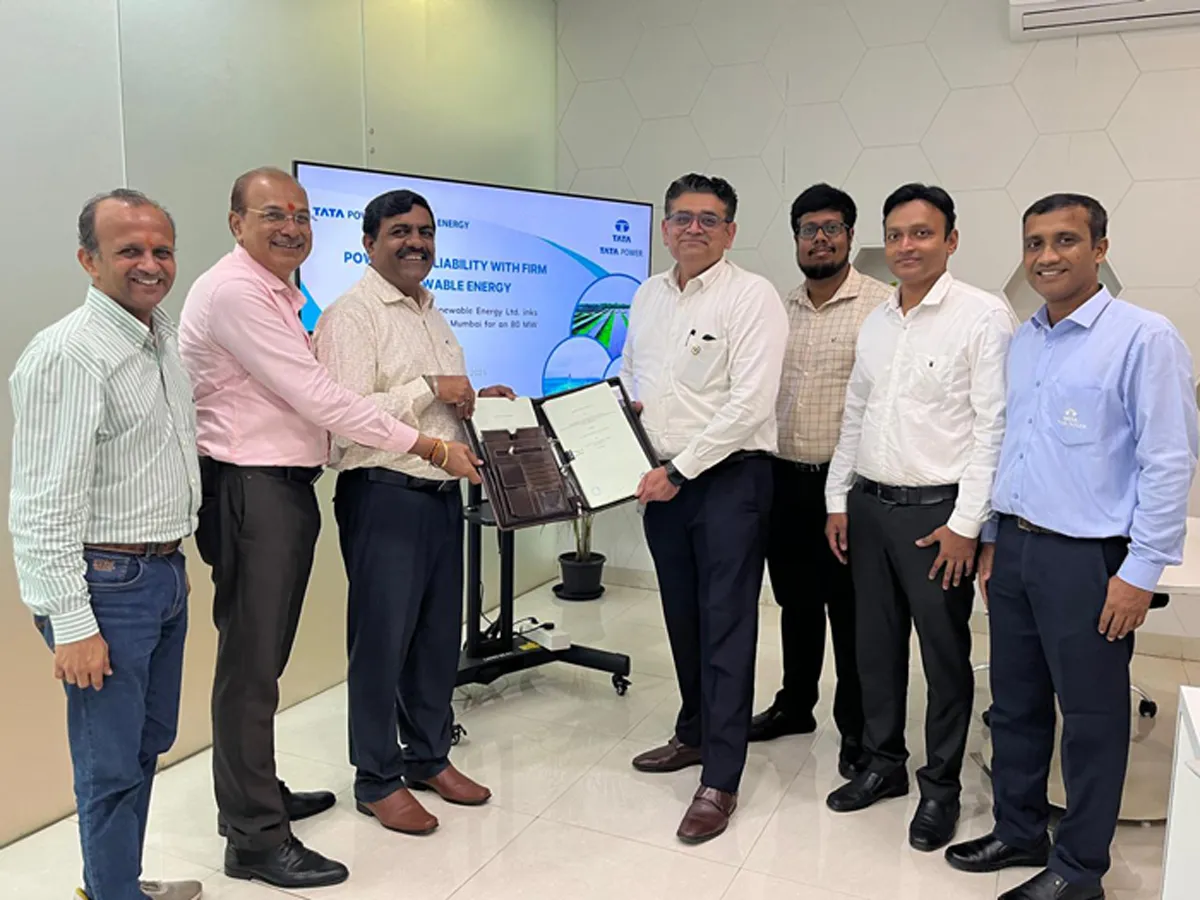
Tata Power Signs Rs 12 Billion PPA For 80 MW Green Project
POWER & RENEWABLE ENERGY

Tata Power Signs Rs 12 Billion PPA For 80 MW Green Project

Tata Power Company announced that its renewable arm, Tata Power Renewable Energy Limited (TPREL), has signed a Power Purchase Agreement (PPA) with Tata Power Mumbai Distribution for an 80 MW Firm and Dispatchable Renewable Energy (FDRE) project.
The Rs 12 billion project will combine solar, wind, and battery storage systems to provide reliable renewable power during peak demand periods, strengthening grid stability and meeting the growing energy needs of Mumbai.
Scheduled for completion within 24 months, the facility is expected to generate around 315 million units (MUs) of clean electricity annually, offsetting over 0.25 million tonnes of carbon dioxide emissions each year. A key highlight is its commitment to a four-hour peak power supply window, ensuring at least 90 per cent availability during high-demand hours.
The project will also enable Tata Power Mumbai Distribution to meet its Renewable Purchase Obligation (RPO), as mandated by the State Regulatory Commission. Once operational, the clean power generated will feed directly into Tata Power’s Mumbai distribution network, supplying low-emission electricity to over 800,000 residential, commercial, and industrial consumers.
The company stated that this initiative further strengthens TPREL’s leadership in India’s renewable energy sector, reinforcing its focus on sustainability and innovation. With this addition, TPREL’s total renewable utility capacity now stands at 11.3 GW, which includes 9.4 GW under PPAs. Of this, 5.7 GW is under implementation, and 5.6 GW is operational—comprising 4.6 GW of solar and 1 GW of wind energy.
In addition, TPREL’s solar EPC portfolio exceeds 15.7 GWp of large-scale ground-mounted projects and over 3 GW of rooftop and distributed systems. The company aims to expand green energy access nationwide through integrated renewable solutions.
Parent company Tata Power remains India’s largest vertically integrated power utility, engaged in generation, transmission, and distribution. It has set a goal of producing electricity entirely through renewable sources and plans to install 100,000 EV charging stations by 2025.
In Q1 FY26, Tata Power reported a 6.2 per cent rise in consolidated net profit to Rs 12.62 billion, alongside a 4.3 per cent growth in revenue from operations to Rs 180.35 billion compared to the same quarter last year. Its stock rose 0.58 per cent, trading at Rs 391 on the BSE. 

Tata Power Company announced that its renewable arm, Tata Power Renewable Energy Limited (TPREL), has signed a Power Purchase Agreement (PPA) with Tata Power Mumbai Distribution for an 80 MW Firm and Dispatchable Renewable Energy (FDRE) project.The Rs 12 billion project will combine solar, wind, and battery storage systems to provide reliable renewable power during peak demand periods, strengthening grid stability and meeting the growing energy needs of Mumbai.Scheduled for completion within 24 months, the facility is expected to generate around 315 million units (MUs) of clean electricity annually, offsetting over 0.25 million tonnes of carbon dioxide emissions each year. A key highlight is its commitment to a four-hour peak power supply window, ensuring at least 90 per cent availability during high-demand hours.The project will also enable Tata Power Mumbai Distribution to meet its Renewable Purchase Obligation (RPO), as mandated by the State Regulatory Commission. Once operational, the clean power generated will feed directly into Tata Power’s Mumbai distribution network, supplying low-emission electricity to over 800,000 residential, commercial, and industrial consumers.The company stated that this initiative further strengthens TPREL’s leadership in India’s renewable energy sector, reinforcing its focus on sustainability and innovation. With this addition, TPREL’s total renewable utility capacity now stands at 11.3 GW, which includes 9.4 GW under PPAs. Of this, 5.7 GW is under implementation, and 5.6 GW is operational—comprising 4.6 GW of solar and 1 GW of wind energy.In addition, TPREL’s solar EPC portfolio exceeds 15.7 GWp of large-scale ground-mounted projects and over 3 GW of rooftop and distributed systems. The company aims to expand green energy access nationwide through integrated renewable solutions.Parent company Tata Power remains India’s largest vertically integrated power utility, engaged in generation, transmission, and distribution. It has set a goal of producing electricity entirely through renewable sources and plans to install 100,000 EV charging stations by 2025.In Q1 FY26, Tata Power reported a 6.2 per cent rise in consolidated net profit to Rs 12.62 billion, alongside a 4.3 per cent growth in revenue from operations to Rs 180.35 billion compared to the same quarter last year. Its stock rose 0.58 per cent, trading at Rs 391 on the BSE. 

Next Story
Infrastructure Transport

India Becomes First to Produce Bio-Bitumen for Roads

India has become the first country in the world to commercially produce bio-bitumen for use in road construction, according to Road, Transport and Highways Minister Nitin Gadkari. Bitumen, a black and viscous hydrocarbon derived from crude oil, is a key binding material in road building, and the bio-based alternative is expected to significantly improve the sector’s environmental footprint.Addressing the CSIR Technology Transfer Ceremony in New Delhi, Mr Gadkari congratulated Council of Scientific and Industrial Research on achieving the milestone, noting that the initiative would help curb ..

Next Story
Infrastructure Urban

HILT Policy Seen Boosting Telangana Revenue Sharply

The Hyderabad Industrial Land Transformation (HILT) Policy is expected to generate around Rs 1.08 billion in revenue for the Telangana state exchequer, according to Deputy Chief Minister Bhatti Vikramarka Mallu. Speaking in the Telangana Legislative Assembly, he said the policy would be implemented within a six-month timeframe in a transparent manner, with uniform rules applicable to all stakeholders. Mr Vikramarka noted that without the HILT Policy, the state would have earned only about Rs 1.2 million per acre. Under the new framework, however, revenue is projected to rise sharply to Rs 70 ..

Next Story
Infrastructure Urban

India Post, MoRD Tie Up to Boost Rural Inclusion

The Department of Posts and the Ministry of Rural Development have signed a Memorandum of Understanding to accelerate rural transformation and expand financial, digital and logistics services for Self-Help Groups (SHGs) and rural households across India. The agreement was signed in the presence of Union Minister of Communications and Development of North Eastern Region Jyotiraditya M. Scindia and Union Minister of Rural Development and Agriculture and Farmers’ Welfare Shivraj Singh Chouhan. The collaboration aligns with the government’s “Dak Sewa, Jan Sewa” vision and seeks to repositi..

Advertisement

Subscribe to Our Newsletter

Get daily newsletters around different themes from Construction world.

STAY CONNECTED

Advertisement

Advertisement

Advertisement

Advertisement

Open In App