+
Vaikom Becomes India’s First Energy-Neutral Solar Boat Station
POWER & RENEWABLE ENERGY

Vaikom Becomes India’s First Energy-Neutral Solar Boat Station

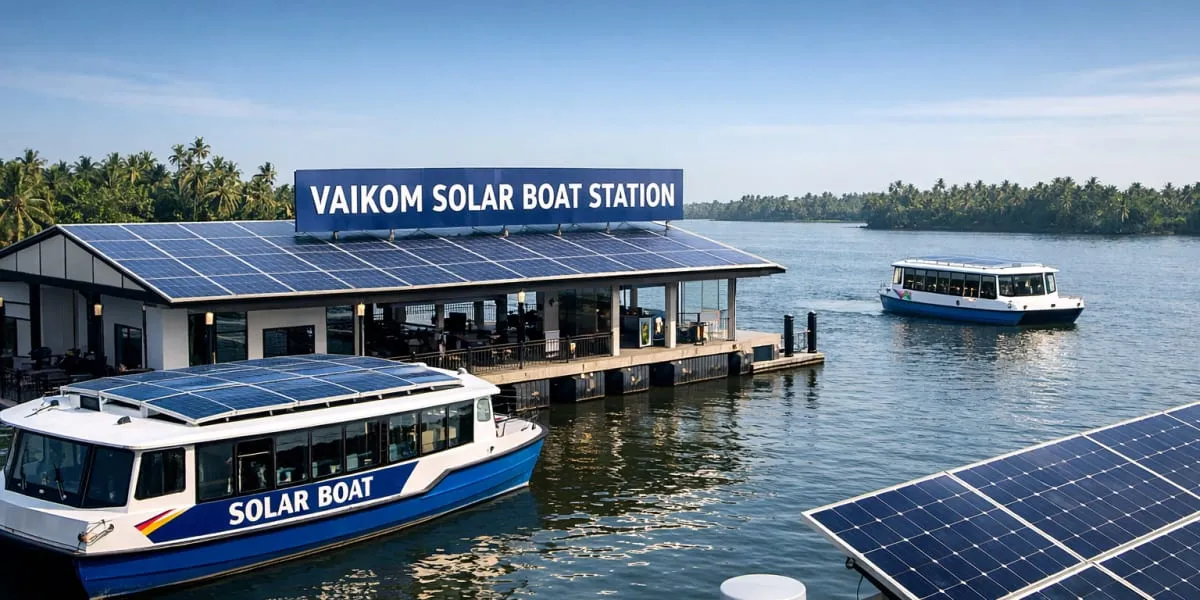
Vaikom, on the Vembanad backwaters, is poised to become India’s first fully energy-neutral boat station as diesel vessels are replaced with solar boats and jetty operations shift to solar power. The transition removes diesel use from the jetty ecosystem and is intended to cut emissions and operating costs. The move supports Kerala’s efforts to integrate renewable energy into public transport.

On February 20 the transport minister will launch three new solar-powered boats, marking the final step in phasing out diesel vessels on the Vaikom route. The Agency for Non-Conventional Energy and Rural Technology (ANERT) will begin converting the jetty’s operational infrastructure to solar energy while the State Water Transport Department (SWTD) prepares to commission the vessels. The SWTD recalls that the shift began in 2017 with Aditya, Kerala’s first solar-powered passenger vessel.

SWTD figures indicate that replacing one diesel vessel with a solar alternative can prevent nearly 40 t of carbon emissions annually. Each new vessel was developed at a cost of Rs31.5 mn and features an upgraded 80 kWh battery, compared with a 50 kWh pack in earlier boats that limited service hours. The vessels travel at an average speed of 10.8 km per hour, complete the Vaikom–Thavanakadavu stretch in around 15 minutes and carry up to 75 passengers.

The higher battery capacity allows operations to extend beyond daylight hours and enables services later into the evening. Earlier services were largely restricted between seven am and seven pm but the upgraded vessels can now operate until nearly nine pm. Each boat is fitted with 20 kW of solar panels and shore-based charging systems are being installed to support clean charging during docking. The station conversion is estimated to cost approximately Rs three mn and grid charging, which previously cost between Rs400 and Rs500 per cycle, is expected to decline sharply as the integrated solar model comes online.

Vaikom, on the Vembanad backwaters, is poised to become India’s first fully energy-neutral boat station as diesel vessels are replaced with solar boats and jetty operations shift to solar power. The transition removes diesel use from the jetty ecosystem and is intended to cut emissions and operating costs. The move supports Kerala’s efforts to integrate renewable energy into public transport. On February 20 the transport minister will launch three new solar-powered boats, marking the final step in phasing out diesel vessels on the Vaikom route. The Agency for Non-Conventional Energy and Rural Technology (ANERT) will begin converting the jetty’s operational infrastructure to solar energy while the State Water Transport Department (SWTD) prepares to commission the vessels. The SWTD recalls that the shift began in 2017 with Aditya, Kerala’s first solar-powered passenger vessel. SWTD figures indicate that replacing one diesel vessel with a solar alternative can prevent nearly 40 t of carbon emissions annually. Each new vessel was developed at a cost of Rs31.5 mn and features an upgraded 80 kWh battery, compared with a 50 kWh pack in earlier boats that limited service hours. The vessels travel at an average speed of 10.8 km per hour, complete the Vaikom–Thavanakadavu stretch in around 15 minutes and carry up to 75 passengers. The higher battery capacity allows operations to extend beyond daylight hours and enables services later into the evening. Earlier services were largely restricted between seven am and seven pm but the upgraded vessels can now operate until nearly nine pm. Each boat is fitted with 20 kW of solar panels and shore-based charging systems are being installed to support clean charging during docking. The station conversion is estimated to cost approximately Rs three mn and grid charging, which previously cost between Rs400 and Rs500 per cycle, is expected to decline sharply as the integrated solar model comes online.

Next Story
Equipment

Kabelschlepp India Installs Robotic VMC in Bengaluru

Kabelschlepp India, part of the Tsubaki Group, has installed a state-of-the-art Vertical Machining Center (VMC) integrated with robotic automation at its Bengaluru facility. The inauguration was held in the presence of Henning Preis, President & CEO, Kabelschlepp Group, Jörg Schulz, Vice President – Production, and Srinivas P. Kamisetty, Managing Director, Kabelschlepp India.The high-precision CNC VMC is designed for advanced milling, drilling, tapping and multi-axis machining. Equipped with a vertical spindle orientation, automatic tool changer and intelligent CNC control system, it en..

Next Story
Infrastructure Transport

Highway Delivery Reset!

Project delays and inefficiencies continue to bedevil the progress of India’s National Highways network. A multi-pronged reform agenda is needed to inject greater transparency and accountability at every stage – from planning and procurement to execution, maintenance and oversight. This article offers key recommendations and reform strategies that government stakeholders – from the Ministry of Road Transport & Highways (MoRTH) and the National Highways Authority of India (NHAI) to state agencies and oversight bodies – should pursue to put highway development on a better track.Decen..

Next Story
Infrastructure Transport

MSIDC Executes ₹37,000 Crore Road Programme

With Rs 37,000 crore worth of road projects under execution across Maharashtra, Maharashtra State Infrastructure Development Corporation (MSIDC) is driving one of the state’s largest infrastructure programmes. Dr Brijesh Dixit, Managing Director, discusses the institutional reforms, execution frameworks, financing strategies and technology adoption enabling timely, high-quality delivery, in conversation with PRATAP PADODE, Editor-in-Chief, CW.With over Rs 37,000 crore worth of road projects underway across districts – many under tight timelines – what institutional and executio..

Advertisement

Subscribe to Our Newsletter

Get daily newsletters around different themes from Construction world.

STAY CONNECTED

Advertisement

Advertisement

Advertisement

Open In App