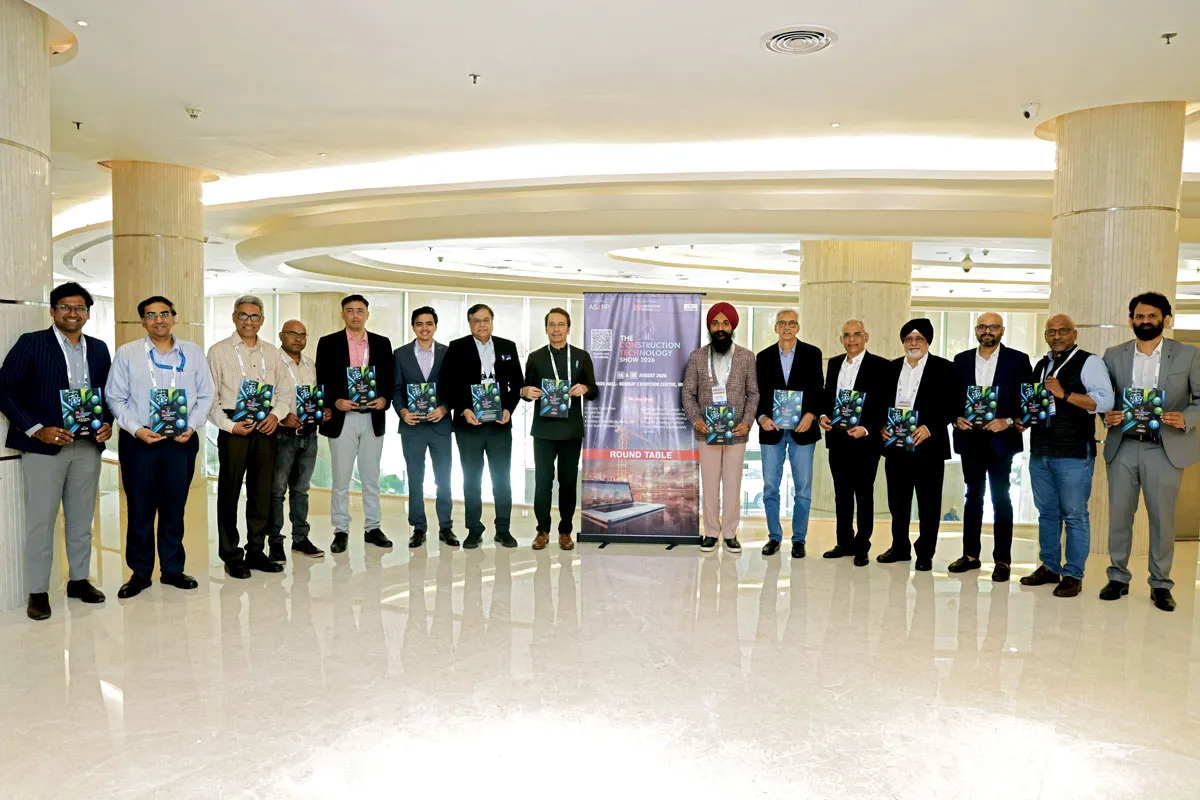
For an industry tasked with building the future, construction has an uneasy relationship with it. India is entering what many describe as a once-in-a-generation build cycle. “What we have not constructed in the last 200 years, we are going to construct in the next 20 years,” observed Naushad Panjwani, Chairman, Mandarus Partners. The scale is unprecedented. The urgency is undeniable. And yet, the sector continues to lag, held back not by lack of technology, but by something far more entrenched: Mindset.Industry’s real faultlineVery quickly, the conversation moved beyond familiar territory – AI, BIM, digital twins – and zeroed in on a deeper issue: fragmentation. Subodh Dixit, former director, Shapoorji Pallonji, articulated it with clarity. “The issue is not just that technologies are in silos. The stakeholders are in silos.”Clients, consultants, contractors and vendors continue to operate with their own priorities and incentives. “If a contractor or a designer adopts technology independently, but it doesn’t percolate through the entire supply chain, it’s not going to work,” Dixit added. It’s a systemic challenge – one that no software can solve on its own.Developers step into the driver’s seatWhat stood out was a clear shift in where the momentum is coming from. Developers, long seen as cautious adopters, are now pushing for change. Anup Mathew, Sr Vice President and Business Head, Godrej Properties, made a strong case for moving beyond fragmented adoption. “We need an integrated approach, right from design to procurement to project execution to asset management. Unless we see it in totality, we will always optimise in silos.”From the client side, Harleen Oberoi, Project Management, Tata Realty, reinforced this with a practical perspective. Technology, he said, cannot succeed in isolation. “It’s not enough for one organisation to invest. Trade partners, vendors… everyone has to be trained and aligned. Otherwise, it doesn’t yield results.”“Contractors are no longer at the bottom of the value chain. It’s the doer’s time now,” he noted, pointing to a more collaborative ecosystem beginning to take shape.When technology actually deliversDespite the scepticism surrounding construction technology, real-world examples are beginning to demonstrate its impact. Oberoi shared a telling case from his own experience. What started as an underutilised investment – “100 BIM licences and nobody using them” – was transformed through sustained internal push and ecosystem alignment. Today, his organisation issues BIM models directly for tendering. The results have been tangible.“Something that used to take two to three months, we could do in one month,” he said. “And the accuracy improved significantly – we were able to bring variation down to about 2 per cent.” “One contractor told us, ‘You print the bill, I’ll sign it’,” he added, highlighting how transparency can reshape relationships.Industrialisation: The quiet shiftWhile digital tools dominated much of the discussion, another transformation is quietly gaining ground: Industrialisation. Precast, modular construction and pre-engineered systems are moving construction away from site-heavy execution towards factory-led processes.For Mathew, this is not just an efficiency play; it’s a necessity. “We are not getting people. And even those who come don’t want to work in site conditions anymore.”Factory-based construction offers predictability, better quality control and faster execution. This shift could also help address a long-standing talent crisis. As Panjwani pointed out, the industry has lost a generation of engineers to IT. A more structured, industrialised environment may be key to bringing them back.The adoption puzzleIf the benefits are evident, why does adoption remain slow? Part of the answer lies in confusion. Abhishek Kumar, COO, LivSYT, pointed out that the market is crowded with solutions, leaving buyers unsure of what to adopt. “People often expect one solution to solve everything,” he said, highlighting a common misconception.There is also the issue of expectation versus reality. As Dr Tenepalli JaiSai, Associate Professor, School of Construction, NICMAR University, noted, “One technology will not suffice; we need an integrated Construction 4.0 approach.”Technology is still viewed as an additional cost rather than a value driver. As one participant put it, “we buy a Mercedes but go to Gaffarbhai for servicing.”The industry continues to undervalue intangible costs – delays, inefficiencies and rework –that technology can significantly reduce.Data problem at the coreEven as AI gains traction globally, construction faces a fundamental limitation: Data.Chandra Vasireddy, CEO & Co-founder, Inncircles, emphasised that the industry lacks both foundational and connected data. “If you don’t have connected data, your point-of-failure analysis won’t work. And if that doesn’t work, no AI can work.”Data today remains fragmented across systems – ERP, BIM, procurement – with little integration. Looking beyond the obviousThe discussion also surfaced gaps that often go unnoticed. Oberoi highlighted the looming challenge of repair and rehabilitation. “We have not built 100 per cent right in the last two decades. All of this will come up for major repairs – and we are not prepared.”From buzzwords to business valueWhat emerged from the discussion was a clear shift in mindset. The industry is moving beyond the buzzword phase. BIM is no longer optional. AI is moving from hype to application. Industrial construction is gaining ground.The question is no longer whether to adopt technology, but how to make it work at scale. As Dixit pointed out, adoption will remain difficult unless incentives are aligned. “If I save money for the owner but there is nothing in it for me, why would I do it?” It’s a simple question, but one that cuts to the heart of the issue.India’s construction sector is not short on ambition. Nor is it short on technology. What it lacks – still – is cohesion. And until that changes, the gap between innovation and implementation will persist. Because in the end, the future of construction will not be defined by the technologies it adopts but the systems it is willing to change.(The above insights were shared during the Construction Technology Show round table organised by Construction World, conducted on 12 March 2026 at Courtyard by Marriott, Mumbai.)