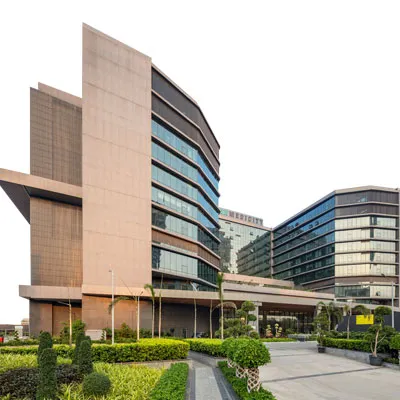
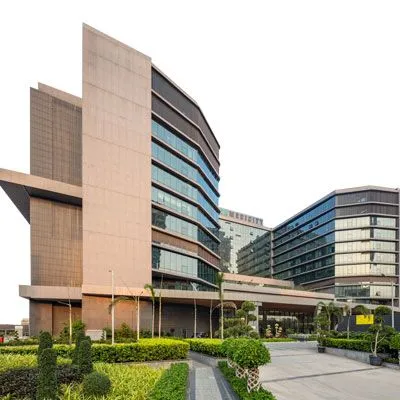
A 1,200-bed healthcare centre rises in Ghaziabad, marrying clinical efficiency, human-centred design and sustainability.In the rapidly expanding urban fabric of Ghaziabad, the demand for advanced tertiary healthcare infrastructure has long outpaced supply. Yashoda Medicity – a 1,200-bed, multi-speciality campus located in Indirapuram – represents a decisive response to this gap. Planned as a next-generation, LEED-ready, digitally enabled healthcare ecosystem, the project combines architectural clarity, engineering precision and strong sustainability benchmarks to deliver a contemporary medicity within a constrained metropolitan footprint.Designed by Creative Designer Architects (CDA) and constructed with Ramacivil India Constructions as EPC partner, the 8-acre campus integrates 65 specialities, modular ICUs, advanced operation theatres, trauma systems and a suite of critical care services arranged vertically across high-intensity floor plates. The project’s development journey, from planning to commissioning, showcases a cohesive effort to align patient experience, medical functionality and environmental responsibility.The master plan The architectural vision was anchored in a clear planning philosophy, as Ravideep Singh, Associate Director, Creative Designer Architects, shares: “The master plan was driven by a clear commitment to synchronising medical efficiency with a humane and reassuring patient experience.”To achieve this, the design team adopted a vertical care model, stacking clinical departments strategically and organising care clusters to reduce unnecessary movement. Clinical adjacencies – such as linking cardiac services, ICUs, diagnostics and surgical zones – were resolved through precise vertical zoning supported by 22 high-speed bed elevators. This arrangement ensures rapid emergency transfers, predictable patient pathways and seamless coordination across specialities.Equally important was creating a calm and legible environment, particularly in moments of stress for patients and their families. The campus opens with a landscaped forecourt and a wide drop-off area capable of managing high footfall. Inside, an expansive, triple-height atrium filled with daylight serves as the primary orientation space. Viewing terraces, therapeutic landscapes, varied waiting spaces and intuitive circulation patterns collectively support emotional well-being – qualities essential to a community-facing institution of this scale.Managing scaleWith floor plates stretching up to nearly 100,000 sq ft, Yashoda Medicity required rigorous spatial discipline. Infection control, emergency response and clean-dirty segregation were paramount concerns.“Each floor is organised into two fully independent zones and equipped with its own visitor, patient and service cores, along with a dedicated fire tower,” explains Singh. This ensures that clinical and support flows do not intersect, reducing contamination risk and preventing congestion. Critical-care floors, clean corridors, sterile zones, emergency links and diagnostic hubs were refined using digital-twin simulations to test circulation efficiency under routine and peak load scenarios. The result is a high-capacity medicity that performs with consistency, resilience and spatial clarity.Engineering precisionConstructing a 1,200-bed tertiary care campus with modular ICUs, advanced OTs and digital trauma command systems required meticulous coordination across civil, structural and MEP domains.According to Parveen Gupta, Director, Ramacivil India Constructions, “The biggest challenge was bringing together highly sensitive spaces – like modular ICUs, advanced OTs, and trauma systems – while ensuring absolute precision in civil, structural and MEP works.” Maintaining pressure regimes, sterility levels and environmental balance demanded extensive planning, stringent supervision and continuous collaboration between engineering teams, architects, clinical planners and equipment suppliers.“Seamless integration comes from understanding how a hospital actually works day to day,” he adds, underscoring the team’s clinical sensitivity and operational insight.Executing in a tight urban contextBuilding at this scale in Indirapuram – a dense residential neighbourhood with limited setbacks and busy surroundings – required a carefully choreographed construction strategy. Material movement, site flows, delivery scheduling and workforce deployment were all designed with the goal of minimising disruptions while maintaining progress.Gupta notes, “We created dedicated movement routes, structured material delivery schedules and a zoned execution strategy to avoid congestion onsite.” Digital workforce management ensured the right teams were positioned as required, while micro-phased tasks and daily reviews kept timelines under control. Over 5,000 professionals were employed during the project, with a disciplined approach to safety, training and quality assurance.“Safety was treated as a non-negotiable priority,” he emphasises, supported by toolbox talks, regular audits and a multi-layered inspection framework suited to healthcare norms.Designing for a greener tomorrowAs a LEED Platinum-ready healthcare campus, Yashoda Medicity integrates a layered sustainability strategy that starts with passive design and extends into active systems optimisation.The building’s orientation maximises diffused daylight from the north and east, while minimising heat gain on the south and west through canted glazing, shading elements and controlled fenestration. Terracotta façade panels, regionally sourced, reduce embodied energy. Low-E double glazing, vitrified tiles, seamless vinyl and low-VOC materials support hygiene, durability and indoor air quality.Energy performance is strengthened through VFD-based HVAC systems, high-efficiency chillers, BMS-enabled controls and occupancy-driven LED lighting. Water management incorporates rainwater harvesting, greywater recycling, low-flow fixtures and landscaped terraces that improve microclimate and reduce heat island effects.Summarising the approach, Singh says, “The project adopts a layered sustainability strategy that begins with passive design principles and extends into systems optimisation and resource management.” These measures reduce operational load while ensuring clinical spaces maintain stringent environmental parameters.A new benchmark for urban medicitiesYashoda Medicity responds not only to Ghaziabad’s current healthcare deficit but also sets a template for future developments in India’s emerging metropolitan peripheries. With land scarcity and high population density shaping design decisions, the vertical medicity model demonstrates how complex, high-intensity healthcare can be delivered within a limited footprint without compromising accessibility or community engagement.Its blend of patient-centricity, engineering excellence and sustainability positions it as a benchmark for next-generation Indian healthcare infrastructure – an entity that is technologically advanced, environmentally responsible and grounded in the real needs of the cities it serves.