



Government Relaxes Procurement Rules For Some State Firms
Equipment

Government Relaxes Procurement Rules For Some State Firms

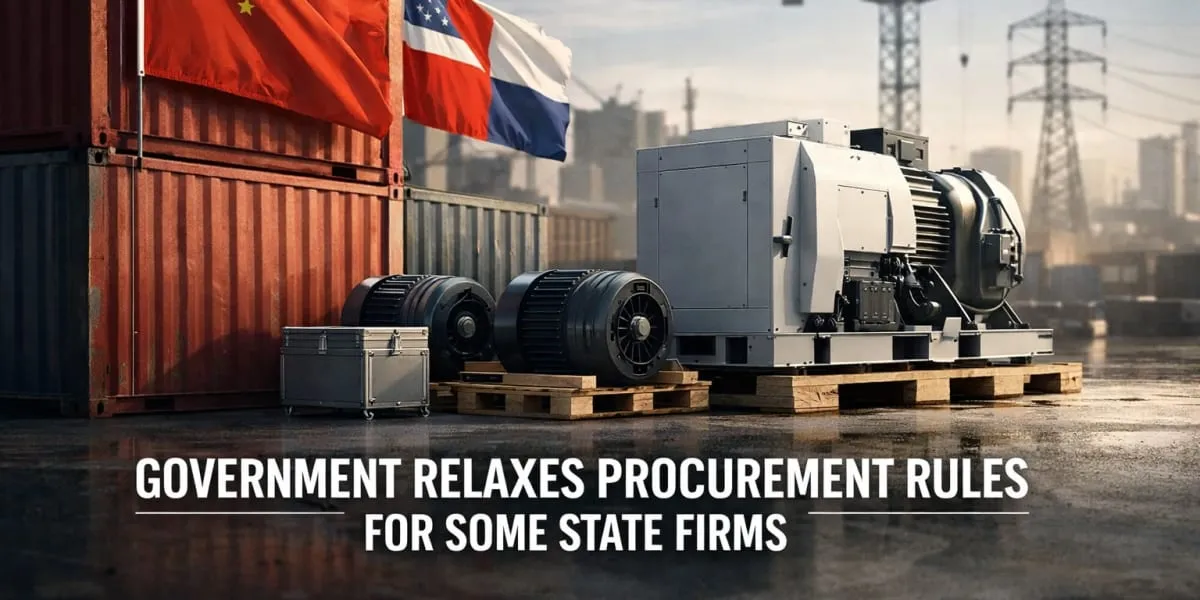
The government has relaxed procurement rules to permit some state firms to source critical equipment from China, according to a policy change announced this week.

The adjustment is intended to accelerate deliveries for projects that have faced delays due to constrained supply chains and manufacturing bottlenecks.

Officials framed the change as a pragmatic step to ensure continuity of essential services while remaining mindful of strategic dependencies.

The move responds to operational imperatives identified by procurement teams.

The measure applies to selected public sector companies that manage infrastructure, energy and industrial projects and will allow them to consider Chinese suppliers where domestic or alternative sources cannot meet timelines.

The relaxation is subject to existing procurement procedures and compliance checks designed to assess quality, security and value for money.

Administrative units are expected to retain discretion and to justify decisions on a case by case basis and to foster competitive sourcing where possible.

The change is likely to reduce lead times and ease cost pressures for time sensitive programmes, enabling faster commissioning of assets that support public services and economic activity.

At the same time, the adjustment could prompt renewed focus on supplier diversification, domestic capacity building and safeguards against over reliance on a single foreign market.

Policymakers are expected to weigh short term operational needs against longer term strategic objectives.

The government will monitor outcomes and may refine the approach as project requirements and geopolitical considerations evolve, emphasising transparency in procurement choices.

Stakeholders have been advised to document procurement rationales and risk assessments to support auditability and accountability.

Observers say the development underscores the balancing act between pragmatic procurement and national strategic interests.

Relevant departments and the firms concerned will be required to coordinate implementation and to report on supplier performance and compliance.

"Join industry leaders at RAHSTA Expo, India's premier platform for roads, highways and traffic infrastructure. Register now to explore innovations, network with experts and shape the future of mobility."

The government has relaxed procurement rules to permit some state firms to source critical equipment from China, according to a policy change announced this week. The adjustment is intended to accelerate deliveries for projects that have faced delays due to constrained supply chains and manufacturing bottlenecks. Officials framed the change as a pragmatic step to ensure continuity of essential services while remaining mindful of strategic dependencies. The move responds to operational imperatives identified by procurement teams. The measure applies to selected public sector companies that manage infrastructure, energy and industrial projects and will allow them to consider Chinese suppliers where domestic or alternative sources cannot meet timelines. The relaxation is subject to existing procurement procedures and compliance checks designed to assess quality, security and value for money. Administrative units are expected to retain discretion and to justify decisions on a case by case basis and to foster competitive sourcing where possible. The change is likely to reduce lead times and ease cost pressures for time sensitive programmes, enabling faster commissioning of assets that support public services and economic activity. At the same time, the adjustment could prompt renewed focus on supplier diversification, domestic capacity building and safeguards against over reliance on a single foreign market. Policymakers are expected to weigh short term operational needs against longer term strategic objectives. The government will monitor outcomes and may refine the approach as project requirements and geopolitical considerations evolve, emphasising transparency in procurement choices. Stakeholders have been advised to document procurement rationales and risk assessments to support auditability and accountability. Observers say the development underscores the balancing act between pragmatic procurement and national strategic interests. Relevant departments and the firms concerned will be required to coordinate implementation and to report on supplier performance and compliance.

Next Story
Infrastructure Urban

ABS Marine Sees CRISIL Credit Rating Upgrade

ABS Marine Services has secured an upgrade to its long term and short term credit ratings from CRISIL, reflecting improved profitability and revenue growth through long term contracts. CRISIL moved the long term rating from BBB+/Stable to A-/Stable and revised the short term rating from A2 to A2+. The action signals strengthened financial metrics and operational resilience. The company benefited from durable client relationships with firms such as ONGC and Schlumberger. The rating decision followed stronger cash flows and an enlarged bank loan facility, which increased from Rs 3,705 million (m..

Next Story
Infrastructure Transport

Project BRAHMANK Marks 16 Years Of Strategic Roads In Arunachal

Project BRAHMANK is marking 16 years of work to establish strategic road and bridge links across Arunachal Pradesh, maintaining and developing 811 kilometres of roads and nearly 86 bridges that range from small culverts to large steel and arch bridges. These transport links are described as critical for ensuring year-round movement of defence personnel, equipment and essential supplies while improving everyday travel for people in remote villages. The project balances national security requirements with regional development by focusing on reliable access in challenging terrain. Notable enginee..

Next Story
Infrastructure Transport

Longleng CSOs Give One Week Ultimatum Over Two-Lane Highway

Civil society organisations (CSOs) in Longleng district have demanded immediate restoration of the deteriorating Changtongya–Longleng two-lane road and sought a detailed status report on the stalled construction within one week. The demand followed a consultative meeting convened under the Phom Peoples' Council (PPC) to discuss welfare and development concerns. PPC president YB Angam Phom said prolonged non-maintenance had caused hardship to commuters and affected transportation, local commerce and the district's development. The meeting urged authorities to undertake immediate restoration a..

Advertisement

Subscribe to Our Newsletter

Get daily newsletters around different themes from Construction world.

STAY CONNECTED

Advertisement

Advertisement

Advertisement