Adani Sets Up Three Airport City Hotel And Real Estate Units
Real Estate

Adani Sets Up Three Airport City Hotel And Real Estate Units

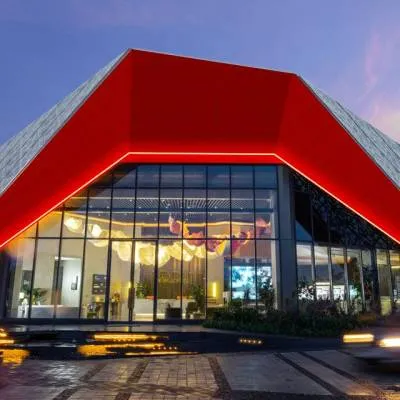
Adani Enterprises Ltd (AEL) announced that its step-down unit Adani Airport City Ltd has incorporated three wholly owned subsidiaries to further its airport city expansion. The new companies are Adani Navi Mumbai Airport City Ltd, Adani Guwahati Airport City Ltd and Adani Ahmedabad Airport City Ltd and they have been formed to undertake real estate activities and hotel development in connection with airport city projects.

A regulatory filing stated that the entities will engage in real estate activities with own or leased property, construction of buildings on own account or on a fee or contract basis, and hotels with integrated restaurants, banquets and business centres. Each subsidiary has been incorporated with a paid-up capital of Rs one million (one mn) with shares subscribed in cash at face value and is fully owned by Adani Airport City Ltd.

The filing did not elaborate whether the plan includes construction of hotels within the vicinity of airports the group operates. Adani Airport Holdings Limited was incorporated in 2019 as a 100 per cent subsidiary of AEL and is described in company filings as the largest airport infrastructure company in the group, with eight airports accounting for 25 per cent of passenger footfalls and 33 per cent of India’s air cargo traffic.

The unit manages airports at Ahmedabad, Lucknow, Mangaluru, Jaipur, Guwahati and Thiruvananthapuram and holds a 73 per cent stake in Mumbai International Airport Ltd, which in turn holds 74 per cent in Navi Mumbai International Airport Ltd. Adani Airport City Ltd is a unit of Adani Airport Holdings Limited and the corporate move is presented as part of an integrated airport city strategy.

The conglomerate previously outlined a USD 15 billion (USD 15 bn) expansion plan for its Indian airport portfolio by 2030 aimed at boosting capacity to 200 million (200 mn) annual passengers and supporting an upcoming IPO of its airport unit. The group recently opened the Navi Mumbai airport with capacity to initially handle 20 mn passengers and has said it intends to raise overall airport capacity by over 60 per cent to meet rising demand projected to surpass 300 mn passengers in India by 2030.

Adani Enterprises Ltd (AEL) announced that its step-down unit Adani Airport City Ltd has incorporated three wholly owned subsidiaries to further its airport city expansion. The new companies are Adani Navi Mumbai Airport City Ltd, Adani Guwahati Airport City Ltd and Adani Ahmedabad Airport City Ltd and they have been formed to undertake real estate activities and hotel development in connection with airport city projects. A regulatory filing stated that the entities will engage in real estate activities with own or leased property, construction of buildings on own account or on a fee or contract basis, and hotels with integrated restaurants, banquets and business centres. Each subsidiary has been incorporated with a paid-up capital of Rs one million (one mn) with shares subscribed in cash at face value and is fully owned by Adani Airport City Ltd. The filing did not elaborate whether the plan includes construction of hotels within the vicinity of airports the group operates. Adani Airport Holdings Limited was incorporated in 2019 as a 100 per cent subsidiary of AEL and is described in company filings as the largest airport infrastructure company in the group, with eight airports accounting for 25 per cent of passenger footfalls and 33 per cent of India’s air cargo traffic. The unit manages airports at Ahmedabad, Lucknow, Mangaluru, Jaipur, Guwahati and Thiruvananthapuram and holds a 73 per cent stake in Mumbai International Airport Ltd, which in turn holds 74 per cent in Navi Mumbai International Airport Ltd. Adani Airport City Ltd is a unit of Adani Airport Holdings Limited and the corporate move is presented as part of an integrated airport city strategy. The conglomerate previously outlined a USD 15 billion (USD 15 bn) expansion plan for its Indian airport portfolio by 2030 aimed at boosting capacity to 200 million (200 mn) annual passengers and supporting an upcoming IPO of its airport unit. The group recently opened the Navi Mumbai airport with capacity to initially handle 20 mn passengers and has said it intends to raise overall airport capacity by over 60 per cent to meet rising demand projected to surpass 300 mn passengers in India by 2030.

Next Story
Infrastructure Urban

Shyam Metalics Q4 Revenue Rises 27%

Shyam Metalics and Energy reported consolidated revenue of Rs 52.40 billion in Q4 FY26, registering 27 per cent year-on-year growth from Rs 41.39 billion in Q4 FY25. EBITDA rose 33 per cent to Rs 7.56 billion, while Profit After Tax increased 42 per cent to Rs 3.12 billion. Operating EBITDA grew 41 per cent to Rs 7.27 billion during the quarter.For FY26, the company posted consolidated revenue of Rs 185.52 billion, up 22 per cent over FY25. EBITDA stood at Rs 25.37 billion, while PAT increased to Rs 10.61 billion. Operating EBITDA for the year stood at Rs 23.33 billion, marking 25 per cent yea..

Next Story
Infrastructure Urban

DHL Express Launches Heavy Weight Service

DHL Express has expanded its Time Definite International portfolio with the global launch of Heavy Weight Express, an air express solution for shipments weighing up to 1,000 kg per piece and 3,000 kg per shipment. The service will be available across more than 220 countries and territories.The new solution is designed for industries where timing, reliability and shipment visibility are critical. It offers time-definite delivery, end-to-end control, proactive monitoring and transparent all-in pricing. DHL said the service will help reduce uncertainty linked to capacity fluctuations, handling su..

Next Story
Infrastructure Urban

Schaeffler India Opens Research Facility at IISC

Schaeffler India has announced the opening of a computational research infrastructure at the Foundation for Science Innovation and Development (FSID), Bengaluru, as part of its engagement with the Indian Institute of Science (IISC). The facility will support high-performance computing, large-scale simulations, data-intensive modelling and advanced analytics across materials, energy systems and sustainable mobility.The initiative includes dedicated lab space, advanced in-rack cooling systems, power backup and high-performance hybrid computing workstations or clusters. It is expected to improve ..

Advertisement

Subscribe to Our Newsletter

Get daily newsletters around different themes from Construction world.

STAY CONNECTED

Advertisement

Advertisement

Advertisement