




India REIT Market Gains Momentum with Strong Returns
Real Estate

India REIT Market Gains Momentum with Strong Returns

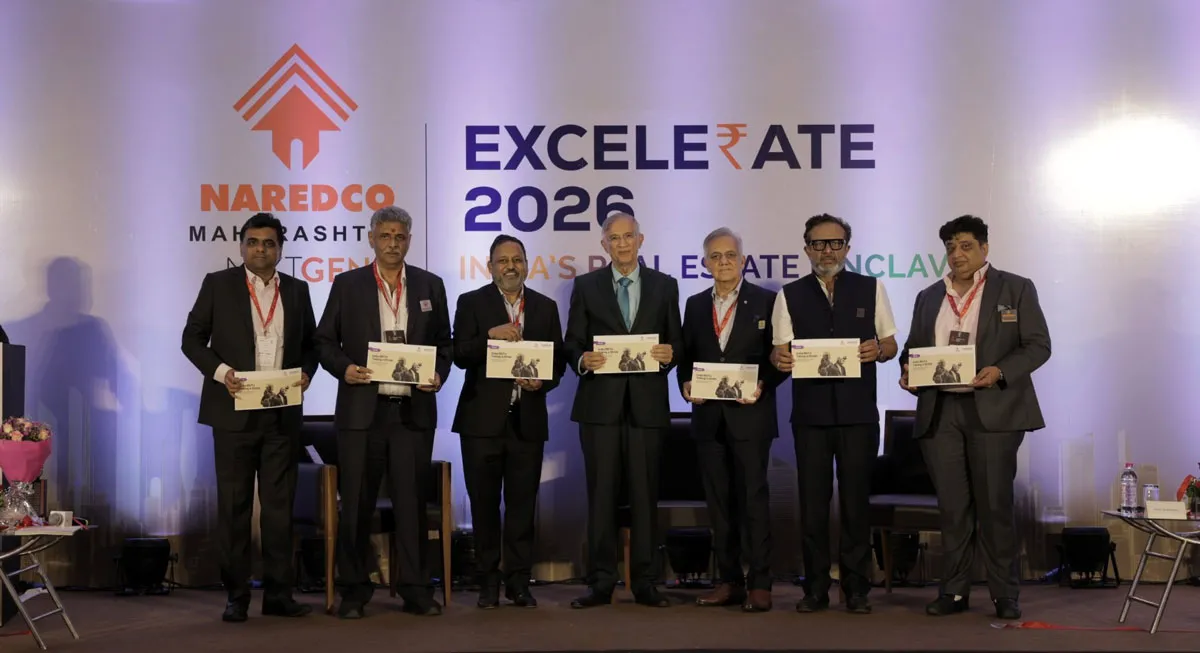
India’s Real Estate Investment Trust (REIT) market is witnessing strong growth, emerging as a competitive investment avenue both domestically and across Asia. According to a recent ANAROCK report released at EXCELERATE 2026 by NAREDCO Maharashtra NextGen, the sector is evolving into a mature asset class driven by solid fundamentals, regulatory backing and rising investor confidence.
The introduction of Small and Medium REITs (SM REITs) in 2025 has further widened access through fractional ownership, unlocking a potential monetisation opportunity of Rs 670–710 billion. Indian REITs have delivered nearly 9 per cent five-year price returns, outperforming several Asian peers, while maintaining distribution yields of 5–6 per cent.
Operational performance remains robust, with portfolio occupancy levels consistently above 90 per cent, backed by global tenants across technology, BFSI and consulting sectors. REITs accounted for over 20 per cent of office leasing in Q2 FY26, supported by healthy re-leasing spreads and rental growth. Since listing, returns have ranged from 12 per cent to over 60 per cent alongside stable income distributions.
Tax efficiency continues to enhance investor appeal. Regulations mandate at least 90 per cent distribution of net cash flows, with over 65 per cent of distributions being tax-exempt, improving post-tax returns for investors.
Growth potential remains significant, with only 32 per cent of REIT-worthy assets currently listed. Expansion into logistics, data centres, healthcare and residential segments is expected to further strengthen the investment landscape.
Introduced by Securities and Exchange Board of India in 2014, REITs have formalised real estate investments by offering liquidity and diversification. India currently has five listed REITs managing over 176 million sq ft of space, reflecting steady expansion supported by institutional capital and policy reforms.
EXCELERATE 2026 brought together global and domestic stakeholders to discuss investment strategies, emerging asset classes and the future of real estate financing in India, reinforcing the sector’s evolving role as a global investment destination.

India’s Real Estate Investment Trust (REIT) market is witnessing strong growth, emerging as a competitive investment avenue both domestically and across Asia. According to a recent ANAROCK report released at EXCELERATE 2026 by NAREDCO Maharashtra NextGen, the sector is evolving into a mature asset class driven by solid fundamentals, regulatory backing and rising investor confidence.The introduction of Small and Medium REITs (SM REITs) in 2025 has further widened access through fractional ownership, unlocking a potential monetisation opportunity of Rs 670–710 billion. Indian REITs have delivered nearly 9 per cent five-year price returns, outperforming several Asian peers, while maintaining distribution yields of 5–6 per cent.Operational performance remains robust, with portfolio occupancy levels consistently above 90 per cent, backed by global tenants across technology, BFSI and consulting sectors. REITs accounted for over 20 per cent of office leasing in Q2 FY26, supported by healthy re-leasing spreads and rental growth. Since listing, returns have ranged from 12 per cent to over 60 per cent alongside stable income distributions.Tax efficiency continues to enhance investor appeal. Regulations mandate at least 90 per cent distribution of net cash flows, with over 65 per cent of distributions being tax-exempt, improving post-tax returns for investors.Growth potential remains significant, with only 32 per cent of REIT-worthy assets currently listed. Expansion into logistics, data centres, healthcare and residential segments is expected to further strengthen the investment landscape.Introduced by Securities and Exchange Board of India in 2014, REITs have formalised real estate investments by offering liquidity and diversification. India currently has five listed REITs managing over 176 million sq ft of space, reflecting steady expansion supported by institutional capital and policy reforms.EXCELERATE 2026 brought together global and domestic stakeholders to discuss investment strategies, emerging asset classes and the future of real estate financing in India, reinforcing the sector’s evolving role as a global investment destination.

Next Story
Infrastructure Transport

Pune To Build Nine Km Link Road Between Highways

The Pune Municipal Corporation (PMC) has decided to appoint an expert to plan the development of a nine km long, 60 metre wide road from Khadi Machine chowk to Wadki chowk as an extension to the Katraj-Kondhwa road to link the Mumbai-Satara and Pune-Solapur national highways. The scheme is intended to divert heavy vehicle traffic away from the city and improve access between the two arterial routes. The project has been prioritised by the PMC and forms part of a larger set of schemes in which 19 roads have been identified for development at a combined cost of Rs 9.82 billion (bn) to address c..

Next Story
Infrastructure Transport

Barabanki Bahraich Six Lane Highway Approved in Uttar Pradesh

The Uttar Pradesh government has approved construction of a new six-lane highway linking Barabanki and Bahraich as part of National Highway 927, and the cabinet has cleared the project. The alignment will pass through Mustafabad and Kaiserganj and extend for about 101.5 km, creating a key corridor for local and long-distance movement. The National Highways Authority of India will oversee the work and has signalled the scheme is intended to strengthen regional connectivity and cross-border access to Nepal. The project carries an estimated total cost of Rs 69,690 million, equivalent to Rs 69.69..

Next Story
Infrastructure Transport

Toll At Kharegaon Likely As Highway Upgrade Nears Completion

A section of the highway at Kharegaon has undergone an upgrade and is approaching completion, and authorities have indicated plans for a toll to be introduced once works finish. The project has focused on strengthening the carriageway, improving drainage and upgrading intersections to enhance safety and capacity. Officials have said the toll will be used to recover construction costs and fund ongoing maintenance. The upgrade included resurfacing of the pavement, widening of certain stretches and installation of modern signage and lighting to reduce accident risk. Contractors completed most ma..

Advertisement

Subscribe to Our Newsletter

Get daily newsletters around different themes from Construction world.

STAY CONNECTED

Advertisement

Advertisement

Advertisement