


+
Real Estate Developers Urged to Work with Civic Bodies
Real Estate

Real Estate Developers Urged to Work with Civic Bodies

Real estate developers should work closely with municipal agencies to create infrastructure for housing and commercial projects, while assessing their wider impact on water, sewage, energy and surrounding urban systems, D Thara, secretary in the Ministry of Housing and Urban Affairs (MoHUA), said at a Confederation of Indian Industry (CII) conference in New Delhi on September 18.

Thara said each development interacted with the wider urban environment and required its external effects to be identified and mitigated. She urged developers to focus on rainwater harvesting, water recycling and sewage treatment, and to evaluate projects beyond their boundaries, including the infrastructure burden and resources they consume.

The conference discussions highlighted the growing importance of sustainable urban development and the need to include environmental considerations in planning and approval processes. Thara also called for a public-private approach to urban development and a broader definition of value that covered infrastructure requirements, resource consumption and environmental impact, rather than property prices alone.

Participants discussed how emerging sectors, expanding economic corridors and new cities were reshaping demand and creating opportunities for the real estate industry. They also sought faster and more integrated approvals through a single-window system that would allow applications to move simultaneously across departments. Speakers said affordability needed to be addressed throughout the value chain through improved floor space index, efficient land models, better infrastructure and lower capital costs.

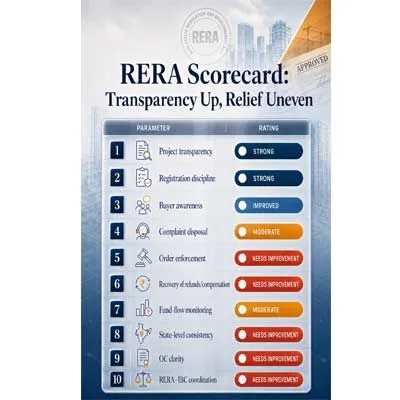
The conference also examined measures to improve housing affordability. Vishal Gupta, president of CREDAI-NCR and managing director of Ashiana Housing, identified shortages of quality contractors and skilled labour as factors increasing construction costs. He said regulatory transparency had improved under the Real Estate (Regulation and Development) Act, but faster approvals, tax rationalisation, greater land availability and affordable capital were still needed. Gupta also said delays in building plan approvals, registrations and other compliance processes added to housing costs, while limited goods and services tax input credit further increased the burden.

Real estate developers should work closely with municipal agencies to create infrastructure for housing and commercial projects, while assessing their wider impact on water, sewage, energy and surrounding urban systems, D Thara, secretary in the Ministry of Housing and Urban Affairs (MoHUA), said at a Confederation of Indian Industry (CII) conference in New Delhi on September 18. Thara said each development interacted with the wider urban environment and required its external effects to be identified and mitigated. She urged developers to focus on rainwater harvesting, water recycling and sewage treatment, and to evaluate projects beyond their boundaries, including the infrastructure burden and resources they consume. The conference discussions highlighted the growing importance of sustainable urban development and the need to include environmental considerations in planning and approval processes. Thara also called for a public-private approach to urban development and a broader definition of value that covered infrastructure requirements, resource consumption and environmental impact, rather than property prices alone. Participants discussed how emerging sectors, expanding economic corridors and new cities were reshaping demand and creating opportunities for the real estate industry. They also sought faster and more integrated approvals through a single-window system that would allow applications to move simultaneously across departments. Speakers said affordability needed to be addressed throughout the value chain through improved floor space index, efficient land models, better infrastructure and lower capital costs. The conference also examined measures to improve housing affordability. Vishal Gupta, president of CREDAI-NCR and managing director of Ashiana Housing, identified shortages of quality contractors and skilled labour as factors increasing construction costs. He said regulatory transparency had improved under the Real Estate (Regulation and Development) Act, but faster approvals, tax rationalisation, greater land availability and affordable capital were still needed. Gupta also said delays in building plan approvals, registrations and other compliance processes added to housing costs, while limited goods and services tax input credit further increased the burden.

Related Stories

Gold Stories
Next Story
Technology

Onward Technologies Renews Rs. 444.6 mn Digital Services Contract

Onward Technologies has renewed a multi-year Managed Digital Services contract, with an expanded scope valued at Rs. 444.6 mn over the contract tenure. The engagement is with one of the world’s leading manufacturers of construction and mining equipment and will run from August 2026 to August 2029, according to a regulatory filing dated September 21, 2026. The renewed contract represents a 72 per cent increase in value compared with the previous agreement. The expansion reflects the customer’s continued confidence in Onward Technologies’ delivery capabilities, digital engineering expertis..

Next Story
Real Estate

Ashiana Housing to Invest Rs. 10 bn in FY27 Land Acquisition

Ashiana Housing plans to invest around Rs. 10 bn in land acquisition during FY27 as it expands its housing and senior living businesses across major markets. The company has sufficient cash to fund the investment, managing director Vishal Gupta said in comments to PTI. The real estate developer is seeking land for regular group housing and senior living projects in Delhi-NCR, Rajasthan, Maharashtra and Tamil Nadu. Acquisitions will be made through outright purchases as well as joint development arrangements with landowners. The company expects sales bookings in FY27 to remain broadly similar t..

Next Story
Infrastructure Urban

Andhra SIPB Approves 28 Projects Worth Rs. 221.78 bn

The 21st State Investment Promotion Board (SIPB) meeting, chaired by Andhra Pradesh Chief Minister Nara Chandrababu Naidu at the Secretariat in Velagapudi, approved 28 industrial proposals involving Rs. 221.78 bn in investment. The projects are expected to generate employment for 19,739 people across energy, information technology and communications, food processing, manufacturing and tourism. Across 21 SIPB meetings, the State has approved 387 projects representing a potential investment of Rs. 14.05 tn and employment opportunities for 1,079,000 people. Naidu instructed officials to ensure th..

Advertisement

Subscribe to Our Newsletter

Get daily newsletters around different themes from Construction world.

STAY CONNECTED

Advertisement

SPECIAL OFFER
QR Code