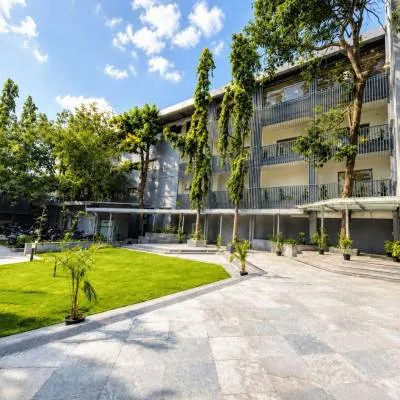
WeWork bags US govt contract for providing hybrid working model
Real Estate

WeWork bags US govt contract for providing hybrid working model

Office-sharing startup WeWork has bagged a US government contract to provide flexible working solutions to government employees as the surge in Covid-19 cases has forced employers to reconsider a complete return to offices.

A spokesperson for the SoftBank Group Corp-backed firm told the media that the contract, granted by the U.S. General Services Administration to WeWork and four other contractors, is for $10 million yearly and a term of five years.

The Covid-19 pandemic has marked a shift away from a conventional stand-alone workplace and towards a more hybrid work model where employees have flexible options to work from offices, co-working spaces, public places and home.

The fast-spreading Delta variant of the coronavirus and the following tightening of restrictions in some areas have increased concerns for office space providers since businesses opt for shorter leases and many employees continue to work remotely.

Earlier this month, WeWork recorded a drop in second-quarter earnings from the previous three months since the Delta variant stoked a slower-than-expected recovery for the first half of the year.

Various U.S. federal firms last month mandated masks at government buildings in Covid-19 hot spots in line with guidance issued by the White House.

WeWork in March agreed to go public through a merger with BowX Acquisition Corp, a special purpose acquisition firm, in a contract that valued it at $9 billion.

Image Source


Also read: Colive transforms co-living properties into hybrid accommodations

Office-sharing startup WeWork has bagged a US government contract to provide flexible working solutions to government employees as the surge in Covid-19 cases has forced employers to reconsider a complete return to offices. A spokesperson for the SoftBank Group Corp-backed firm told the media that the contract, granted by the U.S. General Services Administration to WeWork and four other contractors, is for $10 million yearly and a term of five years. The Covid-19 pandemic has marked a shift away from a conventional stand-alone workplace and towards a more hybrid work model where employees have flexible options to work from offices, co-working spaces, public places and home. The fast-spreading Delta variant of the coronavirus and the following tightening of restrictions in some areas have increased concerns for office space providers since businesses opt for shorter leases and many employees continue to work remotely. Earlier this month, WeWork recorded a drop in second-quarter earnings from the previous three months since the Delta variant stoked a slower-than-expected recovery for the first half of the year. Various U.S. federal firms last month mandated masks at government buildings in Covid-19 hot spots in line with guidance issued by the White House. WeWork in March agreed to go public through a merger with BowX Acquisition Corp, a special purpose acquisition firm, in a contract that valued it at $9 billion. Image Source Also read: Colive transforms co-living properties into hybrid accommodations

Next Story
Infrastructure Urban

Implementation Status of Jal Jeevan Mission

Since August 2019 the Government has implemented Jal Jeevan Mission to provide assured potable water through household tap connections in rural India. At the start of the mission only 32.3 million (mn) rural households, representing 16.7 per cent, were reported to have tap water connections. States and union territories have reported that 125.8 mn additional rural households have since been provided with tap connections. As a result, of about 193.6 mn rural households roughly 158.2 mn, or 81.71 per cent, are reported to have tap water supply at home.\n\nThe State, district and village level st..

Next Story
Infrastructure Urban

Jal Jeevan Mission Reaches Eighty One Per Cent Rural Coverage

The Government reported substantial progress under the Jal Jeevan Mission, launched in August 2019 to provide tap water to every rural household. At launch only 32.3 million (mn) rural households had tap connections and states and Union territories reported provision of 125.8 mn additional households by March 2026. Consequently, out of about 193.6 mn rural households around 158.2 mn, or 81.71 per cent, are reported to have tap water at home. The Finance Minister announced extension of the mission until 2028 in the 2025-26 budget speech. The Swachh Bharat Mission Grameen, launched in October 20..

Next Story
Infrastructure Urban

Empowering Local Governance for Sustainable Rural Water Supply

The Ministry of Jal Shakti has aligned the Jal Jeevan Mission (JJM) with the 73rd Amendment to strengthen village level planning and community ownership of water supply. Gram Panchayats, village water and sanitation committees and Pani Samitis are to plan, implement, manage and maintain piped water systems, with gram sabha processes formalising handover and oversight. Implementation support agencies including non government organisations, community based organisations and self help groups have been empanelled to train local committees and promote women participation. Under JJM, the department ..

Advertisement

Subscribe to Our Newsletter

Get daily newsletters around different themes from Construction world.

STAY CONNECTED

Advertisement

Advertisement

Advertisement