


India Data Centre Capacity To Reach 4 GW By FY30
Technology

India Data Centre Capacity To Reach 4 GW By FY30

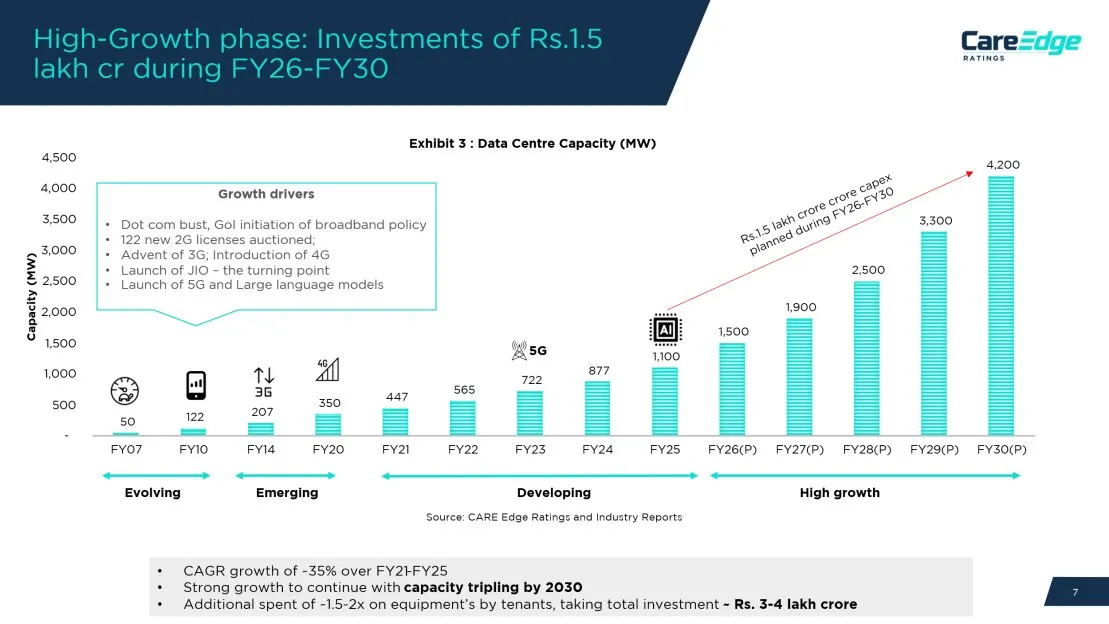
CareEdge Ratings projects India’s data centre capacity to rise to about 4 GW by FY30, supported by an investment potential of Rs 1.5 lakh crore over the period.

Capacity per million internet users in India remains low at 1.2 MW, compared with the global average of 5 MW. Growth is being driven by digitisation, cost competitiveness and rising adoption of artificial intelligence (AI). India currently holds around 4 per cent of global data centre capacity at 1.2 GW in 2025, expected to scale to 4 GW by 2030.

Co-location capacity has expanded steadily, doubling to 1.2 GW during FY22–FY25, with utilisation levels exceeding 90 per cent. Strong demand is expected to sustain absorption levels. Long-term contracts provide revenue visibility, supporting stable cash flows and customer retention. The sector is projected to record a revenue CAGR of about 24 per cent during FY26–FY30, with EBITDA margins of 40–42 per cent, though leverage may remain elevated due to ongoing capex.

Puja Jalan, Director CareEdge Ratings, says, “The industry is in an upswing with high capex, fundraising capability of strong sponsors and large equity investments targeted to the Indian Data Centre entities. The industry is likely to witness a revenue CAGR of 24% during FY26-30, with steady-state margins ranging between 40% and 42%. The AI-led demand shall catapult the growth story. However, power infrastructure support is critical to realise the industry's potential. Also, the capability to manage cash flows amid rising costs and escalating commissioning timelines shall be key to sustenance.”

Data centre costs have risen by 50–70 per cent due to higher land prices, advanced cooling systems and renewable energy adoption. Project timelines have also extended due to scope changes and approval delays. However, increasing use of renewable energy and efficient cooling is improving PUE and supporting the shift towards green data centres.

India’s digital penetration is approaching global levels, with mobile subscriber share at 77 per cent and internet penetration at 67 per cent in 2025, close to global averages. Despite this, India’s share in global capacity remains modest, indicating strong growth potential. Tenant investments in IT equipment are expected to be 1.5–2 times infrastructure spend, taking total investment potential to Rs 3–4 lakh crore.

Construction and operating costs in India are 30–40 per cent lower than in China and the US, aided by lower land costs and competitive power tariffs, making the country attractive for hyperscalers and cloud providers.

Tej Kiran, Associate Director CareEdge Ratings, adds, “Global AI investments have crossed nearly USD 1 trillion between 2020–2025, with India witnessing strong momentum supported by government initiatives. While data centre demand is currently driven by enterprise IT and cloud storage, AI-led workloads are expected to power the next phase of growth over the next 5–7 years, with the pace of adoption in India linked to the timely scaling of high-performance Graphics Processing Unit (GPU) availability.”

CareEdge Ratings notes that global macroeconomic disruptions linked to West Asia conflicts are unlikely to significantly impact the sector in the medium term, though near-term effects remain monitorable.

CareEdge Ratings projects India’s data centre capacity to rise to about 4 GW by FY30, supported by an investment potential of Rs 1.5 lakh crore over the period. Capacity per million internet users in India remains low at 1.2 MW, compared with the global average of 5 MW. Growth is being driven by digitisation, cost competitiveness and rising adoption of artificial intelligence (AI). India currently holds around 4 per cent of global data centre capacity at 1.2 GW in 2025, expected to scale to 4 GW by 2030. Co-location capacity has expanded steadily, doubling to 1.2 GW during FY22–FY25, with utilisation levels exceeding 90 per cent. Strong demand is expected to sustain absorption levels. Long-term contracts provide revenue visibility, supporting stable cash flows and customer retention. The sector is projected to record a revenue CAGR of about 24 per cent during FY26–FY30, with EBITDA margins of 40–42 per cent, though leverage may remain elevated due to ongoing capex. Puja Jalan, Director CareEdge Ratings, says, “The industry is in an upswing with high capex, fundraising capability of strong sponsors and large equity investments targeted to the Indian Data Centre entities. The industry is likely to witness a revenue CAGR of 24% during FY26-30, with steady-state margins ranging between 40% and 42%. The AI-led demand shall catapult the growth story. However, power infrastructure support is critical to realise the industry's potential. Also, the capability to manage cash flows amid rising costs and escalating commissioning timelines shall be key to sustenance.” Data centre costs have risen by 50–70 per cent due to higher land prices, advanced cooling systems and renewable energy adoption. Project timelines have also extended due to scope changes and approval delays. However, increasing use of renewable energy and efficient cooling is improving PUE and supporting the shift towards green data centres. India’s digital penetration is approaching global levels, with mobile subscriber share at 77 per cent and internet penetration at 67 per cent in 2025, close to global averages. Despite this, India’s share in global capacity remains modest, indicating strong growth potential. Tenant investments in IT equipment are expected to be 1.5–2 times infrastructure spend, taking total investment potential to Rs 3–4 lakh crore. Construction and operating costs in India are 30–40 per cent lower than in China and the US, aided by lower land costs and competitive power tariffs, making the country attractive for hyperscalers and cloud providers. Tej Kiran, Associate Director CareEdge Ratings, adds, “Global AI investments have crossed nearly USD 1 trillion between 2020–2025, with India witnessing strong momentum supported by government initiatives. While data centre demand is currently driven by enterprise IT and cloud storage, AI-led workloads are expected to power the next phase of growth over the next 5–7 years, with the pace of adoption in India linked to the timely scaling of high-performance Graphics Processing Unit (GPU) availability.” CareEdge Ratings notes that global macroeconomic disruptions linked to West Asia conflicts are unlikely to significantly impact the sector in the medium term, though near-term effects remain monitorable.

Next Story
Real Estate

Indian real estate attracts USD 1.4 bn institutional investments in Q1 2026: Vestian

Institutional investments in India’s real estate sector touched USD 1.4 billion in Q1 2026, marking the highest first-quarter inflow since 2022, according to Vestian. While investments fell 62 per cent quarter-on-quarter due to an exceptionally high base in the previous quarter, they rose 74 per cent compared to the same period last year, reflecting sustained investor confidence despite rising geopolitical and macroeconomic challenges.Commercial real estate remained the key driver of investment activity during the quarter, accounting for 80 per cent of total inflows, sharply higher than 38 p..

Next Story
Infrastructure Transport

VECV crosses 1 lakh annual vehicle sales milestone in FY26

VE Commercial Vehicles (VECV), a joint venture between Volvo Group and Eicher Motors, has surpassed the 1 lakh annual sales mark in FY 2025–26, recording its highest-ever commercial vehicle sales performance. The company said it sold more than 100,000 vehicles during the year, marking a major milestone aligned with the original vision of the Volvo–Eicher joint venture.The strong performance was supported by demand across categories. Light and Medium Duty (LMD) trucks contributed 47,789 units, accounting for 46.1 per cent of total sales. Heavy Duty (HD) trucks recorded 26,867 units (25.9 pe..

Next Story
Technology

Rodic Digital & Advisory partners SatSure to deploy EO intelligence in public sector

Rodic Digital & Advisory (RDA), the strategic advisory and digital transformation arm of Rodic Consultants, has signed a strategic cooperation Memorandum of Understanding (MoU) with SatSure to jointly pursue opportunities in India’s public sector. The collaboration aims to integrate high-resolution Earth Observation (EO) data and geospatial AI into government workflows to strengthen monitoring, compliance, and operational decision-making across key sectors.The partnership combines SatSure’s Earth intelligence capabilities with RDA’s expertise in government digital transformation and ..

Advertisement

Subscribe to Our Newsletter

Get daily newsletters around different themes from Construction world.

STAY CONNECTED

Advertisement

Advertisement

Advertisement