
L&T 3D prints first G+1 building in India
Technology

L&T 3D prints first G+1 building in India

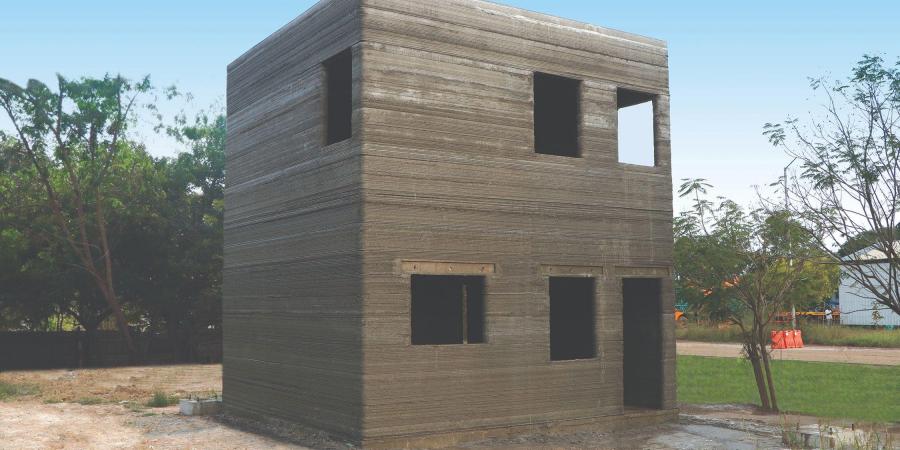
In a first, L&T Construction has successfully 3D printed a G+1 (ground-plus-one floor) building in India.

The company 3D-printed the building at its Kancheepuram (Tamil Nadu) facility, which consists of a total built-up area of 700 sq ft. It used an in-house developed concrete mix and construction materials that are indigenously available.

MV Satish, Whole Time Director and Senior Executive Vice President (Buildings), Larsen & Toubro (L&T), stated that 3D concrete printing is a technology disruptor that will redefine the construction methodologies. It will help accelerate construction speed and build quality.

The building was printed with a vertical reinforcement bar as well as horizontal distributors. The construction used welded mesh that satisfies the provisions of Indian codes, thus optimising the cost of construction.

Excluding the horizontal slab members, the whole structure was 3D printed at the job site in an “open to sky” environment, also known as “Cast in Situ”. The statement mentioned it was built in 106 hours using a fully automated 3D printer.

In the 3D printing process, the material is printed under computer control to create a 3-dimensional product. It is made layer by layer as seen in manufacturing industries to print prototypes. These prototypes are usually complex shapes and are made in small batches using metal alloys and special polymers.

The 3D concrete printing technology is still a work in progress around the world.

The team also 3D printed a 1 BHK of 240 sq ft earlier in November 2019. It was in line with the building layout of the Economically Weaker Sections (EWS). It helped to understand the feasibility of innovative technology.

Image Source

In a first, L&T Construction has successfully 3D printed a G+1 (ground-plus-one floor) building in India. The company 3D-printed the building at its Kancheepuram (Tamil Nadu) facility, which consists of a total built-up area of 700 sq ft. It used an in-house developed concrete mix and construction materials that are indigenously available. MV Satish, Whole Time Director and Senior Executive Vice President (Buildings), Larsen & Toubro (L&T), stated that 3D concrete printing is a technology disruptor that will redefine the construction methodologies. It will help accelerate construction speed and build quality. The building was printed with a vertical reinforcement bar as well as horizontal distributors. The construction used welded mesh that satisfies the provisions of Indian codes, thus optimising the cost of construction. Excluding the horizontal slab members, the whole structure was 3D printed at the job site in an “open to sky” environment, also known as “Cast in Situ”. The statement mentioned it was built in 106 hours using a fully automated 3D printer. In the 3D printing process, the material is printed under computer control to create a 3-dimensional product. It is made layer by layer as seen in manufacturing industries to print prototypes. These prototypes are usually complex shapes and are made in small batches using metal alloys and special polymers. The 3D concrete printing technology is still a work in progress around the world. The team also 3D printed a 1 BHK of 240 sq ft earlier in November 2019. It was in line with the building layout of the Economically Weaker Sections (EWS). It helped to understand the feasibility of innovative technology. Image Source

Related Stories

Gold Stories
Next Story
Infrastructure Urban

KONE Opens India's First Digital Experience Centre in Pune

KONE, a global elevator and escalator manufacturer, has inaugurated its first Digital Experience Centre (DEC) in India, located in Pune. The facility aims to showcase how artificial intelligence (AI), connectivity and data-driven technologies can enhance customer experiences and improve building operations.The centre was inaugurated by Jussi Herlin, Executive Vice Chair, KONE Corporation; Philippe Delorme, President and CEO, KONE; and Nandan Nilekani, Co-founder and Chairman of the Board, Infosys.Designed as an interactive customer environment, the facility demonstrates digital solutions cover..

Next Story
Infrastructure Urban

CII GreenCo Launches Circularity Guidelines for Indian Industry

The Confederation of Indian Industry (CII) GreenCo Council has launched the CII GreenCo Circularity Guidelines – Pilot Version at the 17th CII GreenCo Waste & Resource Management Summit 2026 in Chennai. The initiative aims to strengthen resource efficiency, waste reduction and circular economy practices across Indian manufacturing and process industries.The guidelines introduce a structured framework with circularity indices covering raw materials, consumables, packaging and other resource inputs. These indicators will help industries assess existing practices, identify opportunities to ..

Next Story
Infrastructure Energy

Global Electronics Association Launches IPC-1783-CO2E Standard

The Global Electronics Association has introduced IPC-1783-CO2E, a new international standard aimed at improving consistency, transparency and comparability in product carbon footprint reporting across the electronics manufacturing industry.The standard, titled International Standard for Data Collection and Reporting of CO2 Equivalent (CO2e) Emissions for the Electronics Manufacturing Supply Chain, provides industry-specific guidance for collecting, estimating and reporting carbon emissions data.With increasing regulatory requirements and customer expectations, electronics manufacturers face c..

Advertisement

Subscribe to Our Newsletter

Get daily newsletters around different themes from Construction world.

STAY CONNECTED

Advertisement

SPECIAL OFFER
QR Code