

MIT-WPU Develops AI Models to Boost Oil Recovery
Technology

MIT-WPU Develops AI Models to Boost Oil Recovery

Amid global energy market volatility driven by geopolitical tensions and oil supply disruptions, researchers at MIT World Peace University (MIT-WPU), Pune, have developed advanced artificial intelligence (AI) and machine learning (ML) models to enhance oil recovery from mature reservoirs and improve production forecasting. The research is expected to support India’s energy security by increasing efficiency in existing oil fields and reducing reliance on crude oil imports.
With oil and gas contributing nearly 32–37 per cent of India’s energy consumption and crude imports estimated at USD 161 billion, improving domestic production has become a strategic priority. Researchers from the Department of Petroleum Engineering at MIT-WPU are applying AI to address complex challenges in reservoir management.
A research team led by Dr Rajib Kumar Sinharay, along with Dr Hrishikesh K Chavan, has developed a machine learning model that identifies the most suitable Enhanced Oil Recovery (EOR) techniques for complex reservoirs. Trained on global field data, the model achieved 91 per cent accuracy and significantly reduced evaluation time from months to hours. The findings were published in Petroleum Science and Technology.
In another development, Prof Samarth Patwardhan and Dr Soumitra Nande created a deep learning model capable of identifying carbonate reservoir rocks with 97 per cent accuracy, similar to formations in Bombay High. This research appeared in the Arabian Journal for Science and Engineering in 2025.
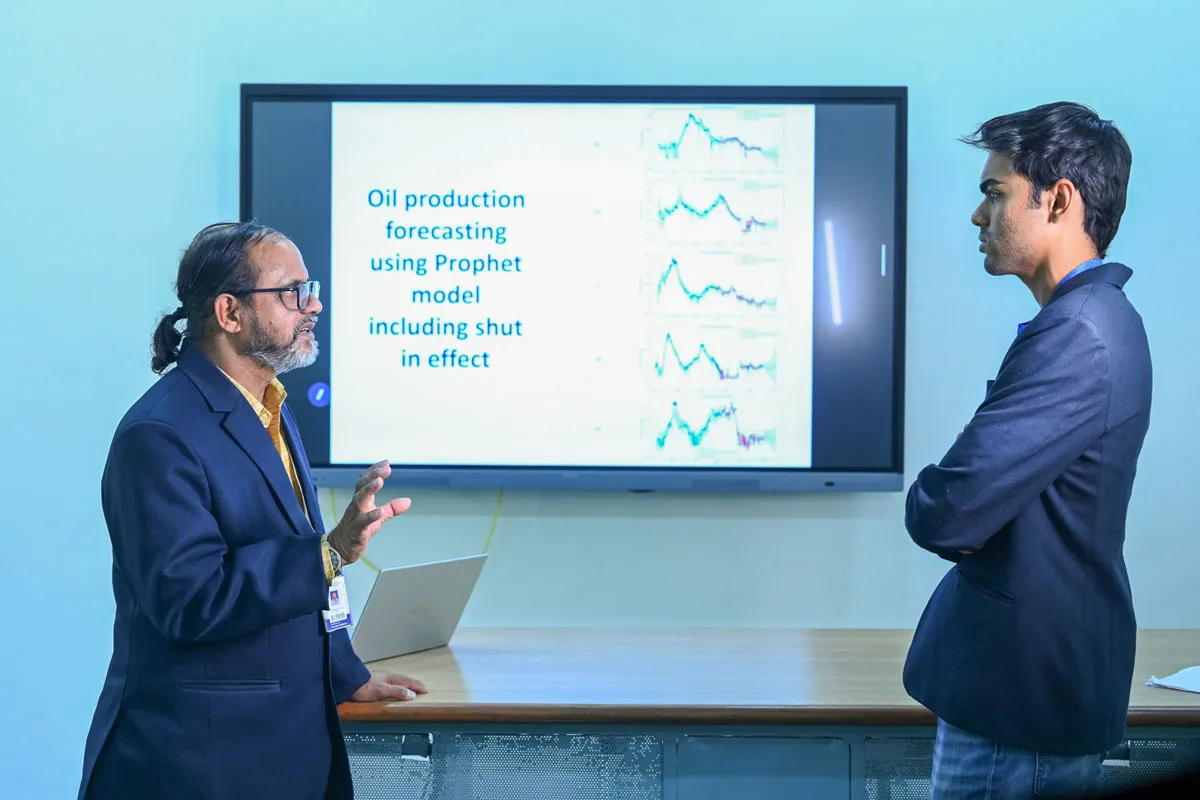
The team has also developed a machine learning model for forecasting oil production in mature fields, achieving 92 per cent accuracy when tested on Indian onshore reservoir data. The research, published in Physics of Fluids, highlights the importance of accurate forecasting in investment planning and reservoir management.
Additionally, an AI-based model for optimising oil production tubing design has been developed, enabling efficient pipe size selection for extraction. This work was presented at the International Conference on Computational Science and Applications and later published in Springer Nature’s Algorithms for Intelligent Systems series. The team has secured a patent for this innovation.
Ongoing research includes identifying ‘sweet spots’ in unconventional reservoirs and developing sustainable drilling fluids for high-temperature and high-pressure conditions. These advancements underscore the growing role of AI in improving oil recovery and strengthening India’s domestic energy capabilities in an uncertain global landscape.

Amid global energy market volatility driven by geopolitical tensions and oil supply disruptions, researchers at MIT World Peace University (MIT-WPU), Pune, have developed advanced artificial intelligence (AI) and machine learning (ML) models to enhance oil recovery from mature reservoirs and improve production forecasting. The research is expected to support India’s energy security by increasing efficiency in existing oil fields and reducing reliance on crude oil imports.With oil and gas contributing nearly 32–37 per cent of India’s energy consumption and crude imports estimated at USD 161 billion, improving domestic production has become a strategic priority. Researchers from the Department of Petroleum Engineering at MIT-WPU are applying AI to address complex challenges in reservoir management.A research team led by Dr Rajib Kumar Sinharay, along with Dr Hrishikesh K Chavan, has developed a machine learning model that identifies the most suitable Enhanced Oil Recovery (EOR) techniques for complex reservoirs. Trained on global field data, the model achieved 91 per cent accuracy and significantly reduced evaluation time from months to hours. The findings were published in Petroleum Science and Technology.In another development, Prof Samarth Patwardhan and Dr Soumitra Nande created a deep learning model capable of identifying carbonate reservoir rocks with 97 per cent accuracy, similar to formations in Bombay High. This research appeared in the Arabian Journal for Science and Engineering in 2025.The team has also developed a machine learning model for forecasting oil production in mature fields, achieving 92 per cent accuracy when tested on Indian onshore reservoir data. The research, published in Physics of Fluids, highlights the importance of accurate forecasting in investment planning and reservoir management.Additionally, an AI-based model for optimising oil production tubing design has been developed, enabling efficient pipe size selection for extraction. This work was presented at the International Conference on Computational Science and Applications and later published in Springer Nature’s Algorithms for Intelligent Systems series. The team has secured a patent for this innovation.Ongoing research includes identifying ‘sweet spots’ in unconventional reservoirs and developing sustainable drilling fluids for high-temperature and high-pressure conditions. These advancements underscore the growing role of AI in improving oil recovery and strengthening India’s domestic energy capabilities in an uncertain global landscape.

Next Story
Infrastructure Urban

Greenply Advances Sustainability with ESG and Plantation Drive

Greenply Industries Limited has recently reinforced its sustainability commitment by integrating environmental, social and governance (ESG) principles across its operations. The company continues to align its growth strategy with environmental stewardship, resource efficiency and transparent governance.Guided by its ESG framework, Greenply focuses on measuring and managing its environmental and social impact while setting clear, measurable sustainability goals. This approach ensures transparency and drives continuous improvement across its business processes.A key highlight of its sustainabili..

Next Story
Infrastructure Urban

BIO-ROXX Boosts Efficiency at Mühlacker Biomethane Plant

The Mühlacker biomethane plant in Baden-Württemberg, Germany, has recently enhanced its operational efficiency by integrating the BIO-ROXX substrate preparation module from Wangen Pumps. The system improves substrate consistency, handles long fibres, and effectively removes solid contaminants, addressing the growing complexity of biogas feedstocks.The plant, established in 2007, processes around 30,000 tonnes of feedstock annually from over 120 suppliers, producing biomethane and fertilisers. With increasing use of long-fibre materials such as straw and manure, the existing dry infeed system..

Next Story
Infrastructure Urban

HIRECT Launches Copper Conductors for High-Power Transformers

Hind Rectifiers (HIRECT) has recently announced the commercial availability of advanced copper conductors from its expanded facility in Sinnar, Nashik. The new product portfolio includes Continuously Transposed Conductors (CTC), Paper Insulated Copper Conductors (PICC), and Enameled Paper Insulated Copper Conductors (EPICC), designed for high-power transformers, traction motors, and wound components.The conductors are engineered to support key infrastructure sectors such as power grids, railway systems, and industrial power networks, while also strengthening the company’s presence in global ..

Advertisement

Subscribe to Our Newsletter

Get daily newsletters around different themes from Construction world.

STAY CONNECTED

Advertisement

Advertisement

Advertisement