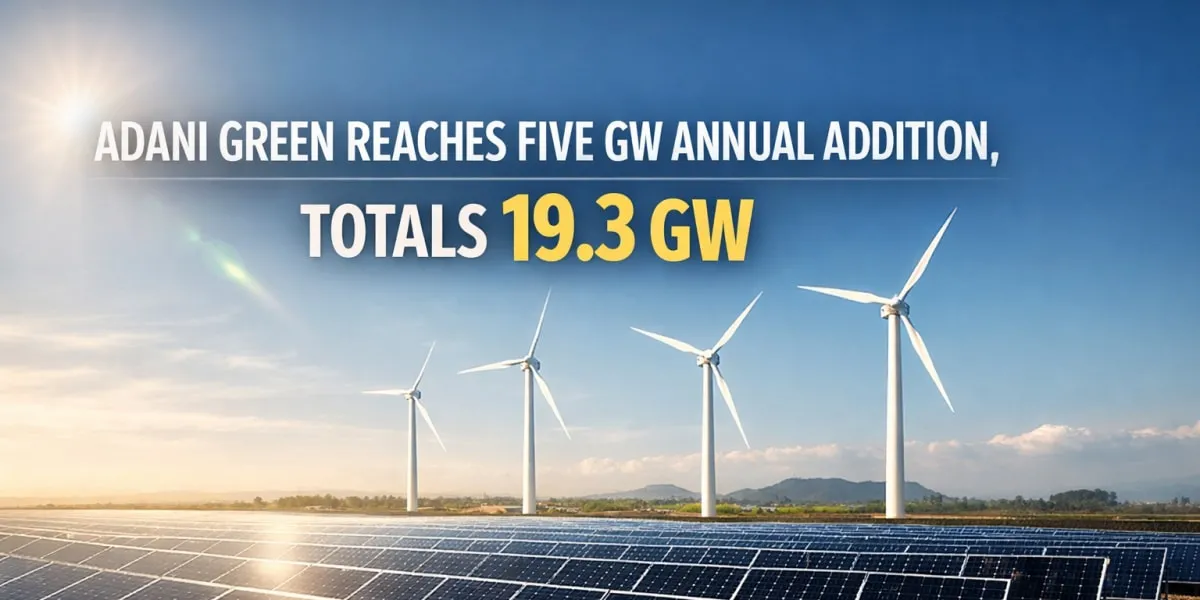
Adani Green Reaches Five GW Annual Addition, Totals 19.3 GW
ECONOMY & POLICY

Adani Green Reaches Five GW Annual Addition, Totals 19.3 GW

Adani Green Energy Limited added five gigawatts (GW), equal to 5,051 megawatts (MW), in the financial year 2025–26, taking its total operational portfolio to 19.3 GW. This annual greenfield capacity addition is the highest by any company globally outside China and reinforces the firm's leadership in India's renewable sector. The company framed the achievement as a pivotal step in accelerating the country's transition to a low-carbon economy and strengthening energy security.

The new capacity comprised three point four GW (3,409 MW) of solar, zero point seven GW (686 MW) of wind and one GW (956 MW) of wind-solar hybrid installations. The additions are expected to offset around 10 million tonnes of carbon emissions annually, and the company's 19.3 GW portfolio will deliver an annual carbon offset of 36 million tonnes. The firm said the result demonstrated that ultra large-scale renewable deployment is executable at pace.

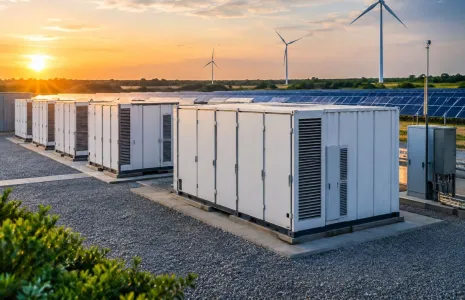
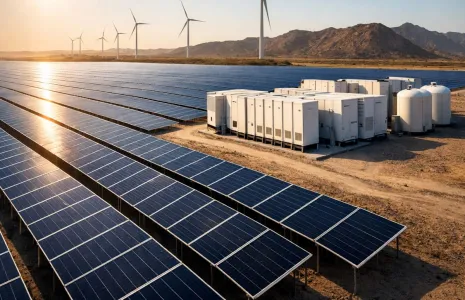
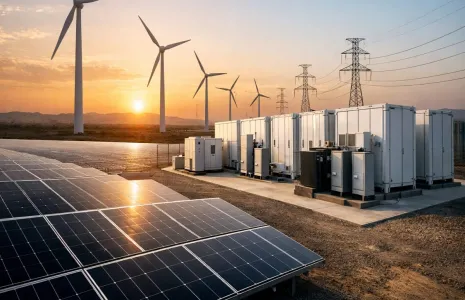
Most of the additional capacity was commissioned at the Khavda site in Gujarat, described by the company as the world's largest single-location renewable energy plant and built across 538 square kilometres, an area five times the size of Paris. Out of the planned 30 GW at Khavda by 2029, the firm has already installed cumulative capacity of nine point four GW (9,413 MW) on the site. The project also brought online an initial 1,376 megawatt hours (MWh) of battery energy storage within eight months of starting work, supporting grid stability and renewable integration.

The Khavda deployment uses bifacial solar modules and solar trackers, employs five point two MW wind turbines and deploys waterless robotic cleaning systems to minimise water use while improving operational efficiency. The company noted continued focus on reducing the levelised cost of energy and on scaling storage solutions as it pursues a target of 50 GW by 2030. The firm also cited third-party recognition, including a top ranking in the Global Top 100 Green Utilities list for 2025 and being named India's leading sustainability performer in the power sector for a second consecutive year.

Adani Green Energy Limited added five gigawatts (GW), equal to 5,051 megawatts (MW), in the financial year 2025–26, taking its total operational portfolio to 19.3 GW. This annual greenfield capacity addition is the highest by any company globally outside China and reinforces the firm's leadership in India's renewable sector. The company framed the achievement as a pivotal step in accelerating the country's transition to a low-carbon economy and strengthening energy security. The new capacity comprised three point four GW (3,409 MW) of solar, zero point seven GW (686 MW) of wind and one GW (956 MW) of wind-solar hybrid installations. The additions are expected to offset around 10 million tonnes of carbon emissions annually, and the company's 19.3 GW portfolio will deliver an annual carbon offset of 36 million tonnes. The firm said the result demonstrated that ultra large-scale renewable deployment is executable at pace. Most of the additional capacity was commissioned at the Khavda site in Gujarat, described by the company as the world's largest single-location renewable energy plant and built across 538 square kilometres, an area five times the size of Paris. Out of the planned 30 GW at Khavda by 2029, the firm has already installed cumulative capacity of nine point four GW (9,413 MW) on the site. The project also brought online an initial 1,376 megawatt hours (MWh) of battery energy storage within eight months of starting work, supporting grid stability and renewable integration. The Khavda deployment uses bifacial solar modules and solar trackers, employs five point two MW wind turbines and deploys waterless robotic cleaning systems to minimise water use while improving operational efficiency. The company noted continued focus on reducing the levelised cost of energy and on scaling storage solutions as it pursues a target of 50 GW by 2030. The firm also cited third-party recognition, including a top ranking in the Global Top 100 Green Utilities list for 2025 and being named India's leading sustainability performer in the power sector for a second consecutive year.

Next Story
Infrastructure Urban

Centre Disburses Over Rs 24,610 mn in XV Finance Commission Grants

The Union Government has released XV Finance Commission tied grants during the financial year 2025–26 to rural local bodies in Chhattisgarh, Gujarat, Madhya Pradesh, Punjab and Sikkim and has released withheld portions of tied and untied grants to Himachal Pradesh, Odisha and Tripura. The total disbursal exceeded Rs 24,610 mn, with figures expressed in million (mn) thereafter. The releases cover allocations pertaining to different financial years and aim to strengthen rural local governance. State-wise disbursements included Rs 3,324.6 mn for Punjab, Rs 9,432.7 mn for Madhya Pradesh, Rs 3,47..

Next Story
Infrastructure Urban

Centre Releases Over Rs 15 bn as XV FC Grants to Rural Bodies

The Union Government has released over Rs 15 bn in grants recommended by the Fifteenth Finance Commission (XV FC) to strengthen Panchayati Raj Institutions (PRIs) and Rural Local Bodies (RLBs) in six states. The funds comprise tied and untied grants disbursed in FY 2025–26. Telangana received Rs 2.48 bn as the first instalment of untied grants for FY 2025–26, benefitting 12600 Gram Panchayats (GPs). Uttarakhand received Rs 913.1 mn as the second instalment and an additional Rs 18.4 mn of a withheld first instalment was released to a further 216 GPs. Mizoram is included among beneficiary st..

Next Story
Infrastructure Energy

Government Assures Fuel Supplies And Seafarer Safety Amid West Asia Developments

The Government of India has stepped up coordinated measures to maintain stability in critical sectors as developments in West Asia continue to unfold. It has prioritised uninterrupted energy supplies, safeguarded maritime operations and extended consular assistance to nationals. Central authorities are working with State and Union territory administrations to ensure timely information dissemination and operational continuity. Refineries are reported to be operating at high capacity with adequate inventories of petrol and diesel, and domestic LPG production has been increased to support consump..

Advertisement

Subscribe to Our Newsletter

Get daily newsletters around different themes from Construction world.

STAY CONNECTED

Advertisement

Advertisement

Advertisement