AFMS and NIMHANS Forge Partnership for Mental Health
ECONOMY & POLICY

AFMS and NIMHANS Forge Partnership for Mental Health

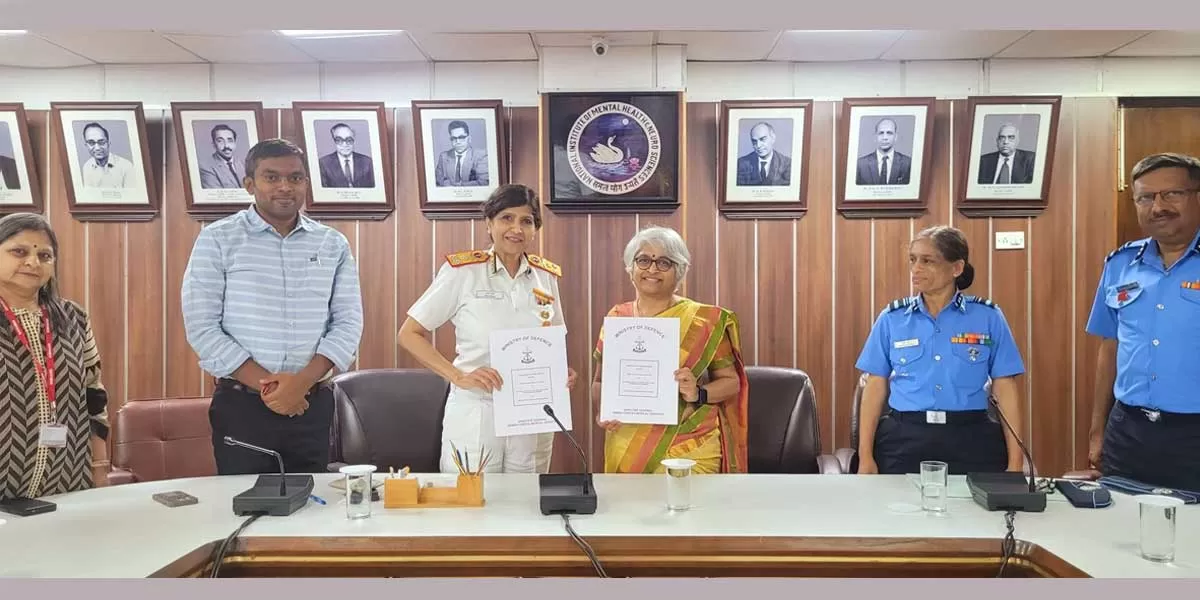
In a landmark initiative aimed at enhancing mental health support for the nation’s defence personnel, the Armed Forces Medical Services (AFMS) and the National Institute of Mental Health and Neurosciences (NIMHANS), Bengaluru, have signed a Memorandum of Understanding (MoU) for collaborative research and training.

A Strategic Collaboration for Mental Well-being The MoU was signed by Surgeon Vice Admiral Arti Sarin, AVSM, VSM, Director General, AFMS, and Dr Pratima Murthy, Director, NIMHANS, in the presence of senior officials from both institutions.

This partnership will focus on: Strengthening mental health services for the Armed Forces. Specialised training for military medical personnel. Innovative programmes to address the mental health challenges faced by soldiers, sailors, airmen, and their families.

Key Objectives of the MoU Collaborative Research: NIMHANS will assist AFMS in conducting advanced research on mental health conditions affecting military personnel. Faculty Exchange & Training: Specialised training programmes will be designed for defence medical professionals. Psychiatric Care & Support: The focus will be on treating Post-Traumatic Stress Disorder (PTSD), anxiety, depression, and other neuropsychiatric conditions.

Leaders Speak on the Initiative Surg VAdm Arti Sarin: “The mental well-being of our soldiers is as vital as their physical health. This partnership with NIMHANS will ensure they receive the best possible support to overcome the challenges they face in service of the nation.”

Dr Pratima Murthy: “It is an honour to collaborate with the Armed Forces Medical Services. NIMHANS is committed to providing world-class mental health care to those who serve our country, ensuring they receive the support they deserve.”

A Pioneering Step for Military Mental Health This initiative marks a critical step in prioritising mental health awareness within the defence sector and is expected to set a benchmark for similar programmes across India. Both institutions remain committed to delivering comprehensive mental health services that enhance the well-being of Armed Forces personnel and their families.

In a landmark initiative aimed at enhancing mental health support for the nation’s defence personnel, the Armed Forces Medical Services (AFMS) and the National Institute of Mental Health and Neurosciences (NIMHANS), Bengaluru, have signed a Memorandum of Understanding (MoU) for collaborative research and training. A Strategic Collaboration for Mental Well-being The MoU was signed by Surgeon Vice Admiral Arti Sarin, AVSM, VSM, Director General, AFMS, and Dr Pratima Murthy, Director, NIMHANS, in the presence of senior officials from both institutions. This partnership will focus on: Strengthening mental health services for the Armed Forces. Specialised training for military medical personnel. Innovative programmes to address the mental health challenges faced by soldiers, sailors, airmen, and their families. Key Objectives of the MoU Collaborative Research: NIMHANS will assist AFMS in conducting advanced research on mental health conditions affecting military personnel. Faculty Exchange & Training: Specialised training programmes will be designed for defence medical professionals. Psychiatric Care & Support: The focus will be on treating Post-Traumatic Stress Disorder (PTSD), anxiety, depression, and other neuropsychiatric conditions. Leaders Speak on the Initiative Surg VAdm Arti Sarin: “The mental well-being of our soldiers is as vital as their physical health. This partnership with NIMHANS will ensure they receive the best possible support to overcome the challenges they face in service of the nation.” Dr Pratima Murthy: “It is an honour to collaborate with the Armed Forces Medical Services. NIMHANS is committed to providing world-class mental health care to those who serve our country, ensuring they receive the support they deserve.” A Pioneering Step for Military Mental Health This initiative marks a critical step in prioritising mental health awareness within the defence sector and is expected to set a benchmark for similar programmes across India. Both institutions remain committed to delivering comprehensive mental health services that enhance the well-being of Armed Forces personnel and their families.

Next Story
Infrastructure Urban

Implementation Status of Jal Jeevan Mission

Since August 2019 the Government has implemented Jal Jeevan Mission to provide assured potable water through household tap connections in rural India. At the start of the mission only 32.3 million (mn) rural households, representing 16.7 per cent, were reported to have tap water connections. States and union territories have reported that 125.8 mn additional rural households have since been provided with tap connections. As a result, of about 193.6 mn rural households roughly 158.2 mn, or 81.71 per cent, are reported to have tap water supply at home.\n\nThe State, district and village level st..

Next Story
Infrastructure Urban

Jal Jeevan Mission Reaches Eighty One Per Cent Rural Coverage

The Government reported substantial progress under the Jal Jeevan Mission, launched in August 2019 to provide tap water to every rural household. At launch only 32.3 million (mn) rural households had tap connections and states and Union territories reported provision of 125.8 mn additional households by March 2026. Consequently, out of about 193.6 mn rural households around 158.2 mn, or 81.71 per cent, are reported to have tap water at home. The Finance Minister announced extension of the mission until 2028 in the 2025-26 budget speech. The Swachh Bharat Mission Grameen, launched in October 20..

Next Story
Infrastructure Urban

Empowering Local Governance for Sustainable Rural Water Supply

The Ministry of Jal Shakti has aligned the Jal Jeevan Mission (JJM) with the 73rd Amendment to strengthen village level planning and community ownership of water supply. Gram Panchayats, village water and sanitation committees and Pani Samitis are to plan, implement, manage and maintain piped water systems, with gram sabha processes formalising handover and oversight. Implementation support agencies including non government organisations, community based organisations and self help groups have been empanelled to train local committees and promote women participation. Under JJM, the department ..

Advertisement

Subscribe to Our Newsletter

Get daily newsletters around different themes from Construction world.

STAY CONNECTED

Advertisement

Advertisement

Advertisement