Websol Energy H1 PAT Soars 75% to Rs 114 Cr; EBITDA Margin at 45%
POWER & RENEWABLE ENERGY

Websol Energy H1 PAT Soars 75% to Rs 114 Cr; EBITDA Margin at 45%

Websol Energy System Limited, a leading Indian manufacturer of high-efficiency solar cells and modules, has reported strong financial results for the half year ended September 30, 2025. The company’s H1 FY26 profit after tax (PAT) surged 75 per cent year-on-year to Rs 1.14 billion, translating to an EPS of Rs 26.9, with a healthy PAT margin of 29.3 per cent.
EBITDA stood at Rs 1.76 billion, up 65 per cent YoY, with a robust margin of 45.4 per cent. Revenue from operations rose 52 per cent YoY to Rs 3.87 billion, despite a one-time eight-day production shutdown in Q2 due to electrical integration of its newly commissioned 600 MW Mono PERC solar cell line at Falta, West Bengal, and a temporary logistics slowdown during the festive season.
The company generated Rs 1.32 billion in operating cash flow, maintained net debt at Rs 108.5 crore, and recorded strong returns with ROCE at 34.5 per cent and ROE at 33.9 per cent.
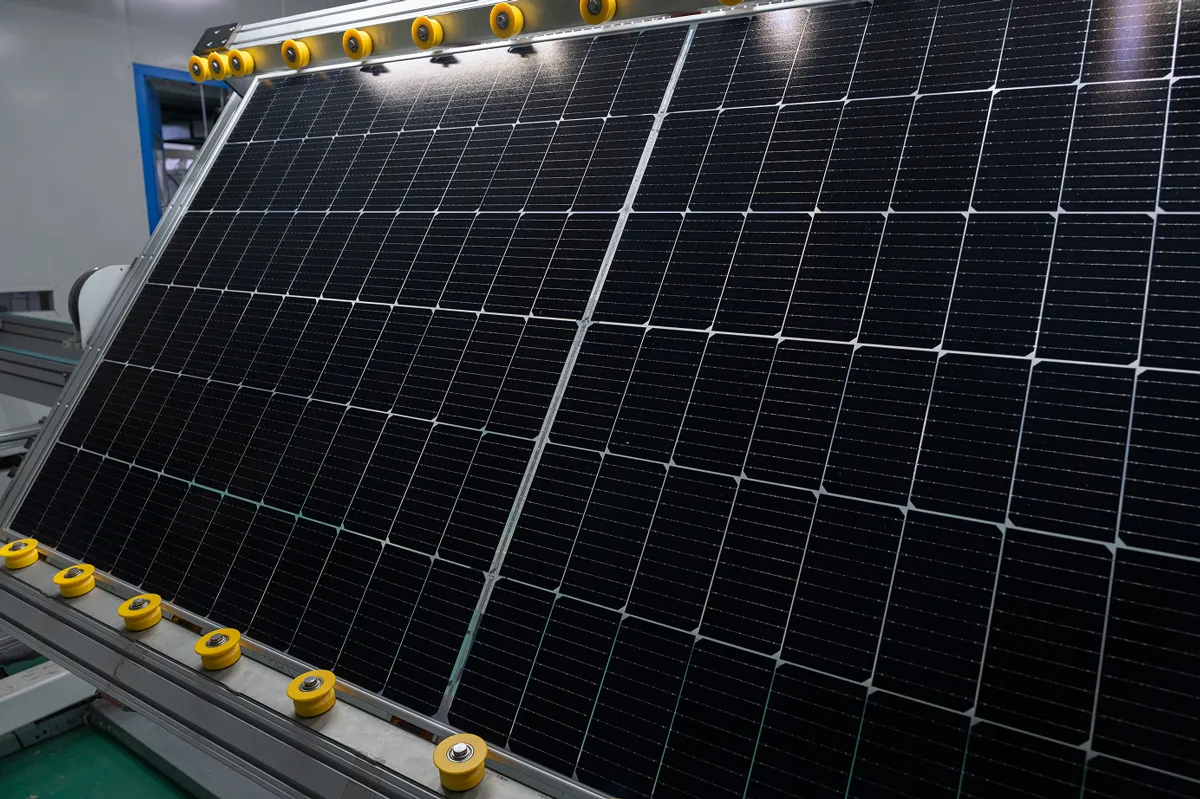
Websol commissioned its Phase II 600 MW Mono PERC solar cell line in September 2025, taking its total cell capacity to 1.2 GW. Production has already achieved efficiency levels above 23 per cent within a month of commissioning. The expansion was entirely funded through internal accruals, demonstrating financial prudence and operational efficiency.
The Board has approved a Rs 30 billion investment plan to expand total manufacturing capacity to 5.2 GW of solar cells and 4.5 GW of modules by June 2028, incorporating next-generation Topcon solar technology. The plan will be executed in two phases — 2 GW each of cell and module capacity by June 2027, followed by another 2 GW each by June 2028.
Commenting on the results, Sohan Lal Agarwal, Managing Director, Websol Energy System Limited,  said, “We continue to strengthen our position as one of India’s leading high-efficiency solar manufacturers. Our new capacity and technology investments will enhance competitiveness, meet evolving customer needs, and align with India’s clean energy ambitions. The Rs 30 billion expansion marks the beginning of an exciting new phase in Websol’s growth journey.”
Websol remains well-positioned to leverage India’s renewable energy transition, supported by policy tailwinds and growing demand for advanced solar products.

Websol Energy System Limited, a leading Indian manufacturer of high-efficiency solar cells and modules, has reported strong financial results for the half year ended September 30, 2025. The company’s H1 FY26 profit after tax (PAT) surged 75 per cent year-on-year to Rs 1.14 billion, translating to an EPS of Rs 26.9, with a healthy PAT margin of 29.3 per cent.EBITDA stood at Rs 1.76 billion, up 65 per cent YoY, with a robust margin of 45.4 per cent. Revenue from operations rose 52 per cent YoY to Rs 3.87 billion, despite a one-time eight-day production shutdown in Q2 due to electrical integration of its newly commissioned 600 MW Mono PERC solar cell line at Falta, West Bengal, and a temporary logistics slowdown during the festive season.The company generated Rs 1.32 billion in operating cash flow, maintained net debt at Rs 108.5 crore, and recorded strong returns with ROCE at 34.5 per cent and ROE at 33.9 per cent.Websol commissioned its Phase II 600 MW Mono PERC solar cell line in September 2025, taking its total cell capacity to 1.2 GW. Production has already achieved efficiency levels above 23 per cent within a month of commissioning. The expansion was entirely funded through internal accruals, demonstrating financial prudence and operational efficiency.The Board has approved a Rs 30 billion investment plan to expand total manufacturing capacity to 5.2 GW of solar cells and 4.5 GW of modules by June 2028, incorporating next-generation Topcon solar technology. The plan will be executed in two phases — 2 GW each of cell and module capacity by June 2027, followed by another 2 GW each by June 2028.Commenting on the results, Sohan Lal Agarwal, Managing Director, Websol Energy System Limited,  said, “We continue to strengthen our position as one of India’s leading high-efficiency solar manufacturers. Our new capacity and technology investments will enhance competitiveness, meet evolving customer needs, and align with India’s clean energy ambitions. The Rs 30 billion expansion marks the beginning of an exciting new phase in Websol’s growth journey.”Websol remains well-positioned to leverage India’s renewable energy transition, supported by policy tailwinds and growing demand for advanced solar products.

Next Story
Real Estate

RBI Rate Cut Boosts Confidence Across Housing Market

Industry Context and Market DynamicsThe real estate industry has welcomed the RBI’s rate cut as a timely boost to affordability and demand. With home prices having risen steadily across major markets, even a marginal reduction in interest rates meaningfully strengthens purchasing power, especially for first-time and mid-income buyers.Ashish Jerath, President – Sales & Marketing, Smartworld Developers, observes:“The RBI’s 25-basis-point cut, bringing the repo rate down to 5.25%, is a timely boost for the real estate sector. Lower interest rates reduce borrowing costs, enabling homeb..

Next Story
Infrastructure Transport

BMC Resumes Rs 170 Billion Road Works, Targets 80 per cent By Jan 2026

Following the withdrawal of the southwest monsoon in October, the Brihanmumbai Municipal Corporation (BMC) has restarted work on 645 roads—covering 297.49 kilometres—under its large-scale concretisation programme. Data shows that more than 60 per cent of the resumed works are located in the western suburbs. Officials said the civic body aims to complete concretisation on 80 per cent of the roads where fresh work has begun by January 2026. Launched in 2022, the Rs 170 billion project seeks to concretise 700 kilometres of roads across Mumbai. All civil works were halted during the monsoon ..

Next Story
Infrastructure Urban

India Pushes Digital Shift In Urban Land Mapping

The Department of Land Resources (DoLR) under the Ministry of Rural Development has convened a National Symposium on NAKSHA – the National Geospatial Knowledge-based Land Survey of Urban Habitations – to advance India’s transition to modern, technology-driven land mapping. Speaking at the inaugural session, Secretary Manoj Joshi underscored the urgent need to move revenue departments away from outdated, tape-based methods and rough hand-drawn sketches. He stressed that adopting latitude–longitude-based digital mapping and GIS-linked registration systems is essential for economic stabi..

Advertisement

Subscribe to Our Newsletter

Get daily newsletters around different themes from Construction world.

STAY CONNECTED

Advertisement

Advertisement

Advertisement

Advertisement

Open In App