Amit Shah Inaugurates Projects Worth Rs 6.51 Billion in Ahmedabad
ECONOMY & POLICY

Amit Shah Inaugurates Projects Worth Rs 6.51 Billion in Ahmedabad

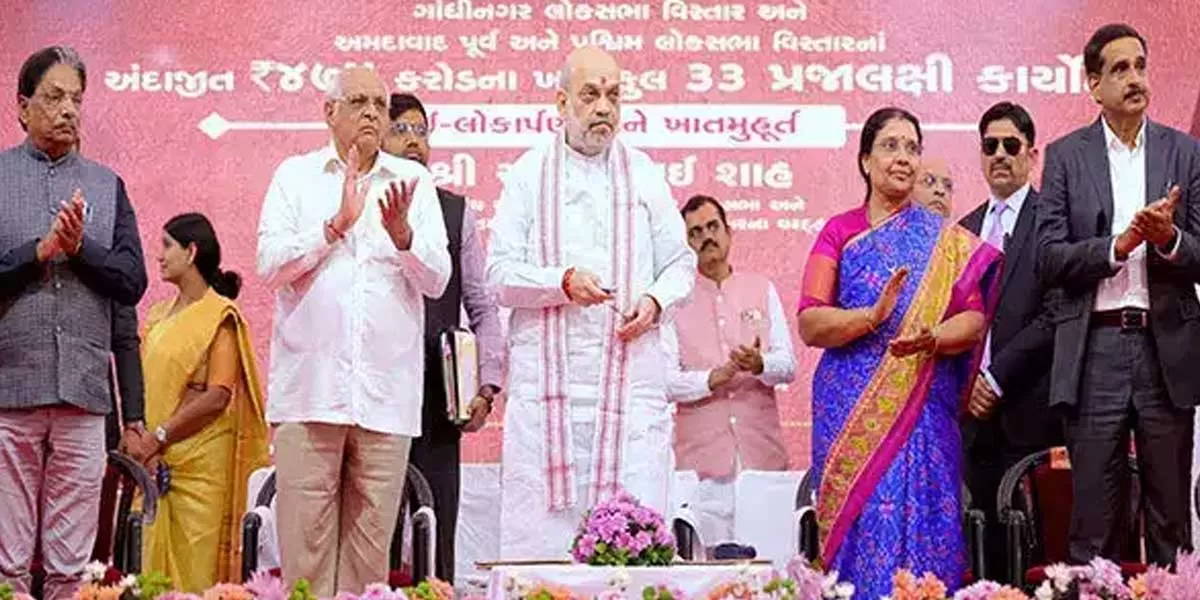
Union Home Minister Amit Shah inaugurated and laid the foundation for 37 public welfare projects totaling Rs 6.51 billion in Ahmedabad. The projects span Ahmedabad East, Ahmedabad West, and Gandhinagar constituencies, marking a significant push towards urban development and heritage conservation.

The event, graced by Gujarat Chief Minister Bhupendra Patel and other state leaders, saw the inauguration of 10 projects worth Rs 950 million and the foundation laying of 27 projects amounting to Rs 5.56 billion. Key initiatives included the D-Cabin LC 241 underpass, Chenpur LC2 underpass, and several drainage and water management projects aimed at improving connectivity and infrastructure.

The focus on sustainable urban growth was evident through projects like percolation wells and rainwater drainage systems in over 350 societies. Shah emphasized adopting solar rooftops and water conservation measures to promote sustainable living.

Under the Doodh Sanjeevani Yojana, symbolic milk distribution highlighted efforts to combat child malnutrition. Additionally, cloth bags were introduced by the Ahmedabad Municipal Corporation (AMC) to reduce plastic usage.

Chief Minister Patel highlighted Gujarat's Rs 216.96 billion urban development budget, emphasizing planned urbanization, clean energy initiatives, and the preservation of Ahmedabad's status as a World Heritage City. Projects like slum rehabilitation, labour welfare centres, and modernized vegetable markets align with the state's vision for inclusive growth.

The initiatives reflect the government's commitment to enhancing citizens' quality of life while preserving the cultural and historical heritage of the region.

Union Home Minister Amit Shah inaugurated and laid the foundation for 37 public welfare projects totaling Rs 6.51 billion in Ahmedabad. The projects span Ahmedabad East, Ahmedabad West, and Gandhinagar constituencies, marking a significant push towards urban development and heritage conservation. The event, graced by Gujarat Chief Minister Bhupendra Patel and other state leaders, saw the inauguration of 10 projects worth Rs 950 million and the foundation laying of 27 projects amounting to Rs 5.56 billion. Key initiatives included the D-Cabin LC 241 underpass, Chenpur LC2 underpass, and several drainage and water management projects aimed at improving connectivity and infrastructure. The focus on sustainable urban growth was evident through projects like percolation wells and rainwater drainage systems in over 350 societies. Shah emphasized adopting solar rooftops and water conservation measures to promote sustainable living. Under the Doodh Sanjeevani Yojana, symbolic milk distribution highlighted efforts to combat child malnutrition. Additionally, cloth bags were introduced by the Ahmedabad Municipal Corporation (AMC) to reduce plastic usage. Chief Minister Patel highlighted Gujarat's Rs 216.96 billion urban development budget, emphasizing planned urbanization, clean energy initiatives, and the preservation of Ahmedabad's status as a World Heritage City. Projects like slum rehabilitation, labour welfare centres, and modernized vegetable markets align with the state's vision for inclusive growth. The initiatives reflect the government's commitment to enhancing citizens' quality of life while preserving the cultural and historical heritage of the region.

Next Story
Infrastructure Urban

Implementation Status of Jal Jeevan Mission

Since August 2019 the Government has implemented Jal Jeevan Mission to provide assured potable water through household tap connections in rural India. At the start of the mission only 32.3 million (mn) rural households, representing 16.7 per cent, were reported to have tap water connections. States and union territories have reported that 125.8 mn additional rural households have since been provided with tap connections. As a result, of about 193.6 mn rural households roughly 158.2 mn, or 81.71 per cent, are reported to have tap water supply at home.\n\nThe State, district and village level st..

Next Story
Infrastructure Urban

Jal Jeevan Mission Reaches Eighty One Per Cent Rural Coverage

The Government reported substantial progress under the Jal Jeevan Mission, launched in August 2019 to provide tap water to every rural household. At launch only 32.3 million (mn) rural households had tap connections and states and Union territories reported provision of 125.8 mn additional households by March 2026. Consequently, out of about 193.6 mn rural households around 158.2 mn, or 81.71 per cent, are reported to have tap water at home. The Finance Minister announced extension of the mission until 2028 in the 2025-26 budget speech. The Swachh Bharat Mission Grameen, launched in October 20..

Next Story
Infrastructure Urban

Empowering Local Governance for Sustainable Rural Water Supply

The Ministry of Jal Shakti has aligned the Jal Jeevan Mission (JJM) with the 73rd Amendment to strengthen village level planning and community ownership of water supply. Gram Panchayats, village water and sanitation committees and Pani Samitis are to plan, implement, manage and maintain piped water systems, with gram sabha processes formalising handover and oversight. Implementation support agencies including non government organisations, community based organisations and self help groups have been empanelled to train local committees and promote women participation. Under JJM, the department ..

Advertisement

Subscribe to Our Newsletter

Get daily newsletters around different themes from Construction world.

STAY CONNECTED

Advertisement

Advertisement

Advertisement