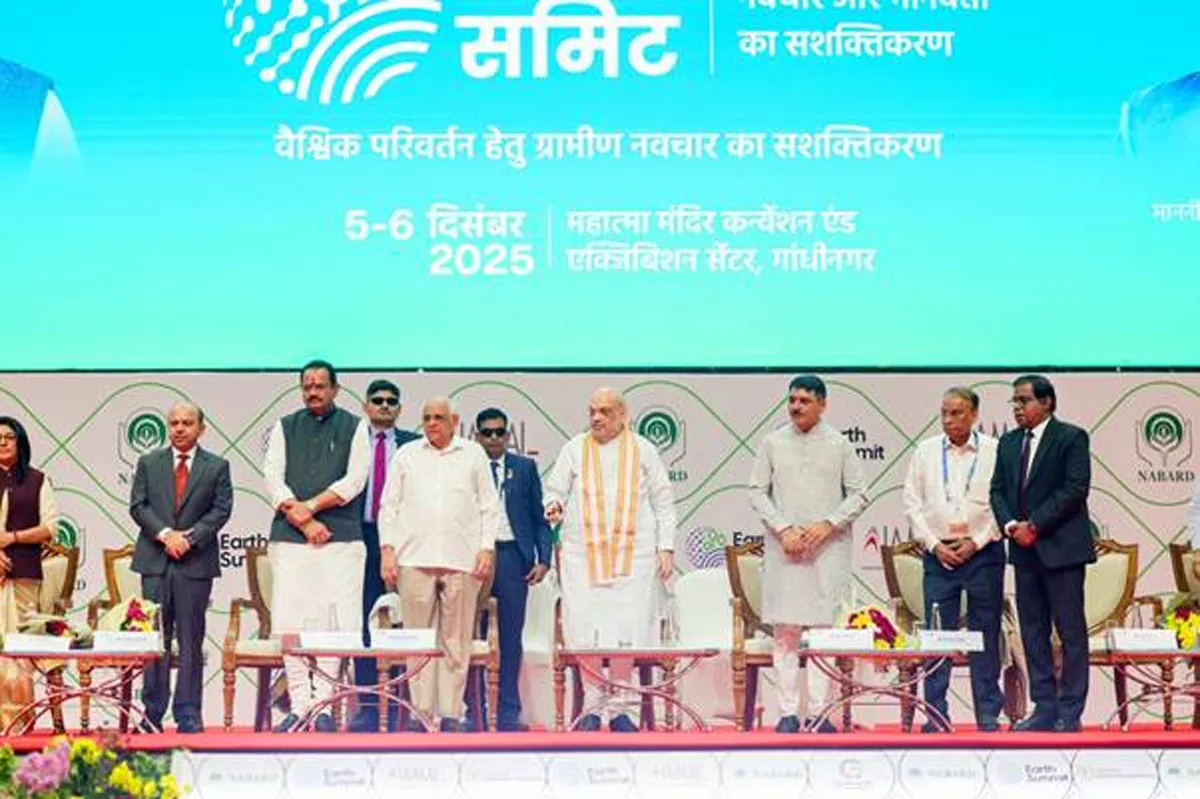
Union Home and Cooperation Minister Shri Amit Shah inaugurated EARTH Summit 2025 at Mahatma Mandir in Gandhinagar, Gujarat, where he launched more than 13 new services and products under Sahakar Sarathi. These include Digi KCC, Campaign Sarathi, Website Sarathi, the Cooperative Governance Index, ePACS, the world’s largest grain storage application, Shiksha Sarathi and the Sarathi Technology Forum. Gujarat Chief Minister Shri Bhupendra Patel, Legislative Assembly Speaker Shri Shankarbhai Chaudhary, Agriculture and Cooperation Minister Shri Jitu Bhai Vaghani, NAFED Chairman Shri Jetha Bhai Ahir and other dignitaries were present.
In his address, Shri Shah said the second EARTH Summit forms a crucial link in a series of three summits aimed at strengthening the rural economy and generating implementable solutions for rural development. He noted that the final summit, scheduled in Delhi next year, will produce a unified policy framework rooted in these deliberations.
Shri Shah emphasised Mahatma Gandhi’s belief that India’s progress depends on village-centred development, a principle neglected in the years following Independence. Agriculture, animal husbandry and cooperatives remained marginalised until 2014, when Prime Minister Shri Narendra Modi’s leadership initiated a major shift placing rural development at the forefront of national policy.
He stated that a cooperative institution will be established in every Panchayat in the coming years, enabling more than 500 million active cooperative members and increasing the cooperative sector’s contribution to GDP. Such reforms, he said, ensure no citizen is left behind — from rural women in animal husbandry to small farmers.
Shri Shah highlighted Gujarat’s successful ‘Cooperation Among Cooperatives’ model, which has generated billions of rupees in low-cost deposits. Under the district cooperative framework, markets, dairies, PACS and cooperatives are integrated, and all cooperative entities maintain their accounts exclusively with cooperative banks. This has boosted low-cost deposits and begun the process of expanding credit capacity fivefold, a model to be replicated nationwide. He added that a concrete plan is being prepared to fully harness priority sector lending potential, based on the Gujarat and Banaskantha model.
Shri Shah underscored the indispensable role of technology in the cooperative sector. Smaller cooperatives lacked the means to build technological infrastructure, but NABARD has enabled access through 13-plus digital services under Sahakar Sarathi. All cooperative banks — district, state, agricultural and urban — will now operate under a unified technology system offering modern banking tools without financial burden. Processes such as recovery, disbursement, KYC, documentation and appraisal will become fully digital, and rural cooperative banks will have real-time tracking systems. With RBI’s support, a robust cooperative banking architecture is being developed, and e-KCC holders will soon enjoy facilities comparable to premium international credit cards.
Shri Shah said national cooperative data systems will identify gaps and expansion needs instantly, and the ongoing technological modernisation will be completed next year. Gujarat’s dairy sector has already created a full circular economy model with indigenous production and direct benefits to farmers, and this model will be implemented nationwide.
He noted that around 4.9 million farmers are engaged in certified organic production, with over 40 organic products available online. A national testing network is being established with Bharat Organics and Amul, aiming to strengthen India’s global organic market share by 2035. Multi-state cooperatives will procure, test and export produce, ensuring earnings go directly to farmers' bank accounts.
Shri Shah also announced the launch of Sahakar Taxi, with more than 51,000 drivers registered during its trial phase. It is expected to become India’s largest cooperative taxi service. He added that cooperative insurance models will bring health, life, agriculture and accident insurance under the cooperative framework, strengthening agriculture, fisheries, animal husbandry and dairy — the pillars of rural development.
Concluding his remarks, Shri Amit Shah described cooperation as a Kalpavriksha whose roots support public welfare and whose branches sustain millions of livelihoods. He expressed confidence that the summit’s open discussions and problem-solving approach will help shape a strong and actionable rural development agenda.