IGBC Green Karnataka Summit 2026 Highlights State’s Green Leadership
Real Estate

IGBC Green Karnataka Summit 2026 Highlights State’s Green Leadership

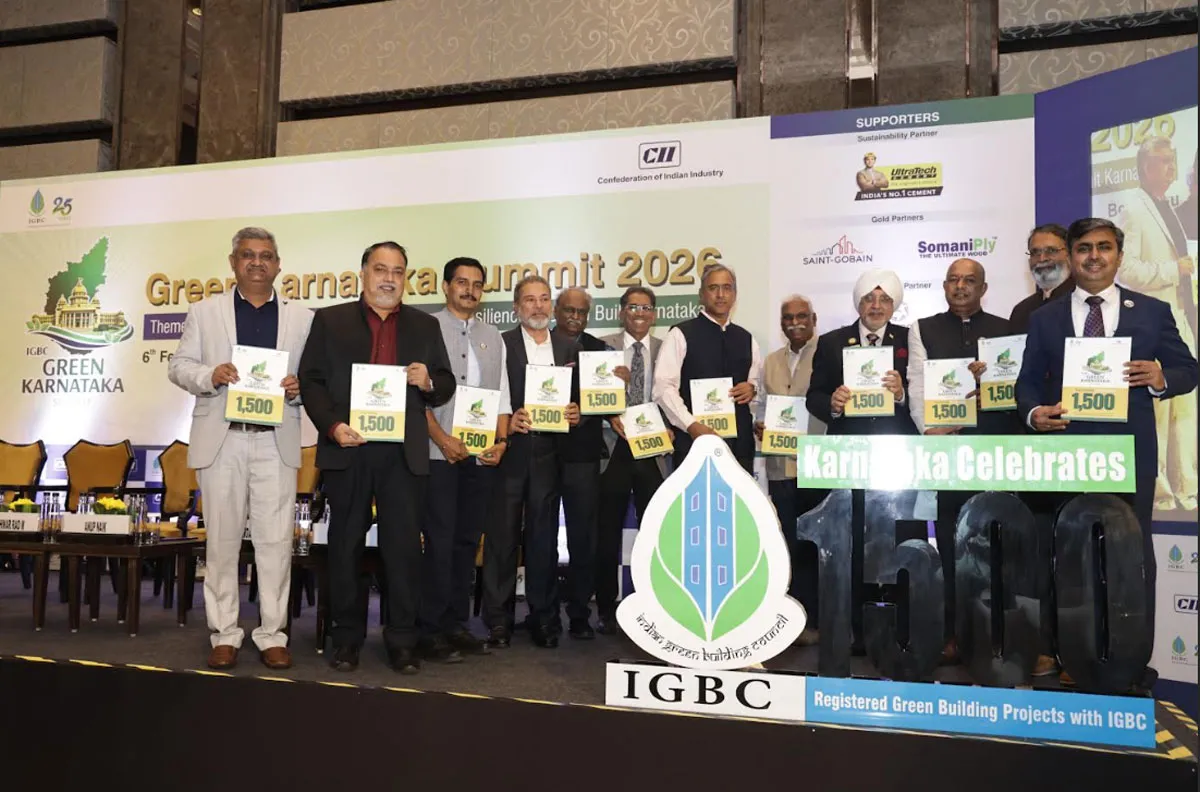
The CII Indian Green Building Council (IGBC) hosted the first IGBC Green Karnataka Summit 2026 in Bengaluru, bringing together government leaders, urban planners, developers, architects and industry stakeholders to deliberate on “Advancing Sustainability vis-à-vis Climate Resilience in Urban Built Karnataka”.

Karnataka currently has 1,539 registered green building projects accounting for a cumulative 1.13 billion sq ft of certified green building footprint, ranking third in India by number of buildings adopting IGBC Green Building Ratings. The summit reinforced a collective shift from intent to implementation, positioning sustainable development as a key driver of urban liveability, climate resilience and long-term economic growth.

The summit was inaugurated by Mr Maheshwar Rao. M, IAS, Chief Commissioner – GBA and Administrator, All Bengaluru City Corporations, along with Mr Zayd Noaman, President, CREDAI Bengaluru; Mr Gurmit Singh Arora, Chairman, IGBC Marketing Outreach & Strategic Alliances; Dr Anup Naik, Chairman, IGBC Bengaluru Chapter; and Mr V Gopal, Co-Chairman, IGBC Bengaluru Chapter.

Addressing the summit, Shri Maheshwar Rao, IAS, said, “Karnataka’s green building journey reflects a decisive shift from ambition to execution. The state has demonstrated how sustainability can be mainstreamed across residential, commercial, industrial, and public infrastructure at scale. What is particularly encouraging is the growing momentum around Net Zero buildings, climate-resilient design, water security, and green factories, which are increasingly becoming the new normal rather than exceptions. While the market has shown strong intent and capability, well-designed incentives—such as faster approvals, fiscal benefits, and recognition mechanisms—can significantly accelerate adoption and ease implementation, especially for Net Zero and high-performance green projects. Through continued collaboration between government, industry, developers, and the design community, Karnataka is well positioned to translate sustainability into enhanced liveability, climate resilience, and long-term economic value. We would like to work closely with IGBC in greening the Bengaluru city as per IGBC Green City Rating System. Also, I would like to congratulate IGBC for 1,539 IGBC-registered projects covering 1.13 billion square feet in the state.”

Ar Anup Naik, Chairperson, IGBC Bengaluru Chapter, said, “Karnataka’s leadership in the green building movement is a result of sustained collaboration across government, industry, and the design community. With over 1,500 registered green building projects covering more than 1.13 billion square feet, the state today ranks among the top three performers nationally. What makes this achievement truly significant is the diversity of our ecosystem—from green commercial and residential developments to large-scale transit and infrastructure projects—demonstrating that sustainability in Karnataka is not confined to one sector but deeply embedded across buildings and built environments. This momentum reflects both our collective commitment and the growth of Karnataka’s green building journey.”

Mr Gurmit Singh Arora, Chairman, IGBC Marketing Outreach and Strategic Alliances, said, “Karnataka has all the fundamentals required to emerge as one of India’s most ideal states for green and net zero development, from strong urban growth to a maturing green building ecosystem. The opportunity now is to move from isolated islands of excellence to green solutions at scale, making sustainable buildings the norm rather than the exception. Policy support and well-structured incentives can play a catalytic role in this transition, making implementation easier, faster, and more economically viable. When incentives align with sustainability goals, they significantly accelerate adoption, enabling cities to become more resilient, livable, and future-ready.”

The summit featured leadership plenaries and expert-led panels on sustainable urban planning, future-ready cities, net-zero strategies, healthy buildings, climate-responsive design, smart infrastructure and decarbonisation across the building lifecycle. Discussions emphasised integrated planning, green infrastructure, transit-oriented development, citizen-centric design and the role of technology in enabling low-carbon urban growth.

The event concluded with the IGBC Green Crusader Awards 2026, recognising 184 upcoming green building projects across Karnataka, collectively covering 83 million sq ft, for committing to build green. The awards also acknowledged the role of government departments, industry partners and stakeholders in advancing the state’s green building movement.


The CII Indian Green Building Council (IGBC) hosted the first IGBC Green Karnataka Summit 2026 in Bengaluru, bringing together government leaders, urban planners, developers, architects and industry stakeholders to deliberate on “Advancing Sustainability vis-à-vis Climate Resilience in Urban Built Karnataka”.Karnataka currently has 1,539 registered green building projects accounting for a cumulative 1.13 billion sq ft of certified green building footprint, ranking third in India by number of buildings adopting IGBC Green Building Ratings. The summit reinforced a collective shift from intent to implementation, positioning sustainable development as a key driver of urban liveability, climate resilience and long-term economic growth.The summit was inaugurated by Mr Maheshwar Rao. M, IAS, Chief Commissioner – GBA and Administrator, All Bengaluru City Corporations, along with Mr Zayd Noaman, President, CREDAI Bengaluru; Mr Gurmit Singh Arora, Chairman, IGBC Marketing Outreach & Strategic Alliances; Dr Anup Naik, Chairman, IGBC Bengaluru Chapter; and Mr V Gopal, Co-Chairman, IGBC Bengaluru Chapter.Addressing the summit, Shri Maheshwar Rao, IAS, said, “Karnataka’s green building journey reflects a decisive shift from ambition to execution. The state has demonstrated how sustainability can be mainstreamed across residential, commercial, industrial, and public infrastructure at scale. What is particularly encouraging is the growing momentum around Net Zero buildings, climate-resilient design, water security, and green factories, which are increasingly becoming the new normal rather than exceptions. While the market has shown strong intent and capability, well-designed incentives—such as faster approvals, fiscal benefits, and recognition mechanisms—can significantly accelerate adoption and ease implementation, especially for Net Zero and high-performance green projects. Through continued collaboration between government, industry, developers, and the design community, Karnataka is well positioned to translate sustainability into enhanced liveability, climate resilience, and long-term economic value. We would like to work closely with IGBC in greening the Bengaluru city as per IGBC Green City Rating System. Also, I would like to congratulate IGBC for 1,539 IGBC-registered projects covering 1.13 billion square feet in the state.”Ar Anup Naik, Chairperson, IGBC Bengaluru Chapter, said, “Karnataka’s leadership in the green building movement is a result of sustained collaboration across government, industry, and the design community. With over 1,500 registered green building projects covering more than 1.13 billion square feet, the state today ranks among the top three performers nationally. What makes this achievement truly significant is the diversity of our ecosystem—from green commercial and residential developments to large-scale transit and infrastructure projects—demonstrating that sustainability in Karnataka is not confined to one sector but deeply embedded across buildings and built environments. This momentum reflects both our collective commitment and the growth of Karnataka’s green building journey.”Mr Gurmit Singh Arora, Chairman, IGBC Marketing Outreach and Strategic Alliances, said, “Karnataka has all the fundamentals required to emerge as one of India’s most ideal states for green and net zero development, from strong urban growth to a maturing green building ecosystem. The opportunity now is to move from isolated islands of excellence to green solutions at scale, making sustainable buildings the norm rather than the exception. Policy support and well-structured incentives can play a catalytic role in this transition, making implementation easier, faster, and more economically viable. When incentives align with sustainability goals, they significantly accelerate adoption, enabling cities to become more resilient, livable, and future-ready.”The summit featured leadership plenaries and expert-led panels on sustainable urban planning, future-ready cities, net-zero strategies, healthy buildings, climate-responsive design, smart infrastructure and decarbonisation across the building lifecycle. Discussions emphasised integrated planning, green infrastructure, transit-oriented development, citizen-centric design and the role of technology in enabling low-carbon urban growth.The event concluded with the IGBC Green Crusader Awards 2026, recognising 184 upcoming green building projects across Karnataka, collectively covering 83 million sq ft, for committing to build green. The awards also acknowledged the role of government departments, industry partners and stakeholders in advancing the state’s green building movement.
Next Story
Infrastructure Transport

MMRDA advances 250 m on Orange Gate–Marine Drive tunnel

The Mumbai Metropolitan Region Development Authority (MMRDA) has completed 250 m of underground tunnelling for the Orange Gate–Marine Drive Urban Road Tunnel using India’s largest slurry shield tunnel boring machine (TBM) deployed for an urban road project.The project involves twin tunnels extending over 7 km beneath critical transport corridors, including Central Railway, Western Railway and Metro Line 3. The work requires high-precision engineering to navigate densely developed urban infrastructure.Once completed, the tunnel is expected to reduce travel time between Orange Gate and Marin..

Next Story
Infrastructure Urban

Hindustan Zinc Pays Rs 188.46 Billion in FY26

Hindustan Zinc contributed Rs 188.46 billion to the public exchequer in FY 2025-26, according to its 9th Tax Transparency Report. The contribution, equivalent to 46 per cent of the company’s revenue, included direct and indirect taxes, government royalties, dividends to the Government of India, withholding taxes and other statutory levies.The company’s five-year cumulative contribution to the exchequer stood at Rs 915.72 billion. In FY26, Hindustan Zinc reported revenue of Rs 408.44 billion, EBITDA of Rs 221.62 billion and profit after tax of Rs 138.32 billion. It also achieved its highest..

Next Story
Infrastructure Urban

World of Concrete India 2026 Opens in Mumbai

Informa Markets in India will host the 12th edition of World of Concrete India 2026 from 3–5 June 2026 at the Bombay Exhibition Centre, Mumbai. The specialised B2B exhibition will bring together manufacturers, suppliers, contractors, developers, architects, consultants, infrastructure companies, project leaders and government stakeholders.The event is expected to feature over 350 brands and more than 18,000 trade professionals. It will cover concrete and cement, dry mortar, precast technologies, formwork, construction chemicals, industrial and commercial flooring, scaffolding, safety solutio..

Advertisement

Subscribe to Our Newsletter

Get daily newsletters around different themes from Construction world.

STAY CONNECTED

Advertisement

Advertisement

Advertisement