




+
CareEdge Analysis Of Union Budget 2026-27
ECONOMY & POLICY

CareEdge Analysis Of Union Budget 2026-27

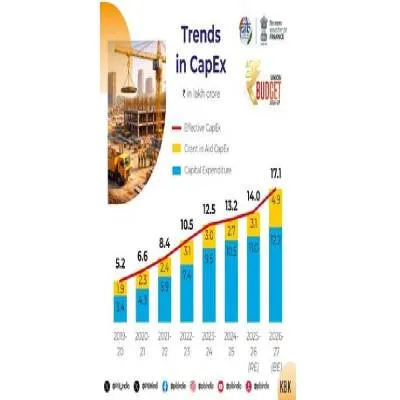
The Union Budget for 2026-27 is presented as a consolidation plan that prioritises public investment and fiscal prudence. Capital spending is budgeted at Rs 12.2 trillion (tn), signalling a continued focus on infrastructure and logistics as growth enablers. The Centre targets a fiscal deficit of four point three per cent while aiming to reduce its debt-to-GDP to 55.6 per cent in FY27.

The Budget sets a clear strategy for the services sector with an ambition to achieve 10 per cent of global services and measures to support information technology, tourism, health and creative industries. Policy steps include extended tax incentives for cloud services, pilot schemes to upskill 10,000 tourist guides across 20 iconic sites and the establishment of five hubs for medical value tourism. Education and skilling measures include embedding artificial intelligence in curricula, formation of an Education to Employment and Enterprise committee and development of university townships.

Manufacturing support spans semiconductor policy, chemical parks and rare earth corridors, and the Electronics Components Manufacturing Scheme outlay is raised from Rs 23,000 crore to Rs 40,000 crore, equivalent to Rs 230 billion (bn) and Rs 400 billion. A Rs 100 billion container manufacturing programme and measures for textiles, capital goods and sports goods aim to boost capacity; the Rs 100 billion SME Growth Fund will provide equity support for smaller firms. Special measures to revive 200 legacy industrial clusters and concessional duties for eligible special economic zone units are intended to spur domestic sales and competitiveness.

Financial sector reforms include a high-level committee on banking, changes to buyback taxation and steps to improve corporate bond market functioning, alongside a rise in securities transaction tax on derivatives. Incentives include an Rs one bn reward for single municipal bond issuances exceeding Rs 10 bn and measures to mobilise TReDS receivables as asset-backed securities to ease MSME liquidity. Dividend receipts and disinvestment assumptions are elevated with transfers budgeted at Rs 3.2 trillion (tn) and PSU dividends at Rs 750 billion (bn), while miscellaneous capital receipts are raised to about Rs 800 billion to support the revenue outlook and spending quality.

The Union Budget for 2026-27 is presented as a consolidation plan that prioritises public investment and fiscal prudence. Capital spending is budgeted at Rs 12.2 trillion (tn), signalling a continued focus on infrastructure and logistics as growth enablers. The Centre targets a fiscal deficit of four point three per cent while aiming to reduce its debt-to-GDP to 55.6 per cent in FY27. The Budget sets a clear strategy for the services sector with an ambition to achieve 10 per cent of global services and measures to support information technology, tourism, health and creative industries. Policy steps include extended tax incentives for cloud services, pilot schemes to upskill 10,000 tourist guides across 20 iconic sites and the establishment of five hubs for medical value tourism. Education and skilling measures include embedding artificial intelligence in curricula, formation of an Education to Employment and Enterprise committee and development of university townships. Manufacturing support spans semiconductor policy, chemical parks and rare earth corridors, and the Electronics Components Manufacturing Scheme outlay is raised from Rs 23,000 crore to Rs 40,000 crore, equivalent to Rs 230 billion (bn) and Rs 400 billion. A Rs 100 billion container manufacturing programme and measures for textiles, capital goods and sports goods aim to boost capacity; the Rs 100 billion SME Growth Fund will provide equity support for smaller firms. Special measures to revive 200 legacy industrial clusters and concessional duties for eligible special economic zone units are intended to spur domestic sales and competitiveness. Financial sector reforms include a high-level committee on banking, changes to buyback taxation and steps to improve corporate bond market functioning, alongside a rise in securities transaction tax on derivatives. Incentives include an Rs one bn reward for single municipal bond issuances exceeding Rs 10 bn and measures to mobilise TReDS receivables as asset-backed securities to ease MSME liquidity. Dividend receipts and disinvestment assumptions are elevated with transfers budgeted at Rs 3.2 trillion (tn) and PSU dividends at Rs 750 billion (bn), while miscellaneous capital receipts are raised to about Rs 800 billion to support the revenue outlook and spending quality.

Next Story
Infrastructure Transport

Lucknow Metro East-West Corridor Consultancy Contract Awarded

The Uttar Pradesh Metro Rail Corporation has awarded the first construction-related consultancy contract for the Lucknow Metro East West Corridor to a joint venture of AYESA Ingenieria Arquitectura SAU and AYESA India Pvt Ltd. The firm was declared the lowest bidder for the Detailed Design Consultant contract for Lucknow Metro Line-2 under Phase 1B and the contract was recommended following the financial bid. The contract is valued at Rs 159.0 million (mn), covering design services for the corridor. Lucknow Metro Line-2 envisages the construction of an 11.165 kilometre corridor connecting Cha..

Next Story
Infrastructure Urban

Div Com Kashmir Urges Fast Tracking Of Jhelum Water Transport Project

The Divisional Commissioner of Kashmir has called for the fast-tracking of the Jhelum water transport project, urging district administrations and relevant agencies to accelerate planning and clearances. In a meeting convened at the divisional headquarters, the commissioner instructed officials from irrigation, public health engineering and municipal departments to prioritise the project and coordinate survey and design work. The directive emphasised removal of administrative bottlenecks and close monitoring to ensure timely mobilisation of resources and contractors. Officials were told to in..

Next Story
Infrastructure Urban

Interarch Reports Strong Q3 And Nine Month Results

Interarch Building Solutions Limited reported unaudited results for the third quarter and nine months ended 31 December 2025, recording strong revenue growth driven by execution and a robust order book. Net revenue for the third quarter rose by 43.7 per cent to Rs 5.225 billion (bn), compared with Rs 3.636 bn a year earlier, reflecting heightened demand in pre-engineered building projects. The company’s total order book as at 31 January 2026 stood at Rs 16.85 bn, supporting near-term visibility. EBITDA excluding other income for the quarter increased by 43.2 per cent to Rs 503 million (mn),..

Advertisement

Subscribe to Our Newsletter

Get daily newsletters around different themes from Construction world.

STAY CONNECTED

Advertisement

Advertisement

Advertisement

Open In App














