Atlas Copco Showcases EV Tech at Pune EVolution Days
ECONOMY & POLICY

Atlas Copco Showcases EV Tech at Pune EVolution Days

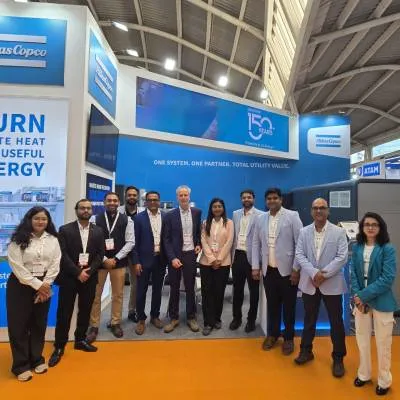
Atlas Copco Tools and Industrial Assembly Solutions successfully hosted “EVolution Days” at its cutting-edge Innovation Centre in Bavdhan, Pune—an event designed to advance next-generation electric vehicle (EV) manufacturing. The showcase brought together over 110 key players from the EV value chain, including OEMs, Tier suppliers, and Line Builders, to explore transformative technologies powering the e-mobility future.

Participants experienced live demonstrations of Atlas Copco’s integrated and sustainable solutions that boost EV production performance through enhanced productivity, quality, and traceability. Highlights included advanced technologies such as Automated Torquing, Robotic Dispensing, Flow Drilling, and Advanced Riveting with error-proofing capabilities supported by integrated vision systems and customised software.

These solutions are engineered to tackle the most pressing challenges in EV production—from battery cell safety and material traceability to the complexity of joining lightweight components and ensuring reliable process control.

Mr Chandrashekhar Pathak, General Manager, Industrial Technique at Atlas Copco (India) Pvt. Ltd., remarked, “As a proud one-stop solution provider for battery pack assembly and complete EV manufacturing, we are committed to enabling the future of mobility. EVolution Days brought the ecosystem together—from EV Tiers and MTBs to OEMs—highlighting the strength of collaboration in pushing the EV transition forward.”

He added, “This wasn’t just about showcasing innovation—it was about demonstrating impact. Through real-world use cases and immersive experiences, we helped participants visualise how our cutting-edge technologies in torquing, dispensing, vision systems, and software work together to address EV-specific requirements. From traceability and lightweight material joining to ensuring battery safety, each innovation reflects our deep industry insight and dedication to sustainable progress.”

The event also included thought leadership sessions led by industry and Atlas Copco experts, offering insights into integrated design practices and digital manufacturing approaches for the EV sector. From product design to final assembly, Atlas Copco’s technologies underscore its long-standing commitment to performance, reliability, and data-driven excellence.

With a strong history of delivering turnkey industrial automation solutions, Atlas Copco remains a central player in the evolving EV landscape, empowering manufacturers across India to build the electric vehicles of tomorrow with confidence and efficiency.

Atlas Copco Tools and Industrial Assembly Solutions successfully hosted “EVolution Days” at its cutting-edge Innovation Centre in Bavdhan, Pune—an event designed to advance next-generation electric vehicle (EV) manufacturing. The showcase brought together over 110 key players from the EV value chain, including OEMs, Tier suppliers, and Line Builders, to explore transformative technologies powering the e-mobility future.Participants experienced live demonstrations of Atlas Copco’s integrated and sustainable solutions that boost EV production performance through enhanced productivity, quality, and traceability. Highlights included advanced technologies such as Automated Torquing, Robotic Dispensing, Flow Drilling, and Advanced Riveting with error-proofing capabilities supported by integrated vision systems and customised software.These solutions are engineered to tackle the most pressing challenges in EV production—from battery cell safety and material traceability to the complexity of joining lightweight components and ensuring reliable process control.Mr Chandrashekhar Pathak, General Manager, Industrial Technique at Atlas Copco (India) Pvt. Ltd., remarked, “As a proud one-stop solution provider for battery pack assembly and complete EV manufacturing, we are committed to enabling the future of mobility. EVolution Days brought the ecosystem together—from EV Tiers and MTBs to OEMs—highlighting the strength of collaboration in pushing the EV transition forward.”He added, “This wasn’t just about showcasing innovation—it was about demonstrating impact. Through real-world use cases and immersive experiences, we helped participants visualise how our cutting-edge technologies in torquing, dispensing, vision systems, and software work together to address EV-specific requirements. From traceability and lightweight material joining to ensuring battery safety, each innovation reflects our deep industry insight and dedication to sustainable progress.”The event also included thought leadership sessions led by industry and Atlas Copco experts, offering insights into integrated design practices and digital manufacturing approaches for the EV sector. From product design to final assembly, Atlas Copco’s technologies underscore its long-standing commitment to performance, reliability, and data-driven excellence.With a strong history of delivering turnkey industrial automation solutions, Atlas Copco remains a central player in the evolving EV landscape, empowering manufacturers across India to build the electric vehicles of tomorrow with confidence and efficiency.

Next Story
Infrastructure Transport

Pune To Build Nine Km Link Road Between Highways

The Pune Municipal Corporation (PMC) has decided to appoint an expert to plan the development of a nine km long, 60 metre wide road from Khadi Machine chowk to Wadki chowk as an extension to the Katraj-Kondhwa road to link the Mumbai-Satara and Pune-Solapur national highways. The scheme is intended to divert heavy vehicle traffic away from the city and improve access between the two arterial routes. The project has been prioritised by the PMC and forms part of a larger set of schemes in which 19 roads have been identified for development at a combined cost of Rs 9.82 billion (bn) to address c..

Next Story
Infrastructure Transport

Barabanki Bahraich Six Lane Highway Approved in Uttar Pradesh

The Uttar Pradesh government has approved construction of a new six-lane highway linking Barabanki and Bahraich as part of National Highway 927, and the cabinet has cleared the project. The alignment will pass through Mustafabad and Kaiserganj and extend for about 101.5 km, creating a key corridor for local and long-distance movement. The National Highways Authority of India will oversee the work and has signalled the scheme is intended to strengthen regional connectivity and cross-border access to Nepal. The project carries an estimated total cost of Rs 69,690 million, equivalent to Rs 69.69..

Next Story
Infrastructure Transport

Toll At Kharegaon Likely As Highway Upgrade Nears Completion

A section of the highway at Kharegaon has undergone an upgrade and is approaching completion, and authorities have indicated plans for a toll to be introduced once works finish. The project has focused on strengthening the carriageway, improving drainage and upgrading intersections to enhance safety and capacity. Officials have said the toll will be used to recover construction costs and fund ongoing maintenance. The upgrade included resurfacing of the pavement, widening of certain stretches and installation of modern signage and lighting to reduce accident risk. Contractors completed most ma..

Advertisement

Subscribe to Our Newsletter

Get daily newsletters around different themes from Construction world.

STAY CONNECTED

Advertisement

Advertisement

Advertisement