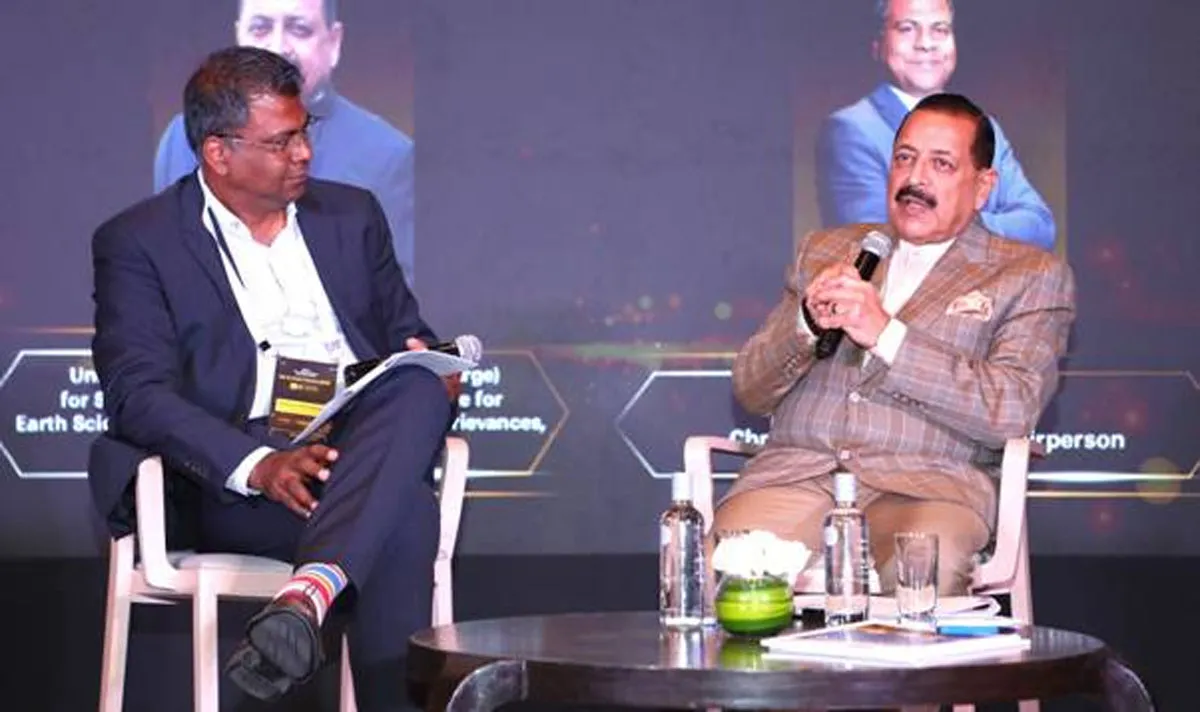
Union Minister of State for Science and Technology, Dr Jitendra Singh, has said that the next major global revolution will be bio-driven, and that India is uniquely positioned to lead it owing to its deep-tech capabilities, expanding startup ecosystem and growing pool of domestic institutional capital.
Speaking at a “FireChat” session organised by the Indian Venture and Alternate Capital Association (IVCA) in New Delhi, the Minister described the recently announced Rs 1 trillion Research, Development and Innovation (RDI) Fund as one of the Government’s most forward-looking initiatives. Designed to support high-risk, high-reward research in frontier technologies, the Fund aims to catalyse partnerships between Government, industry and investors. Dr Singh said the Fund’s long-term, low-interest, risk-sharing structure reflects the Government’s clear intent to crowd-in private investment rather than displace it.
He noted that India is emerging rapidly as a deep-tech and science-led innovation power, backed by strong political will. Unlike in the past, India is now among the first movers globally in framing biotechnology policies and opening strategic sectors such as space and atomic energy to private participation—developments he credited to the leadership of Prime Minister Narendra Modi.
Dr Singh said India’s innovation landscape is undergoing a structural shift: while the previous decade was defined by the digital revolution, the coming years will be driven by deep-tech sectors including space, bio-manufacturing, green hydrogen, quantum technologies and advanced materials. These science- and capital-intensive sectors demand patient, risk-tolerant capital that differs from conventional investment models.
He emphasised that the growth stories of advanced economies were built on strong private-sector participation, philanthropic capital and domestic institutional investors. For long, India relied excessively on government alone, and even the private sector did not anticipate the scale of reforms in strategic areas such as space, nuclear and biotechnology. The RDI Fund, he said, is designed to help overcome this hesitation and encourage early-stage investment in frontier technologies.
India’s startup ecosystem, now the world’s third largest with an estimated 175,000–200,000 startups, is also becoming more regionally diverse: around 60,000 startups are based in Tier-2 and Tier-3 towns. Dr Singh said it is a myth that innovation happens only in major metros, pointing to the strong ambition and creativity emerging from smaller towns and government schools.
Drawing on his interactions with young innovators in aspirational districts, he said that awareness and aspiration levels in remote areas are often higher than in big cities, thanks to digital outreach and programmes such as Vigyan Jyoti. He also highlighted India’s strengths in niche sectors—including the Himalayan ecosystem, coastal and blue economy, agriculture, aroma and natural products—where thousands of successful startups have emerged, often led by non-graduates driven by skill and passion. The Aroma Mission, he said, has created rural entrepreneurs and export-quality products.
The Minister stressed that India stands at an inflection point in its transition from a fast-growing economy to a science-led innovation leader. Achieving the vision of a Viksit Bharat by 2047 will require technological depth and financial self-reliance, areas in which domestic institutional investors—pension funds, insurers, banks, sovereign-linked entities and family offices—will play a decisive role. India today hosts nearly 1,700 registered AIFs with commitments of over Rs 15 trillion, reflecting deepening capital markets.
Dr Singh described the RDI Fund as a cornerstone of the country’s science and innovation architecture. It will support frontier R&D in AI, semiconductors, clean energy, biotech, advanced materials, defence-tech and space-tech, and promote “invent in India” alongside “Make in India”. Complementary institutions such as the Anusandhan National Research Foundation (ANRF), as well as IN-SPACe and BIRAC, provide scientific and financial interfaces to structure high-impact collaborations.
He acknowledged fund-manager suggestions to crowd-in philanthropic and corporate capital for early-stage research, noting that international philanthropic investments are already entering the ecosystem in significant volumes. He stressed the need for a collaborative approach across Government, private sector, corporates, NGOs and philanthropists.
On questions regarding interest rates and operationalisation of the RDI Fund, Dr Singh said the Government is adopting a flexible and learning-oriented approach, adding that mutual trust between Government and investors is essential.
He also highlighted a major shift in mindset among India’s youth: increasing numbers of Indian researchers abroad are planning their return because of expanding opportunities at home. More than half of Indian-origin researchers overseas today were entirely trained in India, demonstrating the growing strength of the domestic research ecosystem.
Looking to 2030 and beyond, Dr Singh said India will continue to leapfrog traditional development stages, just as it transitioned directly from landlines to mobile phones and emerged as an IT leader. Strategic assets such as the Deep Ocean Mission, the Himalayan range, long coastlines and India’s biodiversity will create new opportunities in deep-sea mining, climate technologies and regenerative solutions.
He urged investors, fund managers and entrepreneurs to view the coming decades as a once-in-a-generation opportunity for India to shape global innovation. As the world shifts from manufacturing-centric growth to bio-driven and regenerative systems, India must position itself as a global solutions provider powered by its own scientists, entrepreneurs and capital. The Government, he said, remains committed to a predictable and enabling policy environment.