



Cabinet Approves Startup India Fund Of Funds 2.0
ECONOMY & POLICY

Cabinet Approves Startup India Fund Of Funds 2.0

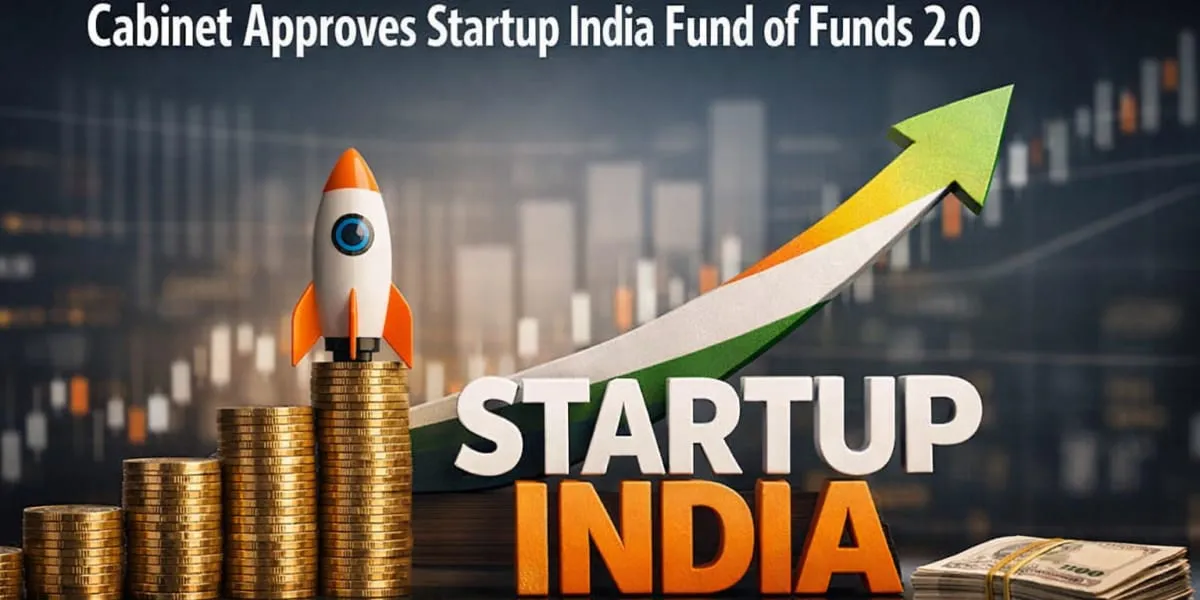
The Union Cabinet chaired by the Prime Minister approved the establishment of the Startup India Fund of Funds 2.0 (Startup India FoF 2.0) with a corpus of Rs 100 billion (Rs 100 bn) to mobilise venture capital for the country’s startup ecosystem. The scheme is designed to accelerate the next phase of India’s startup journey by mobilising long-term domestic capital, strengthening the venture capital ecosystem and supporting innovation-led entrepreneurship. Since the launch of Startup India in 2016 the ecosystem has grown from fewer than 500 startups to over zero point two million Department for Promotion of Industry and Internal Trade (DPIIT) recognised startups.

Startup India FoF 2.0 builds on the earlier Fund of Funds for Startups 1.0 which had committed a corpus of Rs 100 billion to support alternative investment funds. That programme backed 145 alternative investment funds and supported investments across technology, manufacturing, healthcare, fintech, agritech and clean technology. Supported funds had invested over Rs 255 billion (Rs 255 bn) in more than 1,370 startups and helped crowd in private capital for emerging founders.

The new fund will adopt a targeted funding approach prioritising deep tech and tech-driven innovative manufacturing, empowering early-growth founders and encouraging investment beyond major metropolitan centres so that innovation can thrive nationwide. It is intended to address high-risk capital gaps by directing greater capital to priority areas that support self-reliance and growth, while strengthening the domestic venture capital base, in particular smaller funds.

Authorities expect Startup India FoF 2.0 to contribute to India’s innovation-led growth agenda by supporting startups that develop globally competitive technologies and products, strengthening economic resilience and boosting manufacturing capabilities. The fund is expected to generate high-quality employment and help position India as a global innovation hub, in line with the national vision of Viksit Bharat at 2047.

The Union Cabinet chaired by the Prime Minister approved the establishment of the Startup India Fund of Funds 2.0 (Startup India FoF 2.0) with a corpus of Rs 100 billion (Rs 100 bn) to mobilise venture capital for the country’s startup ecosystem. The scheme is designed to accelerate the next phase of India’s startup journey by mobilising long-term domestic capital, strengthening the venture capital ecosystem and supporting innovation-led entrepreneurship. Since the launch of Startup India in 2016 the ecosystem has grown from fewer than 500 startups to over zero point two million Department for Promotion of Industry and Internal Trade (DPIIT) recognised startups. Startup India FoF 2.0 builds on the earlier Fund of Funds for Startups 1.0 which had committed a corpus of Rs 100 billion to support alternative investment funds. That programme backed 145 alternative investment funds and supported investments across technology, manufacturing, healthcare, fintech, agritech and clean technology. Supported funds had invested over Rs 255 billion (Rs 255 bn) in more than 1,370 startups and helped crowd in private capital for emerging founders. The new fund will adopt a targeted funding approach prioritising deep tech and tech-driven innovative manufacturing, empowering early-growth founders and encouraging investment beyond major metropolitan centres so that innovation can thrive nationwide. It is intended to address high-risk capital gaps by directing greater capital to priority areas that support self-reliance and growth, while strengthening the domestic venture capital base, in particular smaller funds. Authorities expect Startup India FoF 2.0 to contribute to India’s innovation-led growth agenda by supporting startups that develop globally competitive technologies and products, strengthening economic resilience and boosting manufacturing capabilities. The fund is expected to generate high-quality employment and help position India as a global innovation hub, in line with the national vision of Viksit Bharat at 2047.

Related Stories

Gold Stories

Next Story
Infrastructure Urban

KONE Opens India's First Digital Experience Centre in Pune

KONE, a global elevator and escalator manufacturer, has inaugurated its first Digital Experience Centre (DEC) in India, located in Pune. The facility aims to showcase how artificial intelligence (AI), connectivity and data-driven technologies can enhance customer experiences and improve building operations.The centre was inaugurated by Jussi Herlin, Executive Vice Chair, KONE Corporation; Philippe Delorme, President and CEO, KONE; and Nandan Nilekani, Co-founder and Chairman of the Board, Infosys.Designed as an interactive customer environment, the facility demonstrates digital solutions cover..

Next Story
Infrastructure Urban

CII GreenCo Launches Circularity Guidelines for Indian Industry

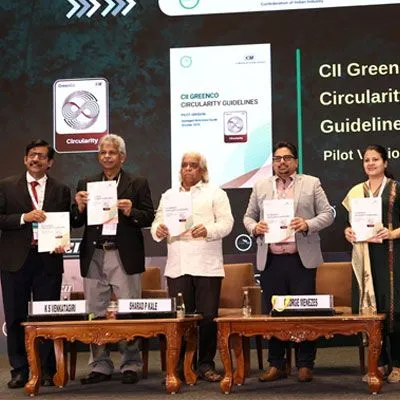
The Confederation of Indian Industry (CII) GreenCo Council has launched the CII GreenCo Circularity Guidelines – Pilot Version at the 17th CII GreenCo Waste & Resource Management Summit 2026 in Chennai. The initiative aims to strengthen resource efficiency, waste reduction and circular economy practices across Indian manufacturing and process industries.The guidelines introduce a structured framework with circularity indices covering raw materials, consumables, packaging and other resource inputs. These indicators will help industries assess existing practices, identify opportunities to ..

Next Story
Infrastructure Energy

Global Electronics Association Launches IPC-1783-CO2E Standard

The Global Electronics Association has introduced IPC-1783-CO2E, a new international standard aimed at improving consistency, transparency and comparability in product carbon footprint reporting across the electronics manufacturing industry.The standard, titled International Standard for Data Collection and Reporting of CO2 Equivalent (CO2e) Emissions for the Electronics Manufacturing Supply Chain, provides industry-specific guidance for collecting, estimating and reporting carbon emissions data.With increasing regulatory requirements and customer expectations, electronics manufacturers face c..

Advertisement

Subscribe to Our Newsletter

Get daily newsletters around different themes from Construction world.

STAY CONNECTED

Advertisement

SPECIAL OFFER
QR Code