Cabinet Clears Rs 250 Billion Export Promotion Mission
ECONOMY & POLICY

Cabinet Clears Rs 250 Billion Export Promotion Mission

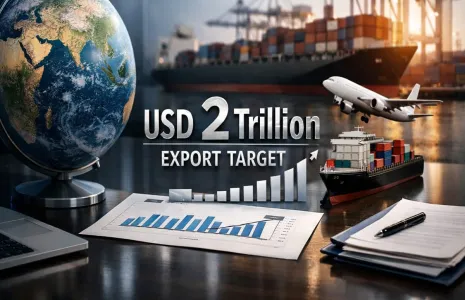
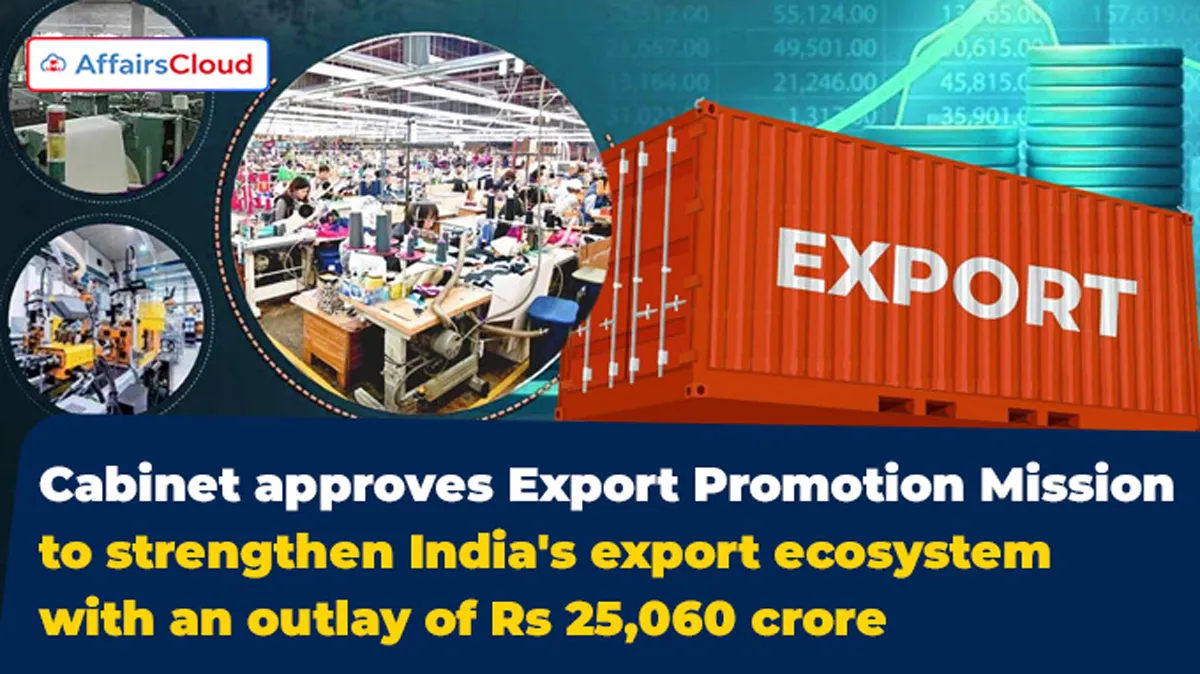
The Union Cabinet, chaired by Prime Minister Narendra Modi, has approved the Export Promotion Mission (EPM) — a flagship programme announced in the Union Budget 2025–26 to strengthen India’s export competitiveness, especially for MSMEs, first-time exporters, and labour-intensive sectors.

The Mission has a total outlay of Rs 250.60 billion for the period FY 2025–26 to FY 2030–31. It marks a decisive shift from multiple fragmented export-support schemes to a unified, outcome-driven and highly adaptive framework capable of responding swiftly to global trade volatility and evolving exporter needs.

EPM will run through a collaborative approach involving the Department of Commerce, Ministry of MSME, Ministry of Finance, Financial Institutions, Export Promotion Councils, Commodity Boards, industry bodies, and state governments.

Two Integrated Sub-Schemes

NIRYAT PROTSAHAN Aims to improve MSMEs’ access to affordable trade finance through instruments such as interest subvention, export factoring, collateral guarantees, specialised credit cards for e-commerce exporters, and credit-enhancement support for entry into new markets.

NIRYAT DISHA Focuses on non-financial enablers such as export-quality compliance, international branding and packaging assistance, support for participation in global trade fairs, export warehousing and logistics, inland transport reimbursements, trade intelligence, and capacity-building.

EPM consolidates major export-support schemes, including the Interest Equalisation Scheme (IES) and the Market Access Initiative (MAI), aligning them with modern trade requirements.

Addressing Key Export Challenges

The Mission is designed to resolve persistent barriers to export growth, including:

restricted and costly trade finance,

high compliance costs for global standards,

weak international branding and fragmented market outreach, and

logistical constraints faced by exporters in interior regions.

Priority support will be extended to sectors hit by recent global tariff increases, such as textiles, leather, gems and jewellery, engineering goods, and marine products. These measures will help safeguard export orders, protect employment and aid diversification into new geographies.

Implementation

The Directorate General of Foreign Trade (DGFT) will serve as the implementing agency, with all applications and disbursals managed through a dedicated digital platform integrated with existing trade systems.

Expected Outcomes

The Mission is projected to:

expand MSMEs’ access to affordable trade finance,

strengthen export readiness through compliance support,

enhance global market access for Indian products,

boost exports from non-traditional districts and emerging sectors, and

generate employment across manufacturing, logistics and allied services.

EPM represents a forward-looking reform to make India’s export ecosystem more inclusive, technology-enabled and globally competitive, aligned with the vision of Viksit Bharat @2047.

The Union Cabinet, chaired by Prime Minister Narendra Modi, has approved the Export Promotion Mission (EPM) — a flagship programme announced in the Union Budget 2025–26 to strengthen India’s export competitiveness, especially for MSMEs, first-time exporters, and labour-intensive sectors. The Mission has a total outlay of Rs 250.60 billion for the period FY 2025–26 to FY 2030–31. It marks a decisive shift from multiple fragmented export-support schemes to a unified, outcome-driven and highly adaptive framework capable of responding swiftly to global trade volatility and evolving exporter needs. EPM will run through a collaborative approach involving the Department of Commerce, Ministry of MSME, Ministry of Finance, Financial Institutions, Export Promotion Councils, Commodity Boards, industry bodies, and state governments. Two Integrated Sub-Schemes NIRYAT PROTSAHAN Aims to improve MSMEs’ access to affordable trade finance through instruments such as interest subvention, export factoring, collateral guarantees, specialised credit cards for e-commerce exporters, and credit-enhancement support for entry into new markets. NIRYAT DISHA Focuses on non-financial enablers such as export-quality compliance, international branding and packaging assistance, support for participation in global trade fairs, export warehousing and logistics, inland transport reimbursements, trade intelligence, and capacity-building. EPM consolidates major export-support schemes, including the Interest Equalisation Scheme (IES) and the Market Access Initiative (MAI), aligning them with modern trade requirements. Addressing Key Export Challenges The Mission is designed to resolve persistent barriers to export growth, including: restricted and costly trade finance, high compliance costs for global standards, weak international branding and fragmented market outreach, and logistical constraints faced by exporters in interior regions. Priority support will be extended to sectors hit by recent global tariff increases, such as textiles, leather, gems and jewellery, engineering goods, and marine products. These measures will help safeguard export orders, protect employment and aid diversification into new geographies. Implementation The Directorate General of Foreign Trade (DGFT) will serve as the implementing agency, with all applications and disbursals managed through a dedicated digital platform integrated with existing trade systems. Expected Outcomes The Mission is projected to: expand MSMEs’ access to affordable trade finance, strengthen export readiness through compliance support, enhance global market access for Indian products, boost exports from non-traditional districts and emerging sectors, and generate employment across manufacturing, logistics and allied services. EPM represents a forward-looking reform to make India’s export ecosystem more inclusive, technology-enabled and globally competitive, aligned with the vision of Viksit Bharat @2047.

Next Story
Infrastructure Transport

Dhalbhumgarh Airport Faces 150-km Rule Hurdle

The issue has resurfaced following a recent statement by Union Civil Aviation Minister Ram Mohan Naidu, who said that under existing aviation policy, a new greenfield airport is generally not permitted within an aerial distance of 150 kilometres of an operational civilian airport. He added, however, that if a formal proposal is submitted, its impact on the existing airport can be examined and relaxations may be considered on a case-by-case basis. While the clarification has revived some hope for Dhalbhumgarh, it has also underlined the scale of the technical challenge facing the project. Unde..

Next Story
Infrastructure Transport

Stakeholders Seek Parallel Ops For Vizag Airports

With road and metro rail links to Bhogapuram still several years away, stakeholders in north Andhra Pradesh have renewed demands to continue civil operations at INS Dega even after the commissioning of Bhogapuram International Airport. The new airport is expected to begin commercial operations from June. Officials said close to 80 per cent of the airport infrastructure at Bhogapuram, including the terminal building and internal approach roads, has already been completed. However, inadequate external connectivity remains a key concern. Making a case for parallel operations, Andhra Pradesh Air ..

Next Story
Infrastructure Transport

Govt To Roll Out V2V Tech To Cut Road Crashes

In an effort to curb road accidents, particularly in low-visibility conditions such as dense fog, the government is set to roll out vehicle-to-vehicle (V2V) communication technology that will allow cars to exchange real-time data and alert drivers to potential dangers. The announcement was made by Union Road Transport and Highways Minister Nitin Gadkari after the 43rd meeting of the Transport Development Council. The technology involves installing an on-board unit (OBU) in vehicles, enabling wireless data exchange between nearby cars. This will allow vehicles to share information such as spee..

Advertisement

Subscribe to Our Newsletter

Get daily newsletters around different themes from Construction world.

STAY CONNECTED

Advertisement

Advertisement

Advertisement

Advertisement

Open In App