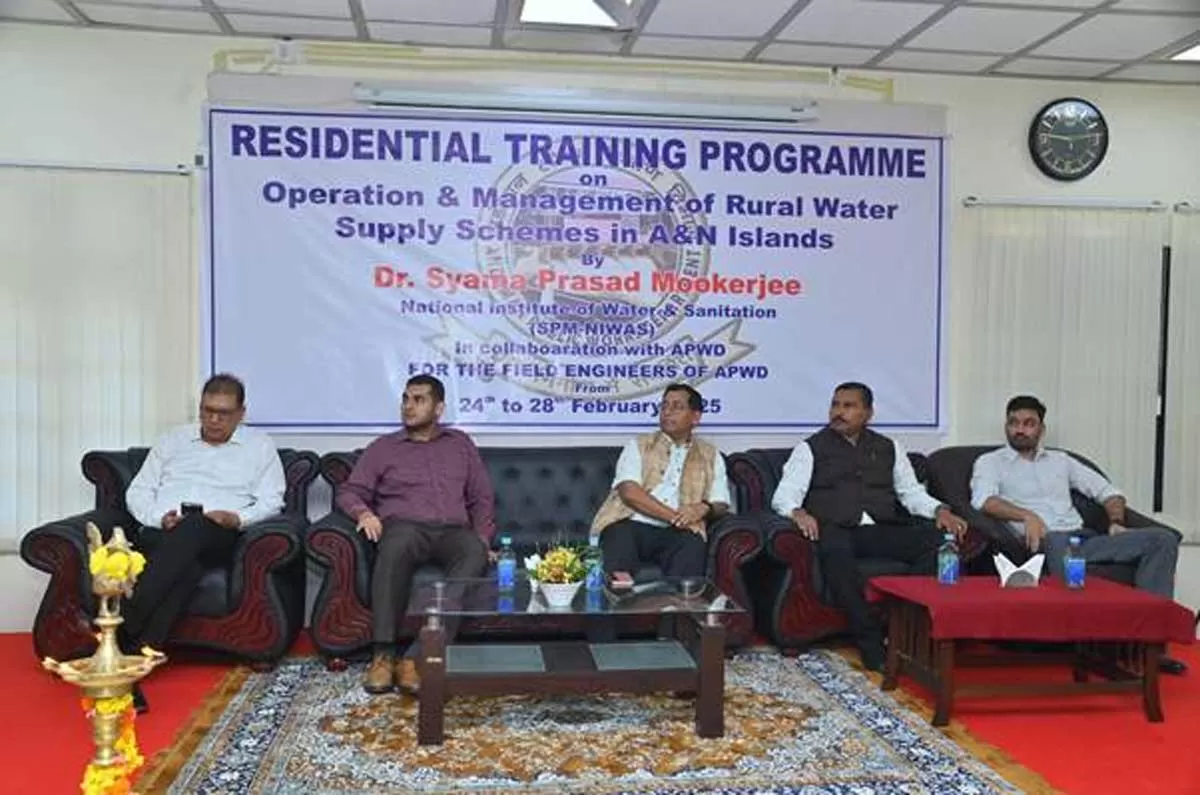
Capacity-Building Training for Engineers Launched in Andaman & Nicobar
ECONOMY & POLICY

Capacity-Building Training for Engineers Launched in Andaman & Nicobar

Recognising the pressing challenges in Operation and Maintenance (O&M) practices, a specialised training programme has been introduced to equip engineers with the skills and knowledge required to tackle system inefficiencies, non-revenue water (NRW), energy consumption, and community engagement issues in water management.

This training module is set to be rolled out across all states and Union Territories in a phased manner. The inaugural session was graced by Shri Chandra Bhushan Kumar, IAS, Chief Secretary, Government of Andaman and Nicobar Islands, as the Chief Guest. While addressing the gathering, Chief Secretary Shri Chandra Bhushan Kumar underscored the importance of training and capacity-building for field engineers to ensure the sustainability of water supply schemes. He emphasised that while significant progress has been made in supply management, demand-side management now requires greater attention.

The training programme aims to enhance the operational and managerial capabilities of Junior Engineers (JEs) and Assistant Engineers (AEs) of the Andaman & Nicobar administration, enabling them to manage water supply schemes more efficiently.

Designed by SPM NIWAS experts in consultation with Andaman Public Works Department (APWD) officials, the curriculum covers a wide array of critical topics, including: Water Supply Systems and Challenges in Andaman & Nicobar Islands Safe Drinking Water Standards (BIS) and Sample Collection Frequency Operation & Maintenance of Surface Water-Based Schemes (including Spring Sources, Sand Filters, and Pressure Filters) Distribution Network Management and Maintenance Practical Strategies for Reducing Water Loss & Non-Revenue Water (NRW) Citizen Service Delivery, Grievance Redressal, and Community Engagement Financial Planning for the Operation & Management of Rural Water Supply Leadership Insights and Expert Participation The inaugural session was also attended virtually by Shri Priyatu Mandal, IAS, JS Cum Director & Head, SPM NIWAS, who emphasised the institute’s commitment to advancing knowledge and capacity-building in the water and sanitation sectors.

This initiative reflects a proactive approach towards strengthening water infrastructure and management in Andaman & Nicobar Islands. By empowering engineers with the latest operational strategies and technological advancements, the programme is set to play a crucial role in enhancing water sustainability and service delivery for communities across the region.

Recognising the pressing challenges in Operation and Maintenance (O&M) practices, a specialised training programme has been introduced to equip engineers with the skills and knowledge required to tackle system inefficiencies, non-revenue water (NRW), energy consumption, and community engagement issues in water management. This training module is set to be rolled out across all states and Union Territories in a phased manner. The inaugural session was graced by Shri Chandra Bhushan Kumar, IAS, Chief Secretary, Government of Andaman and Nicobar Islands, as the Chief Guest. While addressing the gathering, Chief Secretary Shri Chandra Bhushan Kumar underscored the importance of training and capacity-building for field engineers to ensure the sustainability of water supply schemes. He emphasised that while significant progress has been made in supply management, demand-side management now requires greater attention. The training programme aims to enhance the operational and managerial capabilities of Junior Engineers (JEs) and Assistant Engineers (AEs) of the Andaman & Nicobar administration, enabling them to manage water supply schemes more efficiently. Designed by SPM NIWAS experts in consultation with Andaman Public Works Department (APWD) officials, the curriculum covers a wide array of critical topics, including: Water Supply Systems and Challenges in Andaman & Nicobar Islands Safe Drinking Water Standards (BIS) and Sample Collection Frequency Operation & Maintenance of Surface Water-Based Schemes (including Spring Sources, Sand Filters, and Pressure Filters) Distribution Network Management and Maintenance Practical Strategies for Reducing Water Loss & Non-Revenue Water (NRW) Citizen Service Delivery, Grievance Redressal, and Community Engagement Financial Planning for the Operation & Management of Rural Water Supply Leadership Insights and Expert Participation The inaugural session was also attended virtually by Shri Priyatu Mandal, IAS, JS Cum Director & Head, SPM NIWAS, who emphasised the institute’s commitment to advancing knowledge and capacity-building in the water and sanitation sectors. This initiative reflects a proactive approach towards strengthening water infrastructure and management in Andaman & Nicobar Islands. By empowering engineers with the latest operational strategies and technological advancements, the programme is set to play a crucial role in enhancing water sustainability and service delivery for communities across the region.

Next Story
Infrastructure Urban

Implementation Status of Jal Jeevan Mission

Since August 2019 the Government has implemented Jal Jeevan Mission to provide assured potable water through household tap connections in rural India. At the start of the mission only 32.3 million (mn) rural households, representing 16.7 per cent, were reported to have tap water connections. States and union territories have reported that 125.8 mn additional rural households have since been provided with tap connections. As a result, of about 193.6 mn rural households roughly 158.2 mn, or 81.71 per cent, are reported to have tap water supply at home.\n\nThe State, district and village level st..

Next Story
Infrastructure Urban

Jal Jeevan Mission Reaches Eighty One Per Cent Rural Coverage

The Government reported substantial progress under the Jal Jeevan Mission, launched in August 2019 to provide tap water to every rural household. At launch only 32.3 million (mn) rural households had tap connections and states and Union territories reported provision of 125.8 mn additional households by March 2026. Consequently, out of about 193.6 mn rural households around 158.2 mn, or 81.71 per cent, are reported to have tap water at home. The Finance Minister announced extension of the mission until 2028 in the 2025-26 budget speech. The Swachh Bharat Mission Grameen, launched in October 20..

Next Story
Infrastructure Urban

Empowering Local Governance for Sustainable Rural Water Supply

The Ministry of Jal Shakti has aligned the Jal Jeevan Mission (JJM) with the 73rd Amendment to strengthen village level planning and community ownership of water supply. Gram Panchayats, village water and sanitation committees and Pani Samitis are to plan, implement, manage and maintain piped water systems, with gram sabha processes formalising handover and oversight. Implementation support agencies including non government organisations, community based organisations and self help groups have been empanelled to train local committees and promote women participation. Under JJM, the department ..

Advertisement

Subscribe to Our Newsletter

Get daily newsletters around different themes from Construction world.

STAY CONNECTED

Advertisement

Advertisement

Advertisement