



CBDT Signs Record 219 Advance Pricing Agreements
ECONOMY & POLICY

CBDT Signs Record 219 Advance Pricing Agreements

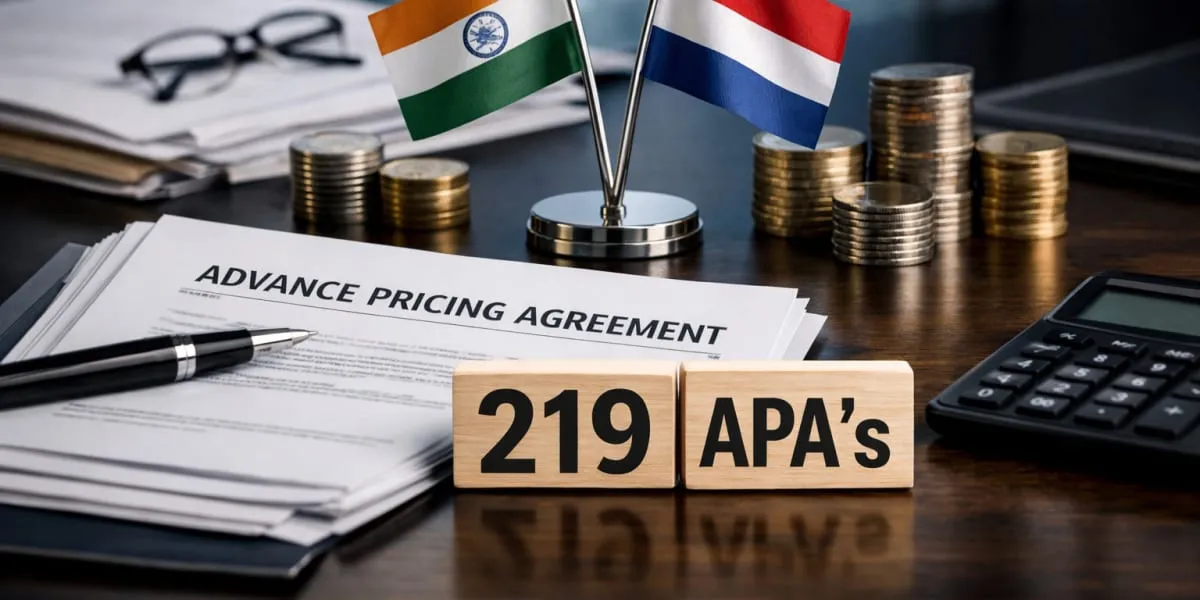
The Central Board of Direct Taxes (CBDT) has entered into a record 219 Advance Pricing Agreements (APAs) in FY 2025–26, taking the total since inception to 1,034. The total comprises 750 Unilateral APAs and 284 Bilateral APAs. The annual figure is the highest since the scheme began and follows 174 APAs in the prior year and 125 APAs in the year before.

This year CBDT concluded 84 bilateral APAs, surpassing the previous record of 65, and these were completed through mutual agreements with 13 treaty partners including the United States, the United Kingdom, Japan and Singapore. India also recorded its first bilateral APAs with France, Ireland, Indonesia and Sweden, expanding international cooperation.

The APA Scheme enables taxpayers to determine transfer pricing methods and arm's length prices for international transactions in advance for up to five years, and bilateral agreements provide protection against double taxation. Safe Harbour Rules offer a faster, lower-cost route to transfer pricing certainty and cover twelve transaction categories including information technology services and contract research and development.

The Finance Act 2026 consolidated multiple technology service segments into a single Information Technology Services category and set a uniform margin of 15.5 per cent, streamlining applicability. Amendments introduced a more system-driven and automated approach to reduce detailed scrutiny and administrative interface. The combined measures are expected to improve efficiency, transparency and compliance.

The Finance Act 2026 raised the Safe Harbour eligibility threshold from Rs three billion (bn) to Rs 20 billion (bn), expanding the regime for larger taxpayers. Authorities anticipate that the higher threshold and automation will enhance ease of doing business by reducing time and cost burdens on compliant entities. CBDT stated that taxpayers remain key stakeholders in the APA programme's implementation.

The Central Board of Direct Taxes (CBDT) has entered into a record 219 Advance Pricing Agreements (APAs) in FY 2025–26, taking the total since inception to 1,034. The total comprises 750 Unilateral APAs and 284 Bilateral APAs. The annual figure is the highest since the scheme began and follows 174 APAs in the prior year and 125 APAs in the year before. This year CBDT concluded 84 bilateral APAs, surpassing the previous record of 65, and these were completed through mutual agreements with 13 treaty partners including the United States, the United Kingdom, Japan and Singapore. India also recorded its first bilateral APAs with France, Ireland, Indonesia and Sweden, expanding international cooperation. The APA Scheme enables taxpayers to determine transfer pricing methods and arm's length prices for international transactions in advance for up to five years, and bilateral agreements provide protection against double taxation. Safe Harbour Rules offer a faster, lower-cost route to transfer pricing certainty and cover twelve transaction categories including information technology services and contract research and development. The Finance Act 2026 consolidated multiple technology service segments into a single Information Technology Services category and set a uniform margin of 15.5 per cent, streamlining applicability. Amendments introduced a more system-driven and automated approach to reduce detailed scrutiny and administrative interface. The combined measures are expected to improve efficiency, transparency and compliance. The Finance Act 2026 raised the Safe Harbour eligibility threshold from Rs three billion (bn) to Rs 20 billion (bn), expanding the regime for larger taxpayers. Authorities anticipate that the higher threshold and automation will enhance ease of doing business by reducing time and cost burdens on compliant entities. CBDT stated that taxpayers remain key stakeholders in the APA programme's implementation.

Next Story
Real Estate

AI: The New Recruit

From getting ideas to evaluating designs, presenting concepts to clients and tracking projects, artificial intelligence (AI) is helping architects work better and faster.“AI allows architects to spend more time doing what only they can do: think critically, synthesise complexity and design with intent,” says Dikshu C Kukreja, Managing Principal, CP Kukreja Architects. “Every minute reclaimed from repetitive processes can be invested in creativity, contextual understanding, interdisciplinary collaboration and innovation – the qualities that define meaningful architecture.”To read the ..

Next Story
Real Estate

Redevelopment 2.0

In 2017, Mumbai identified 160,000 ageing buildings due for structural audit. Close to half of these were in the Western Suburbs. Redeveloping the oldest and structurally weakest of these would help unlock new housing, much needed given the city’s growing population density and constant developed area of 437.7 sq km. At 30,600 people per sq km in 2024, Mumbai’s density was almost thrice that of Gurugram, and 60 per cent higher than Bengaluru’s.Essentially, Mumbai’s realty market has demand. It has capital. It has realty development potential.Fast forward to 2026. Mumbai has 1,094 regis..

Next Story
Technology

Cost intelligence will become a strategic contributor to project success

As India's construction industry accelerates its digital transformation, integrated platforms, AI and connected data are becoming essential to improving cost certainty, project efficiency and sustainability. Ravi Kumar, Sales Director – India, RIB Software India, shares how digital workflows are reshaping project planning, commercial management and decision-making across the construction value chain.India's construction sector is embracing digital technologies at an unprecedented pace. From your perspective, what are the biggest shifts driving this transformation and how is RIB Software enab..

Advertisement

Subscribe to Our Newsletter

Get daily newsletters around different themes from Construction world.

STAY CONNECTED

Advertisement

Advertisement

Advertisement















