




Chhattisgarh Assembly To Run Fully On Solar Power
ECONOMY & POLICY

Chhattisgarh Assembly To Run Fully On Solar Power

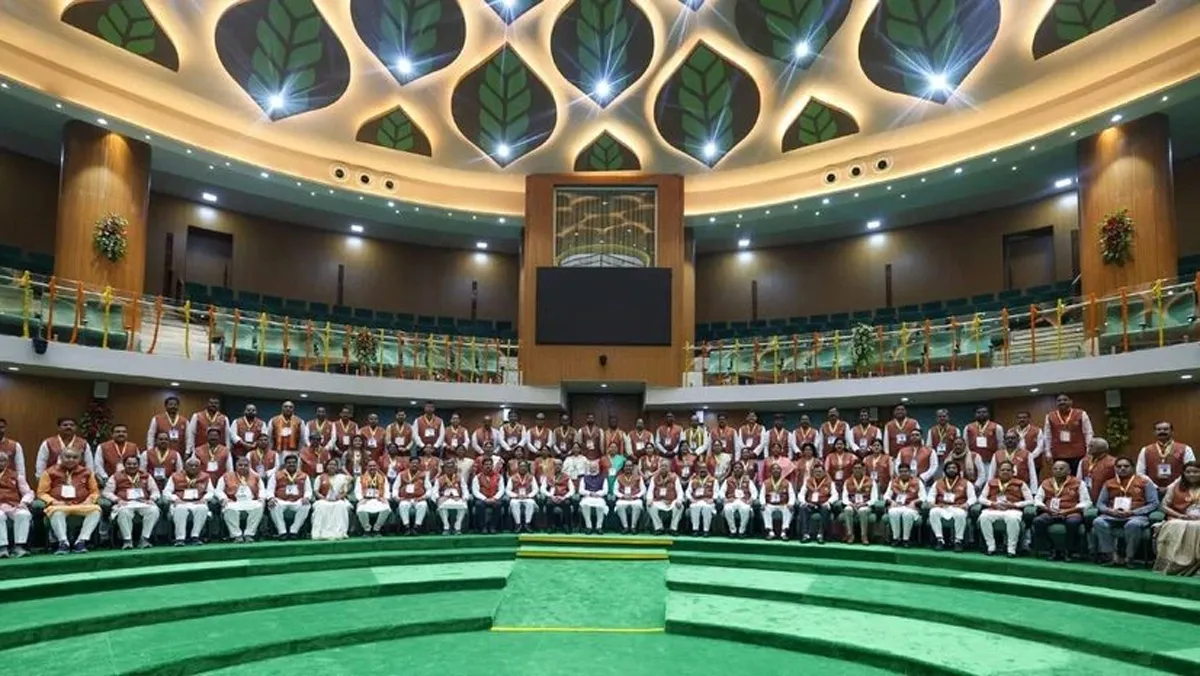
The newly constructed Chhattisgarh Legislative Assembly building will be entirely powered by solar energy, with renewable projects being implemented in phases to ensure the complex runs on 100 per cent green power.

Prime Minister Narendra Modi inaugurated the new Assembly on Saturday, located on a 51-acre site behind Mahanadi Bhawan (Secretariat) in Naya Raipur, the upcoming capital of Chhattisgarh.

Spanning a total area of 622,000 sq ft, the building has been constructed at an estimated cost of Rs 3.25 billion (Rs 325 crore).

Chhattisgarh Assembly Speaker Dr Raman Singh said the complex was designed in line with green building principles and will be gradually powered by solar installations. “We will be installing solar projects in phases, and soon the entire Assembly will operate on solar power,” he said.

Dr Singh added that the project emphasises sustainability and environmental preservation, with more than 23,000 saplings planted around the premises and a rainwater harvesting system included in the design.

The building has also been planned with future expansion in mind, ensuring flexibility as the state’s governance structure evolves.

Currently, the Chhattisgarh Assembly has 90 members, but the new facility is built to accommodate up to 200 legislators, with provisions for a proportional increase in ministerial chambers.

The main Assembly hall, covering 16,000 sq ft, offers seating for 200 members, while the gallery above accommodates 320 spectators, including media representatives, guests, and observers.

The first floor features a conference hall for 100 members across 2,400 sq ft, and the second floor houses a central hall of 3,200 sq ft with capacity for 200 attendees.

On the upper ground floor, the facility includes 24 ministerial rooms, two committee rooms, and a cabinet hall. The lower ground floor hosts medical dispensaries (Allopathic, Homeopathic, and Ayurvedic), a bank, post office, and canteen.

A modern auditorium with a seating capacity of 500 and parking for 850 vehicles have also been incorporated.

Initially, after Chhattisgarh’s formation on 1 November 2000, the Assembly functioned from a school hall, later moving to a central government research institute before now shifting to its purpose-built green campus.

The newly constructed Chhattisgarh Legislative Assembly building will be entirely powered by solar energy, with renewable projects being implemented in phases to ensure the complex runs on 100 per cent green power. Prime Minister Narendra Modi inaugurated the new Assembly on Saturday, located on a 51-acre site behind Mahanadi Bhawan (Secretariat) in Naya Raipur, the upcoming capital of Chhattisgarh. Spanning a total area of 622,000 sq ft, the building has been constructed at an estimated cost of Rs 3.25 billion (Rs 325 crore). Chhattisgarh Assembly Speaker Dr Raman Singh said the complex was designed in line with green building principles and will be gradually powered by solar installations. “We will be installing solar projects in phases, and soon the entire Assembly will operate on solar power,” he said. Dr Singh added that the project emphasises sustainability and environmental preservation, with more than 23,000 saplings planted around the premises and a rainwater harvesting system included in the design. The building has also been planned with future expansion in mind, ensuring flexibility as the state’s governance structure evolves. Currently, the Chhattisgarh Assembly has 90 members, but the new facility is built to accommodate up to 200 legislators, with provisions for a proportional increase in ministerial chambers. The main Assembly hall, covering 16,000 sq ft, offers seating for 200 members, while the gallery above accommodates 320 spectators, including media representatives, guests, and observers. The first floor features a conference hall for 100 members across 2,400 sq ft, and the second floor houses a central hall of 3,200 sq ft with capacity for 200 attendees. On the upper ground floor, the facility includes 24 ministerial rooms, two committee rooms, and a cabinet hall. The lower ground floor hosts medical dispensaries (Allopathic, Homeopathic, and Ayurvedic), a bank, post office, and canteen. A modern auditorium with a seating capacity of 500 and parking for 850 vehicles have also been incorporated. Initially, after Chhattisgarh’s formation on 1 November 2000, the Assembly functioned from a school hall, later moving to a central government research institute before now shifting to its purpose-built green campus.

Next Story
Infrastructure Energy

Delhi HC Stays PGCIL Order against KEC International

KEC International has informed stock exchanges of a significant legal development concerning its eligibility to participate in tenders floated by Power Grid Corporation of India (PGCIL), in a disclosure made under Regulation 30 of the SEBI (Listing Obligations and Disclosure Requirements) Regulations.The update follows the company’s earlier intimation dated November 18, 2025, regarding an order issued by PGCIL that excluded KEC International from participating in its tenders for a period of nine months. Challenging the said order, the company filed a writ petition before the Hon’ble High C..

Next Story
Building Material

LANXESS Advances Pigment Solutions for New-Age Concrete Technologies

LANXESS is deepening its engagement with next-generation concrete technologies by advancing research into the performance of iron oxide pigments across emerging construction applications, including self-compacting concrete (SCC), geopolymers and 3D-printed concrete. Through extensive investigations and long-term weathering tests, iron oxide pigments have proven their suitability for a wide range of concrete construction materials, though their use in new formulations requires a thorough understanding of construction chemistry and material interactions.According to Oliver Fleschentraeger, Techn..

Next Story
Infrastructure Urban

JHS Svendgaard to Invest Rs 250 Million in Kala Amb Expansion

JHS Svendgaard Laboratories (JHS), a leading Indian manufacturer of oral care products, has announced an investment of Rs 250 million to expand its manufacturing footprint in Kala Amb, Himachal Pradesh. The investment is aimed at strengthening production capacity, introducing advanced technologies and supporting the company’s next phase of growth in response to rising domestic and global demand.As part of the expansion plan, JHS will construct a new 100,000 sq ft manufacturing facility on its existing five-acre land parcel at Kala Amb. The project is expected to be executed over a two-year p..

Advertisement

Subscribe to Our Newsletter

Get daily newsletters around different themes from Construction world.

STAY CONNECTED

Advertisement

Advertisement

Advertisement

Advertisement

Open In App














