DARPG Report Shows Faster Grievance Redress In October 2025
ECONOMY & POLICY

DARPG Report Shows Faster Grievance Redress In October 2025

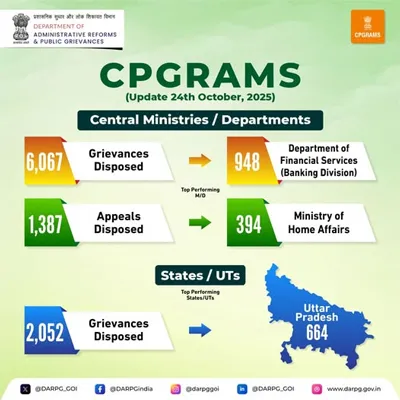
The Department of Administrative Reforms and Public Grievances (DARPG) has released the Centralised Public Grievance Redress and Monitoring System (CPGRAMS) monthly report for October 2025, providing a detailed analysis of the types and categories of public grievances and their disposal trends. This marks the 42nd report on Central Ministries and Departments published by DARPG.

According to the report, a total of 144,503 grievances were redressed by Central Ministries and Departments during October 2025, with the average grievance disposal time recorded at 15 days. The data reflects the continued progress under DARPG’s 10-step CPGRAMS reform process, aimed at improving the quality of grievance handling and reducing response timelines.

During the month, 52,876 new users registered on the CPGRAMS Portal through multiple channels, of which 8,442 registrations originated from Uttar Pradesh. The Feedback Call Centre collected 65,197 responses, including 38,186 related to Central Ministries and Departments.

The report also highlights the integration of CPGRAMS with the Common Service Centre (CSC) portal, expanding citizen access through over 500,000 CSCs linked with 250,000 Village Level Entrepreneurs (VLEs). In October 2025, a total of 9,500 grievances were filed via these centres.

To strengthen oversight, the Review Meeting Module, operational since 14 February 2025, enables Secretary-level reviews of public grievance handling. As of 31 October 2025, 199 review meetings had been conducted across ministries, including 12 meetings during the month of October.

Key Highlights – October 2025

Public Grievances (PG Cases):

1,38,575 new cases received via the CPGRAMS portal.

1,44,503 cases redressed.

66,279 cases pending.

Public Grievance Appeals:

25,991 appeals received.

28,134 appeals disposed.

17,113 appeals pending.

Top Performers – Grievance Redressal Assessment and Index (GRAI)

In the Group A category (ministries handling over 500 grievances):

Department of Land Resources,

Central Board of Indirect Taxes and Customs (CBIC), and

Ministry of AYUSH emerged as the top performers.

In the Group B category (ministries handling fewer than 500 grievances):

Ministry of Development of North Eastern Region,

Department of Official Language, and

Ministry of Power ranked highest in grievance redress efficiency.

The findings underline the government’s ongoing focus on citizen-centric governance, digital accessibility, and timely redressal of public grievances through institutional reforms and technology-driven mechanisms.

The Department of Administrative Reforms and Public Grievances (DARPG) has released the Centralised Public Grievance Redress and Monitoring System (CPGRAMS) monthly report for October 2025, providing a detailed analysis of the types and categories of public grievances and their disposal trends. This marks the 42nd report on Central Ministries and Departments published by DARPG. According to the report, a total of 144,503 grievances were redressed by Central Ministries and Departments during October 2025, with the average grievance disposal time recorded at 15 days. The data reflects the continued progress under DARPG’s 10-step CPGRAMS reform process, aimed at improving the quality of grievance handling and reducing response timelines. During the month, 52,876 new users registered on the CPGRAMS Portal through multiple channels, of which 8,442 registrations originated from Uttar Pradesh. The Feedback Call Centre collected 65,197 responses, including 38,186 related to Central Ministries and Departments. The report also highlights the integration of CPGRAMS with the Common Service Centre (CSC) portal, expanding citizen access through over 500,000 CSCs linked with 250,000 Village Level Entrepreneurs (VLEs). In October 2025, a total of 9,500 grievances were filed via these centres. To strengthen oversight, the Review Meeting Module, operational since 14 February 2025, enables Secretary-level reviews of public grievance handling. As of 31 October 2025, 199 review meetings had been conducted across ministries, including 12 meetings during the month of October. Key Highlights – October 2025 Public Grievances (PG Cases): 1,38,575 new cases received via the CPGRAMS portal. 1,44,503 cases redressed. 66,279 cases pending. Public Grievance Appeals: 25,991 appeals received. 28,134 appeals disposed. 17,113 appeals pending. Top Performers – Grievance Redressal Assessment and Index (GRAI) In the Group A category (ministries handling over 500 grievances): Department of Land Resources, Central Board of Indirect Taxes and Customs (CBIC), and Ministry of AYUSH emerged as the top performers. In the Group B category (ministries handling fewer than 500 grievances): Ministry of Development of North Eastern Region, Department of Official Language, and Ministry of Power ranked highest in grievance redress efficiency. The findings underline the government’s ongoing focus on citizen-centric governance, digital accessibility, and timely redressal of public grievances through institutional reforms and technology-driven mechanisms.

Next Story
Real Estate

RBI Rate Cut Boosts Confidence Across Housing Market

Industry Context and Market DynamicsThe real estate industry has welcomed the RBI’s rate cut as a timely boost to affordability and demand. With home prices having risen steadily across major markets, even a marginal reduction in interest rates meaningfully strengthens purchasing power, especially for first-time and mid-income buyers.Ashish Jerath, President – Sales & Marketing, Smartworld Developers, observes:“The RBI’s 25-basis-point cut, bringing the repo rate down to 5.25%, is a timely boost for the real estate sector. Lower interest rates reduce borrowing costs, enabling homeb..

Next Story
Infrastructure Transport

BMC Resumes Rs 170 Billion Road Works, Targets 80 per cent By Jan 2026

Following the withdrawal of the southwest monsoon in October, the Brihanmumbai Municipal Corporation (BMC) has restarted work on 645 roads—covering 297.49 kilometres—under its large-scale concretisation programme. Data shows that more than 60 per cent of the resumed works are located in the western suburbs. Officials said the civic body aims to complete concretisation on 80 per cent of the roads where fresh work has begun by January 2026. Launched in 2022, the Rs 170 billion project seeks to concretise 700 kilometres of roads across Mumbai. All civil works were halted during the monsoon ..

Next Story
Infrastructure Urban

India Pushes Digital Shift In Urban Land Mapping

The Department of Land Resources (DoLR) under the Ministry of Rural Development has convened a National Symposium on NAKSHA – the National Geospatial Knowledge-based Land Survey of Urban Habitations – to advance India’s transition to modern, technology-driven land mapping. Speaking at the inaugural session, Secretary Manoj Joshi underscored the urgent need to move revenue departments away from outdated, tape-based methods and rough hand-drawn sketches. He stressed that adopting latitude–longitude-based digital mapping and GIS-linked registration systems is essential for economic stabi..

Advertisement

Subscribe to Our Newsletter

Get daily newsletters around different themes from Construction world.

STAY CONNECTED

Advertisement

Advertisement

Advertisement

Advertisement

Open In App