+
Dr Jitendra Singh Launches India’s First Open-Sea Fish Farming Project
ECONOMY & POLICY

Dr Jitendra Singh Launches India’s First Open-Sea Fish Farming Project

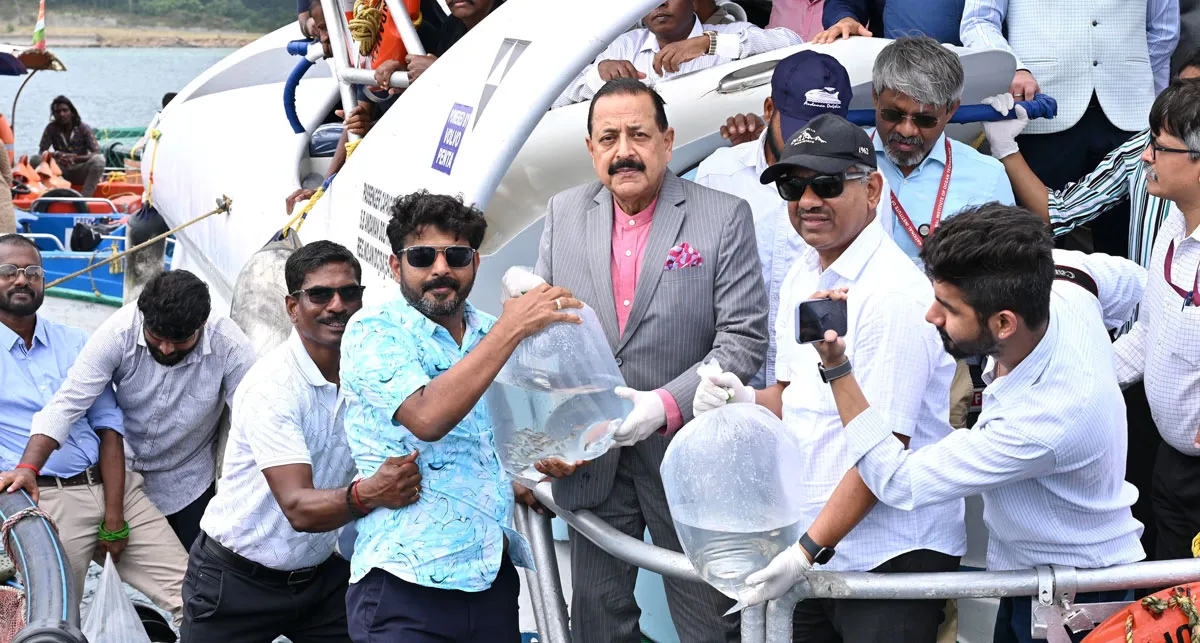
Union Minister of State (Independent Charge) for Science & Technology and Earth Sciences, Dr Jitendra Singh, launched India’s first-ever open-sea Marine Fish Farming project in the Andaman Sea, marking a major milestone in harnessing the country’s vast ocean resources for economic growth. The project was inaugurated at North Bay, Vijaya Puram, during the Minister’s field visit to the open waters of the Andaman Sea.

Describing the initiative as a significant step towards realising the Blue Economy vision articulated by Prime Minister Narendra Modi, Dr Jitendra Singh said the project represents one of the earliest and most impactful efforts to unlock the economic potential of India’s oceans. He noted that for decades after Independence, marine resources remained largely underexplored despite their immense and diverse potential.

The Minister underlined that since 2014, there has been a clear shift in national thinking, with greater recognition of the economic opportunities offered by India’s maritime domain. He highlighted that India’s western, southern and eastern seaboards each possess unique oceanographic characteristics, making marine-based development a critical pillar of the country’s future growth strategy.

The project is being implemented through a collaborative effort involving the Ministry of Earth Sciences, its technical arm the National Institute of Ocean Technology (NIOT), and the Union Territory Administration of Andaman and Nicobar Islands. The pilot initiative focuses on open-sea cultivation of marine finfish and seaweed under natural oceanic conditions, combining scientific innovation with livelihood generation for coastal communities.

During the launch, two livelihood-oriented interventions were initiated. Seaweed seeds were handed over to local fishing communities to promote deep-water seaweed cultivation, while finfish seeds were provided for cage-based farming using NIOT-developed open-sea cages designed to operate in challenging marine environments.

Dr Jitendra Singh said the experience gained from these government-led pilots would help assess feasibility for scaling up through public–private partnership models in the future, thereby expanding livelihoods and strengthening the Blue Economy ecosystem.

As part of his visit, the Minister also toured the Mahatma Gandhi Marine National Park near Wandoor, observing its rich marine biodiversity, including coral reefs, mangroves and diverse marine species. The launch at North Bay, he said, reflects the Government’s commitment to taking science and technology directly to the field and ensuring that island and coastal communities become active partners in India’s ocean-led development.

Union Minister of State (Independent Charge) for Science & Technology and Earth Sciences, Dr Jitendra Singh, launched India’s first-ever open-sea Marine Fish Farming project in the Andaman Sea, marking a major milestone in harnessing the country’s vast ocean resources for economic growth. The project was inaugurated at North Bay, Vijaya Puram, during the Minister’s field visit to the open waters of the Andaman Sea.Describing the initiative as a significant step towards realising the Blue Economy vision articulated by Prime Minister Narendra Modi, Dr Jitendra Singh said the project represents one of the earliest and most impactful efforts to unlock the economic potential of India’s oceans. He noted that for decades after Independence, marine resources remained largely underexplored despite their immense and diverse potential.The Minister underlined that since 2014, there has been a clear shift in national thinking, with greater recognition of the economic opportunities offered by India’s maritime domain. He highlighted that India’s western, southern and eastern seaboards each possess unique oceanographic characteristics, making marine-based development a critical pillar of the country’s future growth strategy.The project is being implemented through a collaborative effort involving the Ministry of Earth Sciences, its technical arm the National Institute of Ocean Technology (NIOT), and the Union Territory Administration of Andaman and Nicobar Islands. The pilot initiative focuses on open-sea cultivation of marine finfish and seaweed under natural oceanic conditions, combining scientific innovation with livelihood generation for coastal communities.During the launch, two livelihood-oriented interventions were initiated. Seaweed seeds were handed over to local fishing communities to promote deep-water seaweed cultivation, while finfish seeds were provided for cage-based farming using NIOT-developed open-sea cages designed to operate in challenging marine environments.Dr Jitendra Singh said the experience gained from these government-led pilots would help assess feasibility for scaling up through public–private partnership models in the future, thereby expanding livelihoods and strengthening the Blue Economy ecosystem.As part of his visit, the Minister also toured the Mahatma Gandhi Marine National Park near Wandoor, observing its rich marine biodiversity, including coral reefs, mangroves and diverse marine species. The launch at North Bay, he said, reflects the Government’s commitment to taking science and technology directly to the field and ensuring that island and coastal communities become active partners in India’s ocean-led development.

Related Stories

Gold Stories

Next Story
Infrastructure Urban

Insurance is not a cost; it is protection for the balance sheet

As infrastructure projects grow larger and more complex, their risk profiles are evolving beyond physical damage. Underinsurance, business interruption, supply-chain disruptions, climate volatility, surety and transactional exposures can all have significant financial consequences. Mohan Agrawal, Director and Business Lead - Construction, Infra & Warehousing, EDME Insurance Brokers, discusses these emerging risks and the gaps in conventional insurance practices in a conversation with KAVITA PARAB, CW. He explains why infrastructure players need to view insurance not merely as a cost, but a..

Next Story
Equipment

Optimising Earthmoving

Constituting India’s biggest fleet of construction equipment by type, earthmovers positively impact project outcomes and company bottomlines if best practices are adopted. Here’s a guide from CW.Select the right machineOne of the biggest challenges in using earthmovers isn’t machine failure but using the wrong machine configuration for the application, according to Chaitanya Bhagde, P&M Head, SHC Projects. “Unless equipment is deployed after considering the soil type, excavation depth, haul distance and production target, the application will face low productivity, longer time depl..

Next Story
Real Estate

We engineer the way architecture gets built

DALBIR SINGH, Founder, HAACE, on the company’s bespoke approach to translating ambitious architecture into precisely engineered and executed structures.What does bespoke construction mean to HAACE, and how is it different from conventional contracting?For HAACE, bespoke construction means choosing the construction methodology around the design rather than forcing the design into a standard template. Every project is studied around its architectural intent, structural requirements and execution challenges. We deliberately take on a limited number of projects because this approach demands atte..

Advertisement

Subscribe to Our Newsletter

Get daily newsletters around different themes from Construction world.

STAY CONNECTED

Advertisement

SPECIAL OFFER
QR Code